
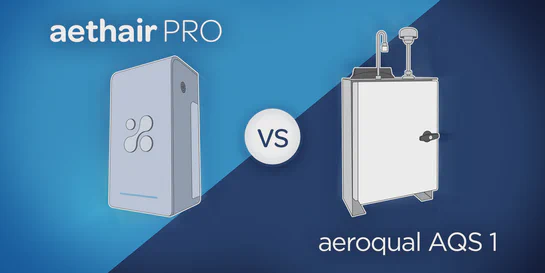
Aethair PRO vs Aeroqual AQS 1: A Compact Air Monitor Comparison
- June 12, 2026
- · 10 min read
- · Aethair Team
If you are weighing the Aethair PRO against the Aeroqual AQS 1, you are comparing two monitors that, on the surface, look like they do the same job. Both measure particulate matter and gases, both are built for outdoor and industrial work such as fenceline and perimeter monitoring, and both pair hardware with cloud software. Look past the surface, though, and they are built very differently. The differences in size, connectivity, sensor flexibility, ease of use, and the platform behind each device are what separate them in practice.
On the specifics that decide most deployments, Aethair PRO is the stronger product. Every unit has 4G LTE built in, and it measures a wide and growing list of gases through sensor cartridges that can be swapped out whenever the monitoring setup needs to change, where the AQS 1 offers a narrower range of gas options. The Aethair PRO sensor configuration can be reconfigured over the life of the device, it works indoors as well as outdoors, and it reports into a platform that carries data through to defensible documentation. This article lays out those differences point by point, so EHS managers, environmental consultants, and operations teams evaluating an Aeroqual AQS 1 alternative can see exactly where Aethair PRO does more.
Schedule a call to discuss Aethair PRO
Aethair PRO vs Aeroqual AQS 1 at a Glance
| Aethair PRO | Aeroqual AQS 1 | |
|---|---|---|
| Built for | Indoor and outdoor; industrial, perimeter, fenceline | Outdoor and ambient; fenceline |
| Particulate | PM1, PM2.5, PM10, TSP | PM1, PM2.5, PM4, PM10, TSP |
| Gas sensors | Two swappable standard cartridges plus a MultiSense cartridge, up to five sensors | Up to three gases at once, modular |
| Gas options | CO, CO₂, NO, NO₂, SO₂, O₃, CH₄, HF, HCl, formaldehyde, H₂S, VOCs, and growing | O₃, NO₂, CO, VOCs, H₂S, SO₂, CH₄ |
| Additional parameters | Temperature, humidity, light, noise, pressure, optional differential pressure, plus calculated dew point, heat index, Leq (dB), and SPL (dB) | Temperature, humidity, noise, barometric pressure, precipitation, solar radiation, wind speed and direction |
| Connectivity | 4G LTE built in, plus WiFi, Bluetooth, Zigbee, GPS | WiFi and Ethernet (cellular optional add-on) |
| Power | USB-C, or plug-on solar panel | AC mains, or solar with separate charger, battery bank, and converter |
| Mounting | Wall, magnetic, pole, or tripod | Pole, tripod, or wall |
| Dimensions | 4.5 x 9.6 x 4.5 in | 27 x 13 x 7.4 in |
| Weight | 1.72 lb (0.78 kg) | Under 28.6 lb (13 kg) |
| Software | Environet platform with Noesis AI | Aeroqual Cloud, with Aeroqual Connect for local access |
| Reporting | Aethair Reports (PDF and online), real-time and historic data, documented lineage | Data access, export, and compliance report templates |
| Third-party instruments | Thiamis, broad integration | Select tested sensors and analog inputs |
Connectivity: 4G Built In, Plug and Play
Start with connectivity, because it is the clearest difference between the two. Every Aethair PRO has 4G LTE built in, alongside WiFi, Bluetooth, Zigbee, and GPS. Power one on and it reports. There are no cables to run and no network to configure first, and data begins flowing into Environet on its own, with real-time alerts you can set.
The AQS 1 works differently. It connects over WiFi and Ethernet, which is fine where there is coverage and a network to join. On a remote fenceline or a short-term site, that usually means arranging connectivity before any data comes back. Cellular is available only as an optional add-on modem, so reaching what an Aethair PRO does out of the box costs more and takes more setup.
Aethair PRO’s built-in connectivity also makes scaling almost trivial. Each Aethair PRO is a complete, standalone monitor, so there is no shared gateway or hub to stand up before the first unit reports, and nothing to resize if you add more monitors. Run one on its own, or ring a perimeter, a campus, or a city with them and relocate units as the work moves. Measurement, logging, connectivity, and alerting all live in the one device, so there is no separate logger or telemetry box to maintain. Our perimeter air quality monitoring article covers how a multi-point boundary setup works in practice.
Measurement: A Wider, Growing Range of Sensors
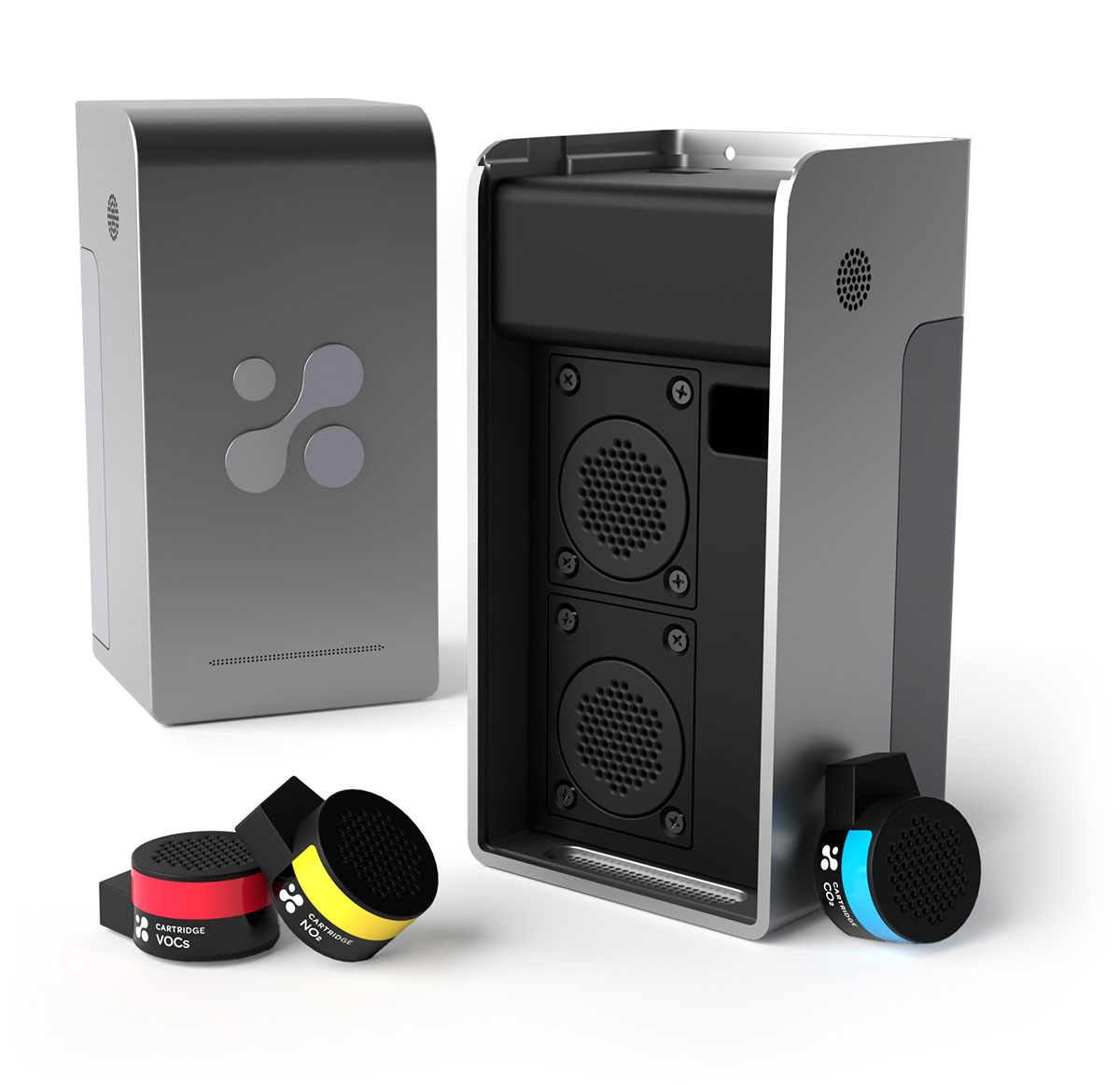
Where Aethair PRO pulls ahead on measurement is the breadth and flexibility of what it can sense, not a single headline number. Its gas sensing is built on swappable cartridges, two standard cartridge slots plus a MultiSense cartridge, drawing from a wide list that includes CO, CO₂, NO, NO₂, SO₂, O₃, methane, hydrogen fluoride, hydrogen chloride, formaldehyde, hydrogen sulfide, and VOCs. That list is actively growing as new sensors are added. Several of those gases, including CO₂, NO, hydrogen fluoride, hydrogen chloride, and formaldehyde, are not available on the AQS 1, which draws from a narrower set and measures up to three gases at a time.
Flexibility matters just as much as range. The gas sensors swap out quickly, so a unit can be reconfigured for different gases, or have one added, even after monitoring has started, with no new hardware. Set one up for a site, then move it to the next with a different parameter set. Everything beyond the gas cartridges is standard, including temperature, humidity, light, noise, and barometric pressure, with differential pressure as an optional add-on, and the platform derives further parameters from those readings: dew point, heat index, and sound levels as Leq and SPL in decibels.
Particulate is more even. Aethair PRO measures PM1, PM2.5, PM10, and TSP across the wide concentration range of construction, wildfire, and industrial events. The AQS 1 covers a similar set and adds a PM4 respirable fraction, worth noting where respirable dust is the specific concern.
Form Factor and Scaling Into a Network
Size is where the two part ways most visibly. The AQS 1 is compact relative to a full ambient monitoring station, which is part of its appeal over a cabinet-class system, but it is still a sizable piece of equipment: roughly 27 by 13 by 7.4 inches and around 28 pounds with its enclosure and solar shield. Aethair PRO is a different class of device entirely, at about 4.5 by 9.6 by 4.5 inches and 1.72 pounds, with wall, magnetic, pole, or tripod mounting.
That difference is not cosmetic. A monitor that fits in one hand and weighs under two pounds ships cheaply, mounts in smaller or temporary spots, and moves with the project instead of anchoring it. Paired with built-in connectivity, that small footprint is what makes dense, multi-point coverage realistic. A construction perimeter can carry several Aethair PRO units around the boundary instead of one monitor at the gate, with units added or relocated as the site changes.
This is also where a network of monitors can outperform a single, more instrumented station. A ring of Aethair PRO units around a site boundary measures conditions at each point on the perimeter directly. That spatial picture is something one ambient station cannot provide on its own, even one reporting wind speed and direction, because wind data infers where pollutants may be heading while a network of monitors actually measures what is happening at each location around the site.
Powering a site off-grid is just as different. The Aethair PRO solar option is a panel that mounts to the device on a bracket and starts charging it, with no extra components to wire or configure. A solar-powered AQS 1 is a system in its own right: a separate solar charge controller, a bank of batteries, and a DC/DC converter, sized and assembled for the load. For a quick or remote deployment, that is the difference between mounting one small unit and commissioning a small power installation.
Indoor and Outdoor on One Platform
The AQS 1 is an outdoor and ambient monitor. Aethair PRO works indoors and out, which matters on a site that has both, like a plant with a fenceline to watch and occupied spaces inside. For dedicated indoor commercial monitoring, Aethair IAQ runs on the same platform, so a mixed-site program stays one system. The article on choosing an Aethair monitoring device maps the hardware to each environment.
Working With Instruments You Already Have
Most sites already run some equipment, and replacing all of it at once is rarely the goal. This is where Thiamis comes in. Thiamis is an IoT data device that connects third-party sensors and instruments into the Aethair platform, so the equipment you already own keeps working and its data lands in the same place as everything else.
Say you run a TSI DustTrak for dust monitoring on a site. Connected through Thiamis, its readings flow straight into Environet and sit in the same record as your Aethair PRO data, your weather inputs, and anything else on the platform. A practical sequence tends to follow: unify the instruments you already have through Thiamis first, then add Aethair PRO units where connected, continuous coverage adds the most value. Over time, a single Aethair PRO often consolidates what used to take a separate sampler, data logger, and telemetry box, while the instruments you keep continue to report in. Nothing has to be ripped out at once. You get one defensible record around the whole site and the freedom to modernize at your own pace.
By comparison, the AQS 1 can integrate a defined list of tested third-party sensors and accept analog inputs, but it is built primarily around Aeroqual’s own modules rather than open integration of the instruments you already operate.
The Platform Behind the Device
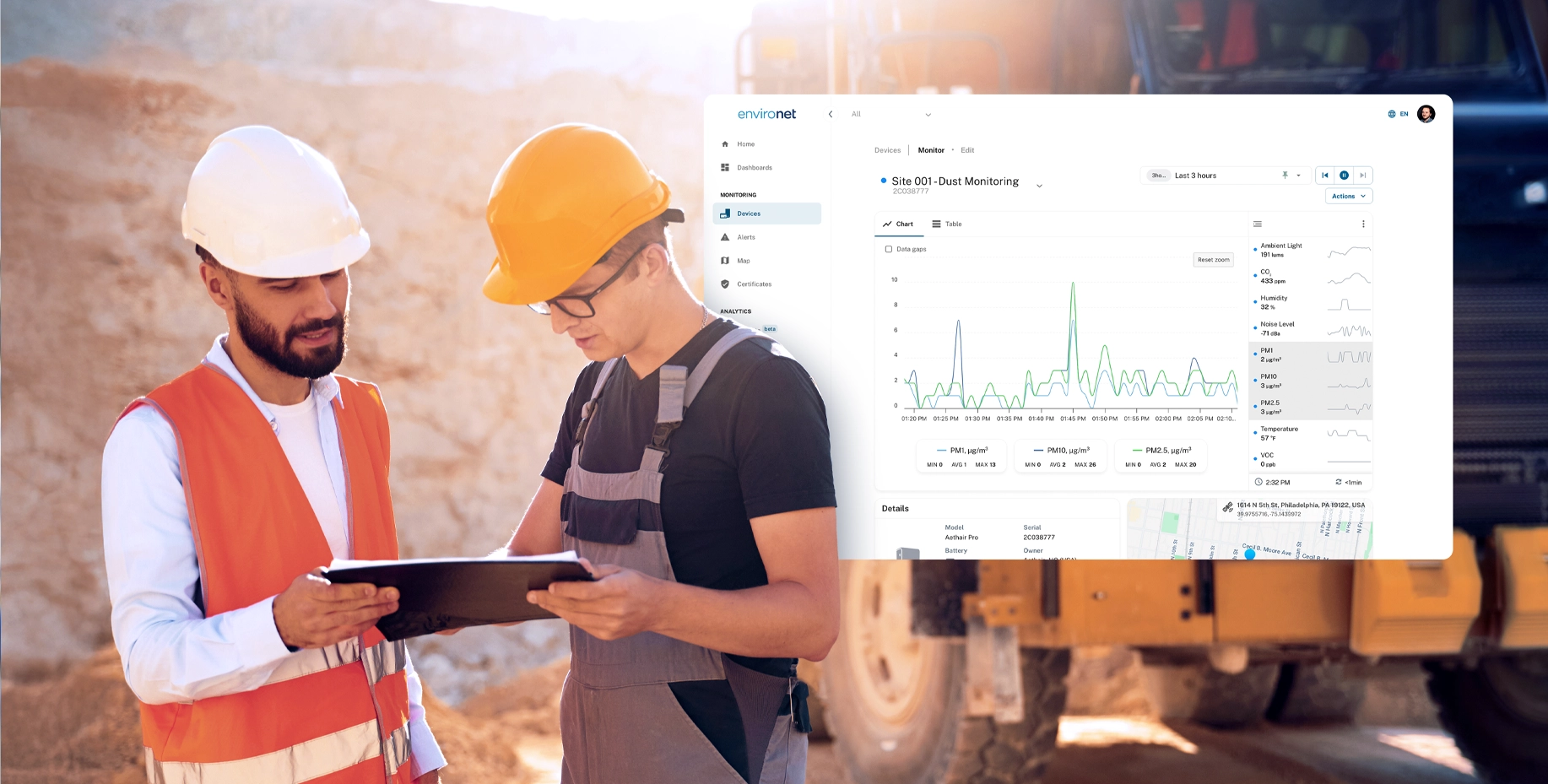
A monitor is only as useful as what happens to its data, and this is where the gap is widest. Aethair PRO reports into Environet, the platform for anytime, anywhere access to your environmental data. Live and historic readings, configurable dashboards, real-time alerting, and public-facing displays all sit in one place, behind a clean, modern interface that stays easy to use without hiding the depth a serious program needs.
Noesis adds an AI layer on top, surfacing trends and helping interpret the data as support for professional judgment, not a replacement for it. Aethair Reports turns the rest into finished documentation: downloadable PDF and online reports, built on calibrated measurement with transparent data lineage, that hold up under regulatory, legal, or audit review. There are report types built for specific jobs too, including a dedicated perimeter monitoring report for boundary and fenceline programs.
The AQS 1 runs on Aeroqual Cloud for online data access, with Aeroqual Connect for local, on-site access to the device. Aeroqual Cloud handles data and export, and includes reporting templates for specific ambient regulations such as South Coast AQMD Rule 1466. Where Aethair goes further is breadth: indoor and outdoor data, AI-assisted analysis, ESG and use-case-specific reports, and documented data lineage in one platform, rather than tooling built mainly around outdoor regulatory reporting. For teams that spend real time interpreting data and producing documentation, having measurement, analysis, and reporting in one place is where the day-to-day value shows up.
When to Choose Aethair PRO
For most programs, Aethair PRO is the stronger choice. It is the right fit for remote or temporary sites where you want cellular without bolting on a modem, and for monitoring that needs a wide gas list, or one that will change, with sensors you can swap in the field. It suits sites that span indoor and outdoor spaces, deployments where a small, light monitor is easier to place and move, and programs that will grow from one unit into a network without new infrastructure. Most of all, it fits when the deliverable is a finished, defensible report rather than a raw export. Where other instruments are already in use, Thiamis brings them onto the same platform.
The Aeroqual AQS 1 is a capable, well-built monitor, and it remains a reasonable option for a purely outdoor, fixed-location ambient program where certified, reference-grade ambient performance is the priority, where a PM4 respirable fraction is specifically required, or where a team is already standardized on Aeroqual equipment. For the broader, more connected, and more report-driven needs of most EHS, environmental, and operations teams, Aethair PRO does more, and does it in a smaller and easier-to-use package. To go deeper on the approach behind it, start with what environmental intelligence means.
| Feature | Aethair PRO | Aeroqual AQS 1 |
|---|---|---|
| 4G LTE connectivity built in | ✓ | Optional add-on |
| Plug and play, no network setup | ✓ | ✗ |
| Plug-in solar, no extra components | ✓ | ✗ |
| Indoor and outdoor monitoring | ✓ | ✗ |
| AI Analysis | ✓ | ✗ |
| Broad third-party integration via Thiamis | ✓ | ✗ |
| Weight | 1.72 lb (0.78 kg) | Under 28.6 lb (13 kg) |
| Dimensions | 4.5 x 9.6 x 4.5 in | 27 x 13 x 7.4 in |