
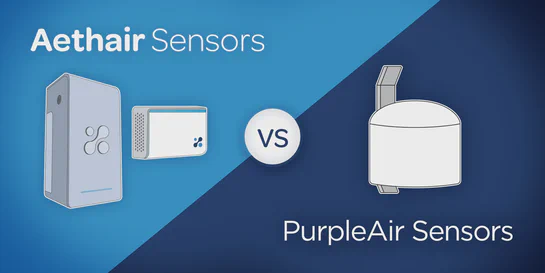
Aethair vs PurpleAir: Low-Cost Sensor or Monitoring Platform
- July 1, 2026
- · 11 min read
- · Aethair Team
If you are weighing Aethair vs PurpleAir, the short answer is that they are built for different jobs. PurpleAir makes low-cost sensors designed to give individuals and communities a general sense of local particulate levels, not the accurate, defensible data that professional monitoring depends on. Aethair is an environmental intelligence platform built to monitor critical spaces, where devices have to be calibrated and the data has to be accurate, complete, and defensible. The two often get mentioned in the same breath because both visualize air quality data, but what stands behind those numbers, and the tools and resources available to act on them, is where they diverge.
That distinction matters most when you intend to act on the data or document it. A sensor that gives a rough, uncorrected sense of particulate trends is fine for personal awareness, but it is a weak foundation for a decision that a regulator, an auditor, or a safety team will scrutinize, where the number has to be accurate and traceable to a source someone trusts. This article compares Aethair and PurpleAir across the things that actually determine fitness for professional use: what each one measures, how it connects, how trustworthy its readings are, the hardware itself, and whether there is a platform behind the sensor at all.
Schedule a call to learn more about the Aethair Platform
What PurpleAir Is and What It Measures
PurpleAir makes low-cost air quality sensors aimed at consumers, community groups, and citizen-science networks. Their appeal is straightforward: they are inexpensive, easy to set up, and their readings can be published to a public real-time map, which has produced dense, crowd-sourced coverage in many areas. For raising general awareness of particulate pollution, that has value.
The hardware reflects the price point. PurpleAir’s outdoor sensors use dual low-cost laser particle counters to estimate PM1, PM2.5, and PM10, paired with a low-cost Bosch environmental sensor that adds temperature, humidity, pressure, and a relative VOC index. They connect over WiFi and, when a sensor is set to public, report to PurpleAir’s cloud and map.
Two things follow from that design. First, the measurement centers on particulates plus basic environmental readings: it does not include calibrated, specific measurements of regulated gases such as nitrogen dioxide, carbon monoxide, ozone, or sulfur dioxide. Second, the sensors are not individually calibrated against a reference, which has direct consequences for accuracy, covered below.
Where PurpleAir Falls Short for EHS and Regulatory Monitoring
PurpleAir does what it was designed to do. The gap appears when it is asked to do something it was not designed for: support professional monitoring where the data drives decisions, alerts, or compliance records.
Connectivity depends on WiFi
PurpleAir’s sensors transmit over WiFi, with no cellular option. For sites without WiFi, some models can log to an SD card instead, but those logs stay on the device and have to be retrieved by hand; they are not sent to the cloud. Relying on WiFi ties every sensor to an available local network and exposes it to dropouts whenever that network goes down. For a home, that is a minor inconvenience. For a construction perimeter, a remote industrial site, or a municipal deployment, dependence on local WiFi is a real limitation, and a network outage means a gap in the record. Aethair devices use built-in 4G LTE cellular connectivity, so monitoring does not hinge on site infrastructure.
It is built around particulates, not regulated gases
PurpleAir reports PM1, PM2.5, and PM10, along with temperature, humidity, pressure, and a relative VOC index from its onboard environmental sensor. What it does not provide is calibrated, specific measurement of the regulated gases many EHS and regulatory programs care about, including nitrogen dioxide (NO₂), carbon monoxide (CO), ozone, and sulfur dioxide. A relative VOC signal is a useful rough indicator, but it is not the same as monitoring those gases at known concentrations, which is what compliance work usually requires.
The readings are not built for regulatory use
This is the core of the credibility question. PurpleAir sensors ship with a general factory calibration applied across the product line, not an individual calibration referenced against a known standard, and their performance varies with conditions, particularly humidity. Independent and EPA research has found that raw PurpleAir readings can significantly overestimate PM2.5. The bias is large enough that, before showing PurpleAir data on the AirNow Fire and Smoke Map, the U.S. EPA applies a national correction equation to reduce it. Even then, the EPA is explicit that it does not use low-cost sensor data for regulatory decisions, treating it as situational awareness that supplements regulatory monitors. Used that way, the data is helpful context. It is not a defensible record on its own.
The hardware is built for the backyard, not the field
PurpleAir’s outdoor housing is a vented, hood-style cover left open at the bottom to let air reach the sensors. It offers basic protection from rain, but it is a consumer enclosure, not a sealed, ruggedized unit engineered for industrial sites, harsh weather, or long-term unattended deployment. Aethair PRO, by contrast, uses an aluminum alloy enclosure and can run on optional solar power, so it can be deployed at off-grid and remote sites a WiFi-dependent consumer sensor cannot reach. In demanding environments, that difference shows up in durability and reliability over time.
There is no platform behind the sensor
The biggest difference comes after a reading is taken. PurpleAir’s data lives on its real-time map, with a data-download tool, a developer API, and basic AQI-threshold alerts through companion apps. What it does not include is the professional layer that EHS and compliance work depends on: calibrated data with a clear record of where each reading came from, audit-ready reporting, and centralized management and alerting across a fleet of devices. For a professional team, the sensor is only the starting point, and turning continuous, trustworthy readings into alerts, analysis, and defensible records is a platform job.
Aethair vs PurpleAir at a Glance
| Capability | PurpleAir | Aethair |
|---|---|---|
| Built for | Hobbyists, community groups, and personal particulate awareness | EHS, industrial, regulatory, municipal, healthcare, government, education, and commercial monitoring, and other critical spaces |
| Parameters measured | PM1, PM2.5, PM10, temperature, humidity, pressure, and a relative VOC index | PM1, PM2.5, PM10, gas-phase pollutants (VOCs, CO₂, NO₂, CO, ozone, formaldehyde, and more), temperature, humidity, pressure, plus noise and light (Aethair PRO), and third-party sensors via Thiamis (for example, weather stations and water-quality instruments) |
| Sensors | Low-cost laser particle counters and a low-cost environmental sensor | Calibrated sensors across Aethair PRO (including pre-calibrated gas cartridges) and Aethair IAQ, plus Thiamis for connecting third-party sensors |
| Calibration | General factory calibration, not individually referenced; EPA applies an external correction to publish the data | Calibrated devices with calibration certificates; an independent Johns Hopkins evaluation found PM2.5 correlating over 90% with reference instruments |
| Connectivity | WiFi only, exposed to network outages | 4G LTE cellular |
| Enclosure and power | Plastic hooded cover, open underside | Aluminum alloy enclosure with optional solar power (Aethair PRO) |
| Data platform | Real-time map (public or private view), data download, and API; basic AQI alerts via companion apps | Environet data platform: real-time monitoring, Intelligent Alerts, device management and mapping, plus data analysis and visualization |
| Reporting and analysis | None native | Aethair Reports (audit-ready) and Noesis AI analysis |
| Third-party integration | None | Thiamis gateway for existing sensors |
| Intended use of data | Awareness and trends | Defensible, compliance-ready documentation |
Choosing a PurpleAir Alternative for EHS and Regulatory Monitoring
It comes down to intent. If you want a low-cost way to follow particulate trends at home, contribute to a community map, or get a rough sense of local conditions, PurpleAir is a reasonable choice and was built for exactly that. There is no need to over-engineer awareness.
A field-grade platform becomes the better PurpleAir alternative when the stakes rise: when the data has to support a compliance position or stand up in an audit, when gas-phase pollutants matter, when sites lack reliable WiFi, when hardware has to survive industrial or outdoor conditions, or when you need alerting and reporting rather than a map to glance at. At that point the question is no longer which sensor is cheapest, but whether the data will hold up when someone asks where the number came from.
PurpleAir is also not the only option in the low-cost, community tier. Clarity, for example, is used in several city-wide programs, including Philadelphia’s Breathe Philly network, and its sensors add nitrogen dioxide alongside particulate matter. It is a more capable community-network option than PurpleAir, but it remains a low-cost sensor network. Aethair supports the same municipal and city-wide monitoring use cases, and does so with calibrated, gas-capable, fully documented data, so a city does not have to choose between wide coverage and readings it can stand behind. Whether the job is a single site or a network across a region, a field-grade platform like Aethair pairs calibrated hardware with the analysis, alerting, and reporting that turn readings into a defensible record.
How Aethair Delivers Defensible, Field-Grade Monitoring
Aethair approaches the same problem from the platform side, starting with calibrated hardware and ending with documentation a team can defend. Aethair PRO is built for outdoor, perimeter, and industrial use, with particle monitoring for PM1, PM2.5, and PM10, configurable, pre-calibrated gas sensor cartridges chosen from a lineup that includes VOCs, CO₂, CO, NO₂, ozone, sulfur dioxide, methane, formaldehyde, and hydrogen sulfide, with additional and custom sensors available on request, and built-in temperature, humidity, pressure, noise, and light sensing, all in an aluminum alloy enclosure. With optional solar power, it can run at off-grid and remote sites a WiFi-dependent consumer sensor cannot reach. Aethair IAQ handles indoor and occupied spaces, tracking PM1, PM2.5, PM10, CO₂, VOCs, formaldehyde, temperature, humidity, and pressure with calibrated sensors. In an independent, peer-reviewed evaluation led by Johns Hopkins researchers, Aethair’s earlier-generation monitor (then sold as Airthinx) tracked reference instruments closely, with PM2.5 readings correlating above 90 percent (an R² of about 0.95). Where a site already runs existing or specialized instruments, Thiamis brings those third-party sensors into the same system. Every device reports over 4G LTE, so deployment does not depend on local networks.
What ties it together is the platform. Environet stores live and historical readings, manages devices across many sites from one console with mapping, and drives Intelligent Alerts against custom thresholds so the right person hears about an exceedance as it happens. Noesis, Aethair’s AI analysis tool, lets teams query their environmental data in plain language and surface trends, while Aethair Reports compiles it into audit-ready documentation on demand or on a schedule. Because every figure traces back to a calibrated reading, the output stays defensible, while the interpretation and sign-off stay with the team. If you want help matching a specific device to your use case, our article on choosing an Aethair monitoring device works through indoor, outdoor, and combined deployments side by side.
Aethair vs PurpleAir: Frequently Asked Questions
Is PurpleAir accurate enough for regulatory or compliance monitoring?
PurpleAir is a low-cost sensor, not a regulatory-grade instrument, and it is not a Federal Reference Method (FRM) or Federal Equivalent Method (FEM) monitor. Its raw readings can significantly overestimate PM2.5, which is why the U.S. EPA applies a national correction equation before publishing PurpleAir data on AirNow, and the EPA does not use low-cost sensor data for regulatory decisions. Aethair devices, by contrast, are calibrated and already used in mission-critical monitoring applications, where real-time monitoring, alerts, and automated report generation make the monitoring process both simpler and more defensible.
Does PurpleAir measure gases like NO2 or VOCs?
PurpleAir measures particulate matter (PM1, PM2.5, and PM10) plus temperature, humidity, pressure, and a relative VOC index from its onboard environmental sensor. It does not provide calibrated, specific measurements of regulated gases such as NO₂, CO, ozone, or sulfur dioxide. Aethair PRO adds configurable, pre-calibrated gas sensor cartridges for those pollutants, and Aethair IAQ tracks CO₂, VOCs, and formaldehyde indoors, so gas-phase data is measured at known concentrations rather than inferred.
Can PurpleAir work without WiFi?
PurpleAir’s sensors depend on WiFi to transmit data and have no cellular option, so coverage is tied to a local network and exposed to outages. Some models store data to an SD card locally, but that still requires manual retrieval rather than live remote access. Aethair devices use built-in 4G LTE cellular connectivity, so they keep reporting from sites without reliable WiFi.
What is a good PurpleAir alternative for EHS or industrial monitoring?
For EHS, industrial, perimeter, or regulatory work, a field-grade platform is a better fit than a community sensor. Aethair PRO provides calibrated PM and configurable gas sensing in a rugged enclosure with cellular connectivity, Aethair IAQ covers indoor and occupied spaces, and both report into Environet for analytics, alerts, and audit-ready reporting. The hardware matters, but the real difference is the calibrated data and the platform behind it.
How is Aethair different from a low-cost sensor like PurpleAir?
PurpleAir is a single-purpose, low-cost particulate sensor built from off-the-shelf components for community and personal awareness. Aethair is an environmental intelligence platform: calibrated hardware that measures particulates and gases, cellular connectivity, and a cloud platform (Environet) with AI analysis (Noesis) and reporting (Aethair Reports). It is designed to produce data that organizations can act on and document with confidence.
To see how Aethair’s own devices compare to one another, read our article on choosing an Aethair monitoring device. For the wider landscape, see our overview of the types of air quality monitors, and for a closer look at the most regulated pollutant in this comparison, read our article on PM2.5 monitoring and its health and regulatory limits.