


Choosing an environmental monitoring device tends to be framed as a product question: which monitor is best, which has the most sensors, which costs less per unit. In practice, that framing produces undersized deployments, oversold specifications, and data records that fall apart the first time a regulator, legal counsel, or an internal auditor reviews them. The better starting point is not the device itself but the work it has to do, because the right hardware almost always falls out of a clear answer to four practical questions about the deployment. Aethair's hardware lineup is built around that decision logic. Aethair PRO is an industrial-grade, customizable air quality monitor for indoor and outdoor deployments where measurement requirements extend beyond a standard commercial space, including industrial sites, perimeter and fenceline networks, healthcare and laboratory environments, and other critical applications. Aethair IAQ is a compact monitor for indoor commercial spaces. Thiamis is an IoT data device rather than an air quality monitor: it connects third-party sensors, instruments, weather stations, and water-quality probes to the same Aethair platform. The three are designed to be used independently or in combination, and the right combination falls out of the same four questions every time.
Four Questions Before You Choose a Device
Most monitoring deployments fail in one of two ways. The first is undersizing, for example: a single indoor monitor in the lobby of a building that also has a loading dock generating diesel particulate, a print shop generating VOCs, and a mechanical room with combustion equipment. The second is mismatching: for example, using a monitor designed for commercial offices in an outdoor application that needs more rugged hardware. Both failures share a common cause: putting the device before the requirement.
The four questions below cover the requirement side of the decision. They are not exhaustive, but in practice they account for almost every meaningful difference between deployments. Working through them before looking at hardware tends to make the hardware choice straightforward.
1. Where Are You Measuring?
Indoor commercial spaces, outdoor and industrial environments, perimeter and fenceline locations, vehicle cabins, and regulated cleanrooms each impose different constraints on the device itself. An indoor monitor in a climate-controlled office can use a narrower temperature range, lower-volume PM sensors calibrated for typical indoor concentrations, and continuous mains power. An outdoor or industrial monitor needs a wider operating temperature, higher PM dynamic range to capture exceedance events, and ruggedization against weather and physical impact. Where you measure also determines what regulatory framework applies, because indoor and outdoor air have different regulations and guidelines.
2. What Needs to Be Measured?
Particulate matter (PM1, PM2.5, PM10, TSP), specific gases (CO, CO₂, NO, NO₂, SO₂, O₃, methane, hydrogen sulfide, hydrogen fluoride, formaldehyde), volatile organic compounds, and meteorological parameters (temperature, humidity, barometric pressure, ambient light, noise) are common requirements, but each deployment has its own subset. The right list depends on what's actually at the site, what the applicable standard requires, and what the EHS or sustainability program already tracks internally. For sites with existing equipment in place (PM samplers, gas detectors, weather stations, water probes), those instruments already define part of the parameter set, and bringing their readings into a single record matters as much as adding any new sensors.
3. What Thresholds or Standards Apply?
A reading is only useful when it is interpreted against a defined limit. EPA's National Ambient Air Quality Standards (opens in a new tab) set ambient limits for pollutants, OSHA's Table Z-1 (opens in a new tab) sets workplace permissible exposure limits, ASHRAE Standard 62.1 sets ventilation and indoor air quality benchmarks for commercial spaces, the WELL Building Standard Air concept (opens in a new tab) sets thresholds for healthy-building certification, and the WHO Air Quality Guidelines (opens in a new tab) provide global health-based reference values. A perimeter monitoring program may also need to meet specific frameworks like NYSDEC DER-10 CAMP or the EPA Refinery Sector Rule, each with its own action levels and averaging windows. The thresholds determine the precision the device needs and the averaging interval the data pipeline has to support.
4. What Does the Data Need to Do?
Continuous monitoring data can serve several purposes, and the use case determines which capabilities matter most. Real-time alerting for exceedance response requires alerts routed within minutes and configurable thresholds. Defensible audit records require documented calibration, continuity of measurement, and joined meteorological context. Public-facing dashboards for occupants, communities, or tenants need a presentation layer that updates automatically, without requiring manual updates. ESG and sustainability disclosure requires structured, periodic outputs with documented data lineage. A device that suits one of these purposes well does not automatically suit all of them, and the unifying platform layer matters as much as the sensor.
Once the four questions are answered, the device choice usually narrows to one or two options. The next section covers what each device in the Aethair lineup is built for, in enough detail to map directly onto the answers from the four questions.
What Each Aethair Device Does
The Aethair lineup is intentionally not a single product. The three devices below address different measurement environments and architectures, and they are designed to operate together when a deployment needs more than one.
Aethair PRO
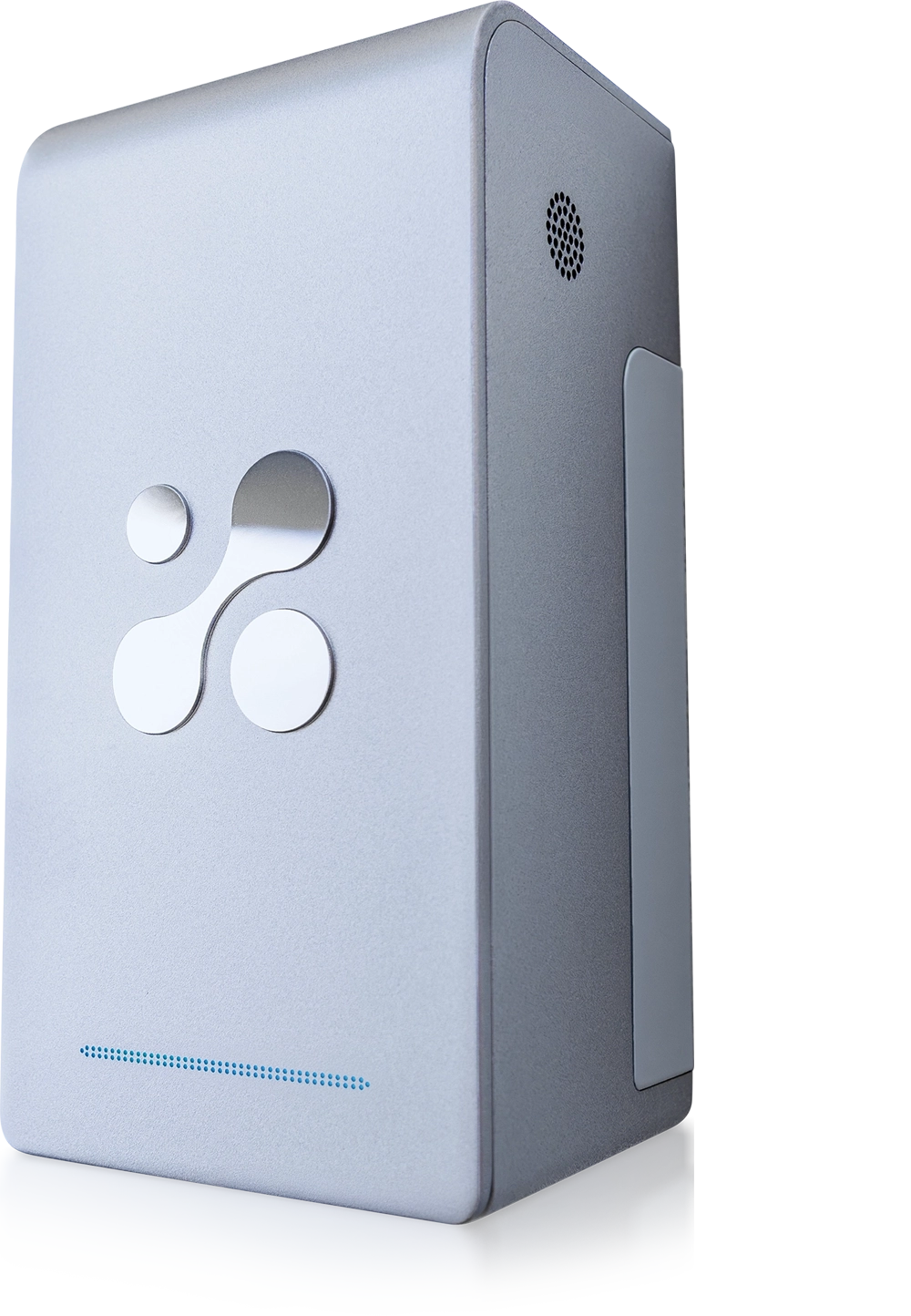
Aethair PRO is an industrial-grade, customizable air quality monitor designed for indoor and outdoor deployments across industrial sites, perimeter and fenceline networks, healthcare and laboratory facilities, and other applications where measurement requirements extend beyond a standard commercial space. It can be deployed indoors or outdoors, with hardwired power or the Solar Panel Bracket for remote or outdoor sites. The form factor is rugged and notably compact compared with competing and legacy equipment of similar capability, with mounting options for walls, poles, or tripods.
The particle measurement is built around a dual-laser sensor that captures PM1, PM2.5, PM10, and TSP. The PM2.5 and PM10 measurement ranges are sized to capture the full extent of construction perimeter events, wildfire smoke episodes, and industrial exceedances that can push concentrations far beyond what typical indoor-class sensors are calibrated to read. TSP capture is included for coarse-dust deployments at aggregate, demolition, and earthworks sites, where it is often the parameter specified by the applicable permit or rule.
Gas monitoring is handled through configurable sensor cartridges, with up to six gases measured simultaneously depending on the cartridge layout. The available gas sensors cover CO, CO₂, NO, NO₂, SO₂, O₃, methane, hydrogen sulfide, hydrogen fluoride, formaldehyde, VOCs (PID), and more. Cartridges can be reconfigured over the life of the device, so a unit deployed for one parameter set can be moved to a different deployment with different requirements without replacing the hardware. See the Aethair PRO product page for current cartridge options, or the gas sensor cartridge spec sheet for the full list. The unit also includes onboard temperature, humidity, barometric pressure, ambient light, and noise sensors, which provide the environmental context a defensible air quality record depends on. Optional differential pressure supports cabin-style applications and healthcare rooms where pressure relationships are monitored for infection control. Data transmits over 4G LTE, with additional WiFi, Bluetooth, Zigbee, and GPS communications. The full specifications can be found on the Aethair PRO spec sheet, which is kept current with the latest device updates and releases.
Aethair IAQ
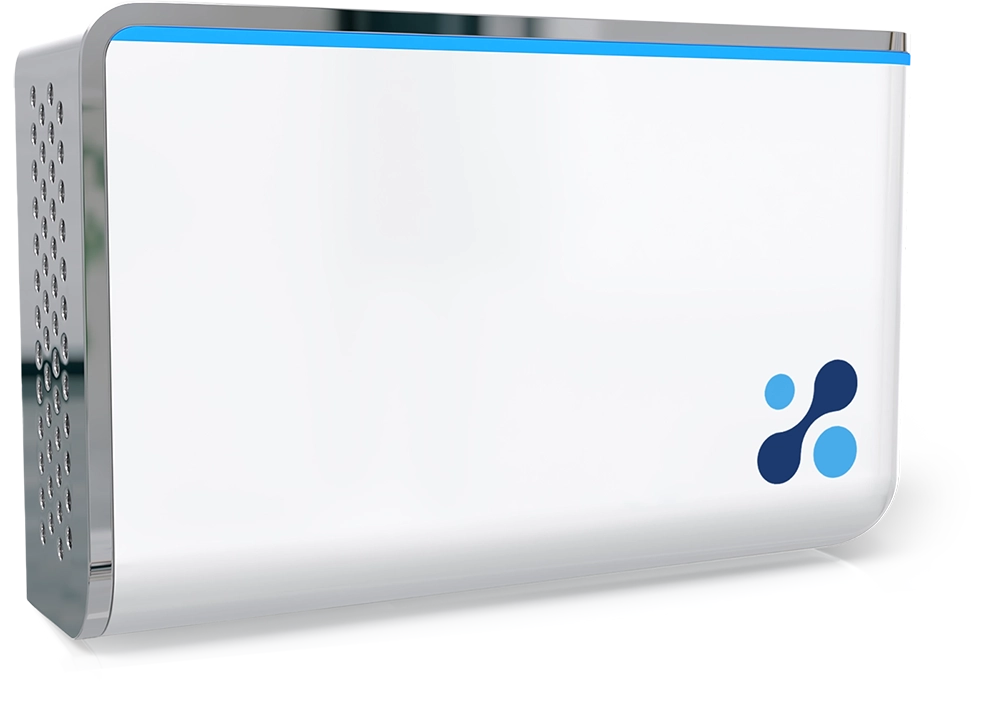
Aethair IAQ is a compact indoor air quality monitor designed for commercial spaces. Its form factor is intended for unobtrusive deployment in offices, classrooms, retail, hospitality, healthcare back-of-house, and similar environments where the device sits in occupied space.
Particulate matter is measured at PM1, PM2.5, and PM10 sizes, at ranges appropriate for indoor occupied spaces. Three gas parameters are measured: formaldehyde (CH₂O), carbon dioxide (CO₂), and total VOCs. The combination is intentional: formaldehyde and VOCs are the typical indoor air quality concerns in occupied commercial space, CO₂ is the proxy for ventilation adequacy, and PM captures particulate matter from infiltration, combustion sources, and indoor activity.
Onboard temperature, humidity, and barometric pressure sensors provide the same environmental context as Aethair PRO, with dew point and heat index calculated as additional parameters. Data transmits over 4G LTE, with additional WiFi, Bluetooth, Zigbee, and GPS communications, on the same Environet platform as Aethair PRO and Thiamis. The full specifications can be found on the Aethair IAQ spec sheet, which is kept current with the latest device updates and releases.
Thiamis
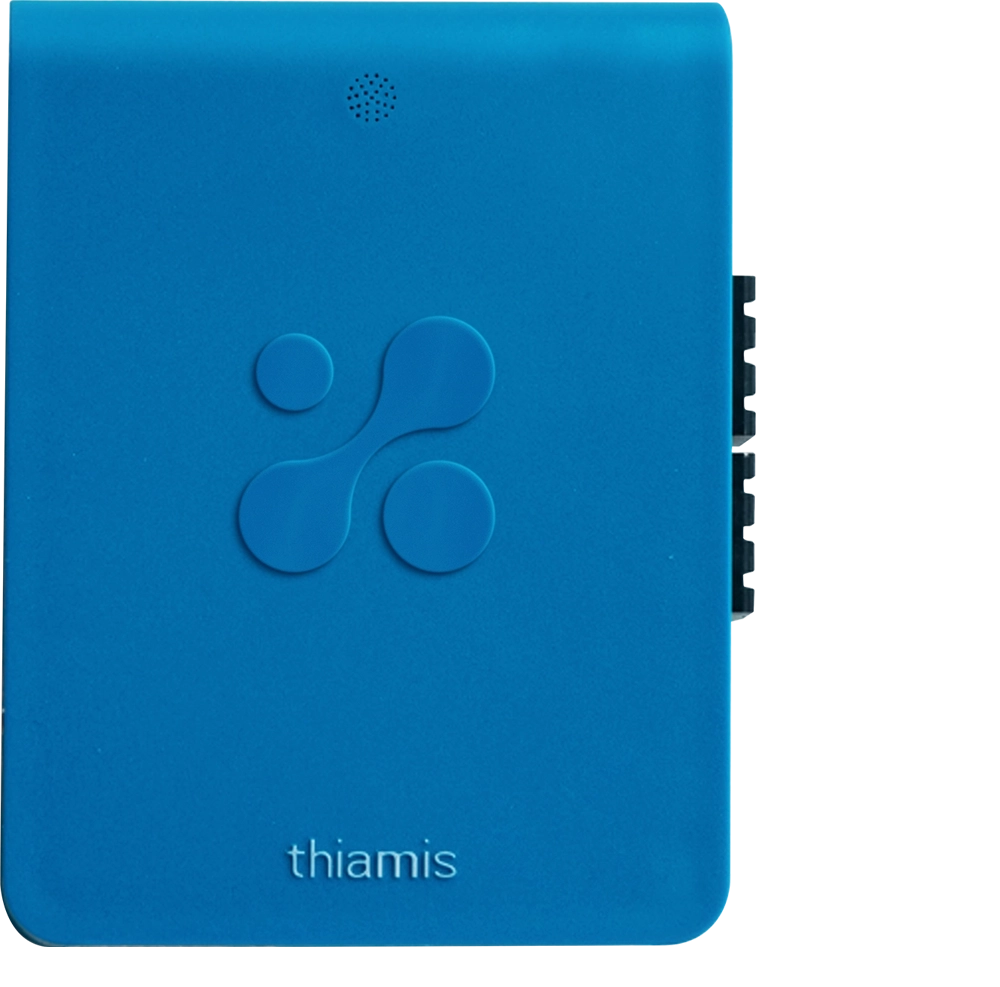
Thiamis is not an air quality monitor. It is an IoT data device built to bring third-party sensors and instruments into the Aethair platform. Its parameter set comes from the instruments you connect to it. Power is supplied via 12 VDC or USB-C.
The integration architecture is the point of the product. Thiamis exposes RS-485, RS-232 (three multiplexed channels), SDI-12, and two USB-C digital ports, takes analog signals through an RS-485 analog input module, and speaks ASCII, ModBUS, SDI-12, UMB, and other industrial protocols. That instrumentation set lets Thiamis connect to a broad range of equipment: third-party PM monitors and particulate samplers (including beta-attenuation and sequential gravimetric samplers), gas monitors and multi-gas detectors, ultrasonic and mechanical weather stations, sound level meters, water-quality and multiparameter sonde probes (covering pH, dissolved oxygen, conductivity, turbidity, and related parameters), water-level sensors, heat stress monitors, and additional environmental instrumentation. The device transmits the aggregated data over 4G LTE, with additional WiFi, Bluetooth, Zigbee, and GPS communications, to the same Environet platform that Aethair PRO and Aethair IAQ use.
For a site with existing monitoring infrastructure, Thiamis brings that infrastructure and all of its collected data into a single platform without replacing what is already deployed, simplifying record keeping and data organization. For a multi-parameter project that needs measurements outside of air quality, including water quality, water level, or specialized industrial parameters, Thiamis is the only option available to connect all that data in one place. The full specifications can be found on the Thiamis spec sheet, which is kept current with the latest device updates and releases.
Example Use Case Walkthroughs
The clearest way to map devices to deployments is to work through specific scenarios. The four below cover common situations, each anchored by the regulatory or operational framework that defines the requirement. The combined-deployment patterns that come up when a single scenario crosses categories are covered in the next section.
Commercial Offices and Healthy-Building Certification
Office, retail, hospitality, and similar commercial environments are typically governed by some combination of ASHRAE Standard 62.1 (opens in a new tab) for ventilation and indoor air quality, the WELL Building Standard for healthy-building certification, and applicable OSHA general duty obligations for occupant safety. ASHRAE 62.1 defines outdoor air supply rates and indoor contaminant guidelines. The WELL v2 Air concept sets thresholds for PM2.5, CO₂, VOCs, and other parameters. OSHA's general industry standards under 29 CFR 1910.1000 Table Z-1 (opens in a new tab) set workplace permissible exposure limits even when no industrial process is present.
The parameter set for commercial offices is well-defined: PM at typical indoor concentrations, CO₂ as a ventilation proxy, formaldehyde and total VOCs from furnishings and finishes, and the environmental context that supports interpretation. The deployment environment is controlled, the data needs are continuous monitoring with real-time dashboards for occupants and audit-ready records for certification, and concentrations stay within a predictable range that doesn't approach industrial extremes.
Aethair IAQ is purpose-built for this scenario. Its fixed parameter set aligns with the key parameters in WELL and ASHRAE 62.1, with no configuration overhead. The form factor sits unobtrusively in occupied space, and the indoor temperature and PM ranges match the deployment environment exactly. For a single-site commercial deployment, one Aethair IAQ deployed in every occupied space is typically sufficient, with Environet handling the dashboards and reporting.
Construction and Industrial Perimeter Monitoring
Construction sites, refineries, chemical plants, demolition projects, and remediation operations all share a common monitoring requirement at the property boundary: continuous, defensible measurement that characterizes what is leaving the site and reaching nearby communities and areas. The regulatory frameworks layer across federal, state, and local jurisdictions, and a single project is often subject to more than one. EPA's NAAQS (opens in a new tab) set ambient limits for pollutants. The EPA Refinery Sector Rule at 40 CFR 63 Subpart CC (opens in a new tab) requires benzene fenceline monitoring at petroleum refineries on rolling 14-day windows, with an action level of 9 μg/m³ on the annual Δc. OSHA's respirable crystalline silica standard (opens in a new tab) at 29 CFR 1926.1153 governs construction dust. State and local programs (NYSDEC DER-10 CAMP, BAAQMD Regulation 12-15, SCAQMD Rule 1180, and municipal dust-control programs such as Philadelphia's Air Management Services regulation) add their own action levels and averaging windows. Project-specific consent decrees and community benefit agreements often add an additional layer.
The parameter set spans particulates (PM10, PM2.5, TSP for construction and aggregate sites), speciated gases (VOC detection via PID, H₂S, SO₂, NO₂, and other compounds for refineries and chemical operations), VOCs at remediation and petrochemical sites, and environmental conditions throughout. Particulate concentrations during exceedance events can reach very high levels, and speciated gases at refinery fencelines require low-level precision on rolling averages. Typical indoor-class sensors cannot reliably capture either. The deployment environment is outdoor, distributed across multiple perimeter locations, and frequently mounted on tripods, fences, or job-site infrastructure across a project lifecycle that ranges from weeks to decades.
Aethair PRO is the fit across this entire category. The dual-laser PM sensor handles concentrations from background through exceedance events, and TSP captures the coarse-dust readings that older permits and local rules still specify. The configurable gas sensor cartridges cover VOCs, H₂S, SO₂, NO₂, and other compounds that fenceline programs require. The onboard noise sensor adds work-practice context that municipal construction programs increasingly request. The operating range, industrial-grade housing, and built-in battery (with the optional Solar Panel Bracket for extended or off-grid power) support distributed perimeter networks across the full range of conditions these sites present. For refinery programs that need to pair continuous field-grade data with reference sampling under EPA Method 325A/B for compliance demonstration, Thiamis typically joins the deployment to bring the periodic reference data into the same Environet record.
Industrial Production Facilities and Manufacturing
Manufacturing, chemical processing, food production, semiconductor fabrication, and other industrial production environments operate under a different framework than perimeter monitoring or commercial buildings. The relevant workplace standards come from OSHA general industry under 29 CFR 1910, with Table Z-1 (opens in a new tab) setting permissible exposure limits for hundreds of chemicals, 29 CFR 1910.95 (opens in a new tab) governing occupational noise exposure, and 29 CFR 1910.119 Process Safety Management (opens in a new tab) applying to highly hazardous chemical processes. NIOSH Recommended Exposure Limits provide more conservative health-based references for many of the same substances, and ACGIH Threshold Limit Values are widely used as industry guidelines that often inform internal action levels even where they are not written into law.
The parameter set is process-driven. Common requirements include CO from combustion and forklift operations, NO and NO₂ from welding and cutting, SO₂ from sulfur-containing processes, H₂S from petrochemical and pulping operations, HF from etching, aluminum production, and battery manufacturing, formaldehyde from resin and adhesive processes, and total VOCs from solvent and coating operations. Particulate matter from grinding, welding, cutting, and material handling is typically coarser than indoor commercial PM and requires PM10 and TSP capture rather than the indoor PM range. CO₂ matters in confined or poorly ventilated areas where ventilation may not keep pace with occupancy and combustion sources. Noise from production equipment is its own regulated parameter under 29 CFR 1910.95. Indoor industrial environments also experience wide temperature swings, sustained dust loading, and mechanical or chemical exposure risk on the device itself, which separates them from typical commercial indoor deployments.
Aethair PRO is the fit on the production floor. The industrial-grade housing, operating range, and high PM dynamic range handle the conditions, and the configurable gas sensor cartridges cover process-specific compounds. TSP capability picks up coarse material-handling dust above the PM10 size range, and the onboard noise sensor captures area noise data where 29 CFR 1910.95 also applies. For larger production sites with separate office, break, or administrative areas, deploying Aethair IAQ in those non-process zones brings their occupants into the same monitoring program without industrial-grade overhead, and the combined PRO-plus-IAQ deployment pattern is covered in the next section.
Sites With Existing Third-Party Instruments or Multi-Parameter Monitoring Needs
Many EHS programs operate sites that already have monitoring infrastructure in place: a beta-attenuation PM sampler installed for a prior permit cycle, a multi-gas detector deployed for periodic monitoring, a meteorological station commissioned by a different consultant, a network of water-quality probes deployed for stormwater compliance under the Clean Water Act, or water-level sensors at a remediation site. These instruments produce defensible data on their own terms, but the data lives in separate files, vendor portals, or spreadsheets. Assembling the joined record that modern compliance and ESG reporting requires then becomes expensive and time-consuming.
The parameter set in these deployments is whatever the existing instruments measure, and the requirement is not new sensing but unified data flow. The deployment environment depends on the host instruments, and the data needs center on aggregation, alert routing, and reporting against a single timeline.
Thiamis is the fit for this scenario. The RS-485, RS-232, SDI-12, and USB-C ports cover the digital protocols that most environmental and industrial instruments speak, an RS-485 analog input module brings in the analog outputs of legacy equipment, and the supported protocols (ASCII, ModBUS, SDI-12, UMB) cover most of what is on the market. Once connected, the third-party data flows into Environet on the same schedule as data from any Aethair monitor, and Aethair Reports, Aethair Dashboards, and Noesis treat it identically. Clients using Aethair Reports have said that it can save thousands of hours of manual work annually. For multi-parameter sites that need to track air, water, and weather under one record, Thiamis is often the only device required.
Combined Deployments
When a site does not fall cleanly into one of the four use cases above, the answer is usually a combination of devices feeding the same Environet record. Three patterns cover most multi-device deployments, plus a fourth pattern for the most complex sites.
Aethair IAQ + Aethair PRO. Sites that combine general indoor commercial space with either outdoor industrial activity or critical indoor environments tend to need both devices. Examples include a manufacturing facility with administrative offices and a production floor, a healthcare facility with waiting rooms alongside operating rooms or infection-control areas, a construction site with office trailers, and a school district monitoring classrooms and outdoor athletic fields during wildfire smoke season. Each calls for Aethair IAQ in the general commercial zones and Aethair PRO in the outdoor, industrial, or critical zones.
Aethair PRO + Thiamis. Outdoor and industrial deployments that combine new continuous monitoring with existing third-party instruments fit this pattern. A refinery or chemical site pairs Aethair PRO continuous gas and particulate monitoring with existing continuous instruments already deployed on site (such as PM samplers or third-party gas monitors), with Thiamis bringing those instruments into the same Environet record on the same timeline. A construction site with a weather station deployed for a previous project uses Thiamis to bring that station's data into the current monitoring program rather than running parallel systems. A brownfield remediation site with specialized samplers for site-specific contaminants of concern uses Thiamis to integrate those samplers with the broader Aethair PRO continuous network.
Aethair IAQ + Thiamis. Indoor commercial spaces with existing third-party infrastructure benefit from this combination. A property manager with newer Aethair IAQ deployments alongside legacy air quality sensors that expose a standard protocol uses Thiamis to bring the legacy device data into the unified Environet record without replacing the older instrumentation. A healthcare facility with existing differential-pressure or environmental sensors in regulated spaces can integrate compatible instruments through Thiamis while running Aethair IAQ in occupied non-clinical zones. A multi-tenant building portfolio with mixed-vintage systems and standalone monitors brings all of it into one platform without standardizing the hardware first.
All three devices in combination. Complex multi-zone facilities sometimes need all three. Examples include a refinery with administrative offices, fenceline monitoring, and existing third-party samplers; a healthcare campus with surgical suites, clinical pharmacies, outdoor loading docks, and legacy sensors; and a multi-building research facility with laboratories, offices, an industrial loading area, and existing instrumentation. In these cases the platform becomes the key architectural decision. Environet treats data from all three device types identically regardless of source, so the deployment can grow and change over time without redesigning the data architecture.
Specifications at a Glance
The table below summarizes the shared dimensions across the three devices. Per-product detail and unique capabilities follow.
| Dimension | Aethair PRO | Aethair IAQ | Thiamis |
|---|---|---|---|
| Primary role | Air quality monitor | Air quality monitor | Data integration device |
| Deployment environment | Indoor and outdoor; industrial, perimeter, healthcare, lab, critical | Indoor commercial | Indoor or outdoor, with connected instruments |
| PM measurement | PM1, PM2.5, PM10, TSP (effective 0–1,000 μg/m³ for PM2.5/PM10) | PM1, PM2.5, PM10 (effective 0–500 μg/m³) | Via integrated third-party sensors |
| Gas measurement | Up to 6 gases via configurable cartridge layout | CO₂, CH₂O, total VOCs | Via integrated third-party sensors |
| Onboard environmental sensors | Temperature, humidity, barometric pressure, ambient light, noise (optional differential pressure) | Temperature, humidity, barometric pressure, dew point/heat index (calculated) | None: the parameters come from the connected instruments |
| Integration ports | N/A | N/A | RS-485, RS-232 (3-multiplexed), SDI-12, 2× USB-C, RS-485 analog input module |
| Communications | 4G LTE, WiFi, Bluetooth, Zigbee, GPS | 4G LTE, WiFi, Bluetooth, Zigbee, GPS | 4G LTE, WiFi, Bluetooth, Zigbee, GPS |
| Dimensions (LxWxD) | 9.625 × 4.5 × 4.5 in | 4.3 × 2.6 × 1.2 in | — |
| Weight | 1.72 lb (0.78 kg) | 0.4 lb (0.18 kg) | See spec sheet |
For full specifications on each device, see the Aethair PRO spec sheet, the Aethair IAQ spec sheet, and the Thiamis spec sheet.
Unique Capabilities by Device
Aethair PRO. The onboard noise level sensor (40 to 120 dB) captures area noise data alongside air quality readings, which is useful in industrial environments where occupational noise is also a tracked parameter under OSHA 29 CFR 1910.95. Modular gas sensor cartridges allow the same device to be reconfigured for different parameter sets. Dual-laser PM with TSP capture (TSP effective range up to 2,000 μg/m³) supports coarse-dust deployments where indoor PM ranges would miss the signal. On-device alerts let site personnel respond at the unit itself, without requiring a connected dashboard. The built-in battery, with the optional Solar Panel Bracket, supports portable, tripod, and roving deployments where mains power is unavailable. The compact, rugged form factor is a small fraction of the size of typical industrial-grade monitoring systems, many of which require enclosures the size of an electrical panel or junction box, while still providing comparable measurement capability.
Aethair IAQ. The compact form factor allows unobtrusive placement in occupied commercial spaces. The PM measurement range is sized for indoor concentrations rather than outdoor exceedance events, which is appropriate for indoor environments. Calculated dew point and heat index parameters provide occupant comfort context alongside the regulated parameters. The low power draw means deployment in a standard office requires only a wall socket and no additional infrastructure work.
Thiamis. Multiple digital ports (RS-485, RS-232 multiplexed across three channels, SDI-12, two USB-C) cover the protocol diversity of environmental and industrial instrumentation. Analog outputs from legacy equipment connect through an RS-485 analog input module. An optional external MCX antenna handles deployments in poor cellular environments. Protocol support including ASCII, ModBUS, SDI-12, and UMB covers most of what is on the market for environmental, industrial, and water-quality instrumentation.
Common Mistakes When Sizing a Monitoring Deployment
Five mistakes come up often in EHS programs, and the four questions earlier in this article are designed to prevent them.
Picking the device before defining the requirement. Sourcing decisions made before the regulatory or operational requirement is defined typically produce undersized deployments (one device where two or three are needed to capture the actual exposure pattern) or over-specified deployments (reference-grade hardware specified for a use case where field-grade continuous data would have served the program better). Working through the four questions first and matching devices to the answers avoids both.
Under-instrumenting outdoor or industrial source contributions. A single indoor monitor in a building with adjacent diesel generator activity, loading-dock idling, or industrial process emissions misses the actual exposure pathway, because an indoor monitor cannot characterize what is migrating in from outside or from non-monitored zones. Sites with multiple emission sources or activity zones need monitors placed where the exposure actually occurs (near or downwind of each source), which often means more than one device or a combined deployment.
Sizing PM dynamic range for indoor concentrations at outdoor sites. Indoor-class PM sensors are calibrated for typical indoor concentrations, which rarely exceed a few hundred micrograms per cubic meter. At construction perimeters during dust events, wildfire smoke episodes, or industrial exceedances, concentrations routinely exceed those ranges and indoor-class sensors saturate, producing flat-lined or inaccurate data at the moments when the data is most consequential.
Ignoring meteorological context for outdoor data. A PM10 reading without wind direction is data without context, particularly for perimeter and fenceline programs where source contribution depends on whether the receptor is upwind or downwind of the activity. Most modern regulatory frameworks for outdoor monitoring (NYSDEC DER-10 CAMP, EPA Refinery Sector Rule, BAAQMD perimeter rules, SCAQMD Rule 1180) require meteorological data joined to pollutant readings for the data to support a regulatory submission. Aethair Reports handles this joining automatically in Perimeter Monitoring reports, pairing pollutant readings with wind direction, wind rose summaries, and upwind/downwind delta calculations across the appropriate averaging window, so the deliverable is a single audit-ready document rather than a manual reassembly from separate logs.
Mixing sensors with inconsistent accuracy and reliability into compliance records. Audit defensibility depends on knowing that every sensor producing a data point can be trusted. Aethair devices are calibrated for measurement accuracy and reliability, with calibration certificates available for the data record. Programs that combine accurate, well-maintained devices with legacy sensors of unknown condition typically lose data records to challenge during regulatory or legal review. The fix is not necessarily replacing every sensor; it is documenting the accuracy and reliability profile of every sensor in the record, which is what the Thiamis-plus-existing-instruments pattern is designed to support.
How Aethair PRO, IAQ, and Thiamis Work Together in Environet
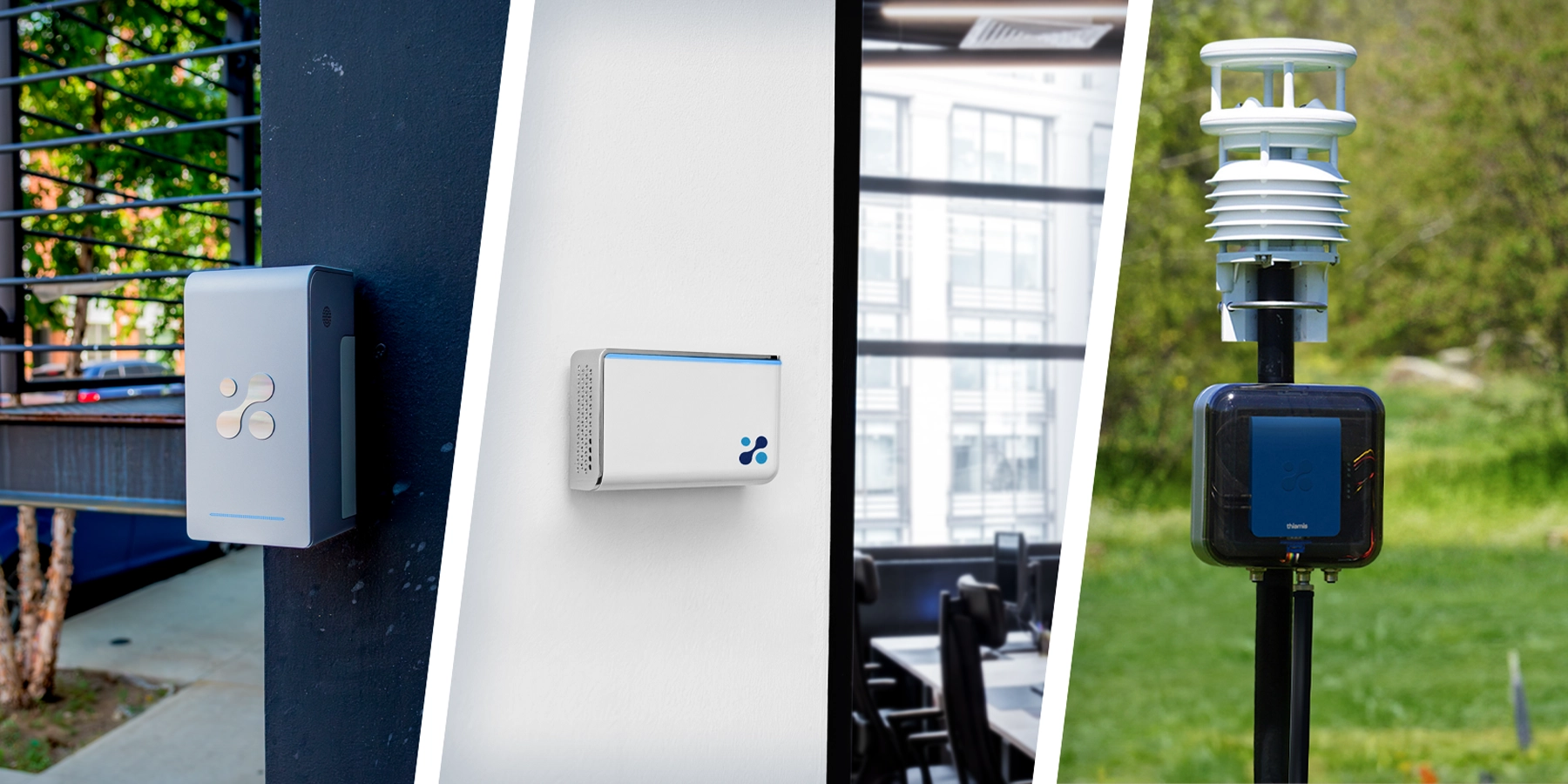
Whichever device or combination of devices fits a given deployment, the data converges in one place: Environet, Aethair's environmental intelligence platform. Environet receives continuous data from Aethair PRO, Aethair IAQ, and Thiamis through the same pipeline regardless of source, aggregates readings at configurable intervals, supports threshold-based alerts and routing, and provides the dashboards and APIs that EHS teams require day to day. The choice of device determines what is measured and where; the choice of platform determines what can be done with the measurement once it arrives.
Aethair Reports sits on top of Environet to produce structured, audit-ready outputs from the underlying record. Report types are configurable for specific deployment contexts (perimeter monitoring with upwind-downwind comparisons, indoor air quality with standards-aligned thresholds, aggregate reports across a portfolio of sites), generate project-specific PDFs that can be reviewed in Environet or scheduled for automatic delivery via email, and preserve data lineage so every reading in the report is traceable to the device and timestamp that produced it.
Noesis is Aethair's AI analysis layer. It lets EHS teams query the Environet record in plain language, surface correlations across pollutant readings, meteorology, and operational events, and generate narrative summaries on demand. Noesis works identically on data from any device in the lineup, which is part of why the initial device choice does not limit any platform capability later.
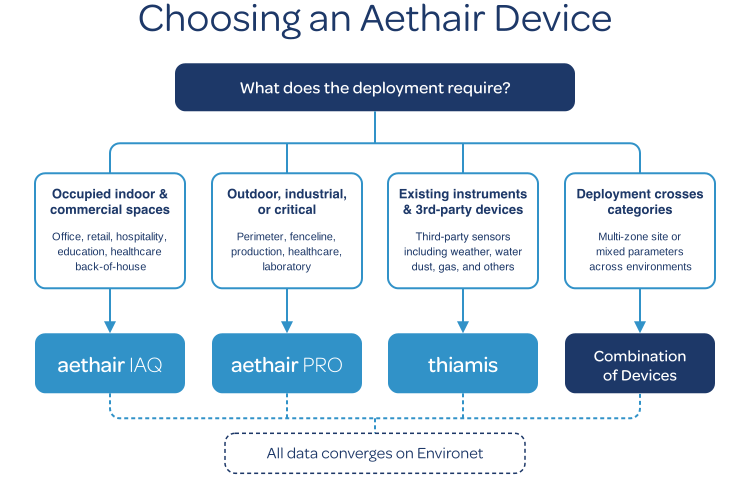
For readers who prefer a text companion to the diagram above, the decision sequence is simple:
- If the deployment is in an indoor commercial space (office, retail, hospitality, education, healthcare back-of-house) and the parameter set covers indoor-range PM, CO₂, formaldehyde, and total VOCs, choose Aethair IAQ.
- If the deployment is outdoor, at a perimeter or fenceline, on an industrial production floor, or in a critical or specialized indoor environment requiring industrial-grade hardware or a configurable gas set, choose Aethair PRO.
- If the deployment integrates existing third-party instruments, weather stations, water-quality probes, or other instrumentation into the Aethair platform without replacing what is already deployed, choose Thiamis.
- If the deployment crosses more than one of the above, combine devices using one of the patterns from the Combined Deployments section, and rely on Environet to bring all the data into a single record.
The right monitoring deployment starts with the right questions. By defining the requirement first, mapping each device to its use case, and combining devices where a site needs more than one, EHS teams build a defensible, scalable monitoring program rather than a collection of disconnected sensors. The combination of Aethair PRO, Aethair IAQ, and Thiamis, unified by Environet, Aethair Reports, and Noesis, means the initial device decision doesn't limit what is possible later. The deployment can grow and adapt as the site, the regulations, and the requirements evolve.
Find the Right Aethair Device for Your Use Case
Talk with an Aethair expert to map your monitoring requirements to the right combination of Aethair PRO, Aethair IAQ, and Thiamis, with all your data unified in Environet.
Schedule a call (opens in a new tab)Talk to Aethair →Explore Our Solutions →
Choosing an Aethair Air Quality Monitor: FAQs
What is the difference between Aethair PRO and Aethair IAQ?
Aethair PRO is an industrial-grade, configurable air quality monitor for indoor and outdoor deployments, including industrial sites, perimeter and fenceline networks, and healthcare or laboratory environments. It measures PM1, PM2.5, PM10, and TSP at a high dynamic range and up to six gases through configurable cartridges. Aethair IAQ is a compact indoor air quality monitor for commercial spaces, measuring indoor-range PM, CO₂, formaldehyde, and total VOCs. PRO suits demanding or outdoor environments; IAQ suits occupied commercial interiors.
Which Aethair device is best for industrial air quality monitoring?
Aethair PRO is the industrial air quality monitor in the lineup. Its industrial-grade housing, wide operating range, high PM dynamic range, and configurable gas sensor cartridges handle production floors, perimeter and fenceline networks, and other demanding sites. Where a site also has existing third-party instruments, Thiamis brings their data into the same Environet record.
Which air quality monitor is best for commercial and office buildings?
Aethair IAQ is purpose-built for commercial and office air quality monitoring. Its fixed parameter set of indoor-range PM, CO₂, formaldehyde, and total VOCs aligns with the parameters specified by ASHRAE 62.1 and the WELL Building Standard, and its compact form factor sits unobtrusively in occupied space.
Is Thiamis an air quality monitor?
No. Thiamis is an IoT data device, not a monitor. It connects third-party sensors, instruments, weather stations, and water-quality probes into the Aethair platform so their readings land in the same Environet record as Aethair PRO and Aethair IAQ data.
Which Aethair device fits hospital, healthcare, or laboratory environments?
Aethair PRO suits critical clinical and laboratory spaces, with optional differential pressure for areas where room-to-room pressure is monitored for infection control. Aethair IAQ covers occupied non-clinical zones such as waiting rooms and offices. Many healthcare deployments use both, unified in Environet.
Can Aethair PRO, IAQ, and Thiamis be used together?
Yes. The three devices are designed to work independently or in combination, and all feed the same Environet record. A single site can run Aethair IAQ in occupied indoor zones, Aethair PRO outdoors or in critical areas, and Thiamis to integrate existing instruments, without managing separate systems.