
Data center air quality monitoring used to mean one thing: keeping dust and corrosive gases away from the servers. It now means that plus a great deal more, because the same facility is also a construction site with a silica obligation, a permitted source of generator emissions, and a neighbor whose dust and noise are measured in public meetings. Nowhere is that clearer than Northern Virginia, the largest data center market in the world with roughly 13 percent of all global data center capacity (opens in a new tab), where permitting has tightened and scrutiny arrives with every new campus.
This article covers the full monitoring problem from the operator's side, inside and out: the ASHRAE and ISO cleanliness envelope that protects IT equipment in the white space (the server rooms themselves), the dust and worker silica exposures of the construction phase, and the generator emissions, dust, and noise measured at the property line.
Quick answer
Data center air quality monitoring runs across three fronts. Inside the facility, ASHRAE TC 9.9 guidance recommends keeping the white space at ISO Class 8 cleanliness under ISO 14644-1, holding corrosive gases within ISA-71.04 severity level G1, and keeping relative humidity below 60 percent to protect circuit boards from corrosion. During construction, earthwork and concrete cutting raise PM10 and total suspended particulates, diesel equipment adds PM2.5, and respirable crystalline silica in workers' breathing zones falls under OSHA's 29 CFR 1926.1153 (opens in a new tab), with a permissible exposure limit of 50 micrograms per cubic meter. At the property line, the questions are diesel generator emissions (PM2.5 and nitrogen oxides), dust crossing the boundary, and continuous noise from cooling and backup power, read against wind conditions. Aethair covers all three: Aethair IAQ in the white space, Aethair PRO at the fence, and Thiamis to bring existing instruments onto one platform.
Why Data Center Air Quality Is Now a Permitting and Uptime Question
A large data center is really two projects in sequence. First comes a construction site, often on former farmland or open ground at the edge of a residential area, running months of earthmoving, foundation work, and concrete pours. Then comes a facility that never switches off, cooled by heavy mechanical systems and backed by banks of diesel generators that test on a schedule and run during grid outages. Each phase creates its own exposures, its own regulatory obligations, and its own data demands.
The regulatory side is moving. Virginia's Department of Environmental Quality revised its permitting guidance for data center generators (opens in a new tab), and for applications submitted on or after July 1, 2026, new generators must meet emissions limits at least as stringent as EPA Tier 4 standards, which in practice points large units toward selective catalytic reduction, diesel particulate filters, and in some cases continuous emissions monitoring. Local policy is moving in the same direction from a different angle: policy toolkits circulating among county officials (opens in a new tab) now recommend requiring continuous monitoring of air and water quality at facility boundaries. Because Northern Virginia's Data Center Alley leads the market, and fast-growing hubs such as Dallas, Phoenix, Atlanta, and Columbus are following its playbook, decisions made there tend to arrive elsewhere a few years later.
The public side is moving too. Data Center Watch (opens in a new tab) recorded at least 75 projects worth roughly $130 billion blocked or delayed in the first quarter of 2026 alone, matching the scale of all of 2025 in three months, with environmental and noise concerns among the reasons residents and officials raise most often. Virginia's legislative watchdog, JLARC, found that about a third of the state's data centers sit near residential areas (opens in a new tab), which is why dust during the build and generator noise afterward turn into agenda items so quickly. For an operator, showing environmental performance with measured data has become part of winning approval and keeping a project in good standing.
And then there is the original meaning of the phrase, the one the industry has worked on for decades: the air inside the building, where dust and corrosive gases shorten the life of the equipment the whole business depends on. A complete data center air quality monitoring program covers all of it with one connected record.
Inside: Contamination, Corrosion, and the ASHRAE Envelope
Servers are more sensitive to air quality than the people walking past them. The shift to lead-free solders and ever-smaller components left modern circuit boards vulnerable to two failure modes documented in the contamination guidelines for data centers (opens in a new tab) from ASHRAE's mission-critical technical committee, TC 9.9. In copper creep corrosion, copper sulfide forms and spreads across a board until it shorts adjacent features. In silver corrosion, sulfur-bearing gases attack component terminations until circuits open. The main culprits are sulfur dioxide and hydrogen sulfide, with nitrogen dioxide and ozone amplifying the damage.
The guidelines translate into a monitoring envelope a facility team can act on. Particulate cleanliness should hold at ISO Class 8 under ISO 14644-1, typically achieved with MERV 8 filtration for recirculating air and MERV 11 to MERV 13 for outside air. Gaseous contamination should stay within severity level G1 of ANSI/ISA-71.04, meaning copper corrodes at less than 300 angstroms per month and silver at less than 200. And relative humidity should stay below 60 percent, because settled dust starts to absorb enough moisture above that point to promote corrosion and ion migration on energized boards.
Hardware specifications turn that guidance into a contractual question. Manufacturers write the contamination class into their environmental specifications: IBM's documentation for its current-generation systems (opens in a new tab), for example, specifies severity level G1 with copper reactivity below 300 angstroms per month, and makes repair or replacement of contamination-damaged parts conditional on remediating the environment. The realistic exposure is not a warranty voided outright; it is being unable to answer a question about the environment when a vendor raises contamination as a possible cause. Corrosion coupons, assessed periodically, establish a severity level across an exposure window. Continuous particulate, temperature, and humidity data fills in what happened between those assessments, shows which excursion is worth investigating, and gives the vendor conversation something to work from.
Contamination is also a slow failure mode, which is what makes it easy to misread as hardware quality or bad luck: component and drive failures accumulate across months rather than arriving as a single event. It reverses when the cause is found. In one Uptime Institute case study (opens in a new tab), a telecommunications facility's corrosion-related card failures fell from an average of 36 per month to roughly 20 within five months of adding chemical filtration, and below 10 per month once the system was tuned further.
Location decides how hard all of this is. A facility drawing outside air near a highway, an industrial corridor, or an active construction site, including the next phase of its own campus, takes on more contamination risk than the same building somewhere cleaner. And filtration is commissioned once, then drifts: media loads, differential pressure climbs, and the outside air changes with the season and with nearby activity, so a hall commissioned in clean conditions can find itself downwind of its own phase-two earthworks eighteen months later. Measuring indoor and outdoor particulates together separates the two explanations, because a degrading filter and a rising outdoor load look the same from inside the hall and call for different responses.
Construction: Dust and the Silica Question
Before a data center affects anyone beyond its fence, it creates exposures for the people building it.
Construction air quality is mostly a dust problem. On a site with heavy concrete cutting, grinding, and earthwork, part of that dust is respirable crystalline silica, the fine fraction released when concrete, stone, and sand are broken up, and the diesel equipment moving around the site adds exhaust that is almost entirely PM2.5. Silica is the part that carries a specific legal obligation, because it falls under OSHA's respirable crystalline silica standard for construction, 29 CFR 1926.1153 (opens in a new tab). That rule sets a permissible exposure limit (PEL) of 50 micrograms of respirable crystalline silica per cubic meter of air over an 8-hour day, with an action level of 25 micrograms per cubic meter that triggers exposure assessment and medical surveillance. Employers have two routes to compliance: follow the engineering controls, work practices, and respiratory protection spelled out for each task in the standard's Table 1, or assess worker exposures directly and control them to the PEL.
What sets silica apart comes down to where you measure. It is a worker exposure, sampled in or near a person's breathing zone across a shift, which is a different task from the area and perimeter monitoring used to gauge off-site impact. Most data center projects have to handle both at once: protecting workers under the OSHA standard through the build, and measuring dust at the boundary to answer for what leaves the site.
At the Property Line: Generator Emissions, Dust, and Noise
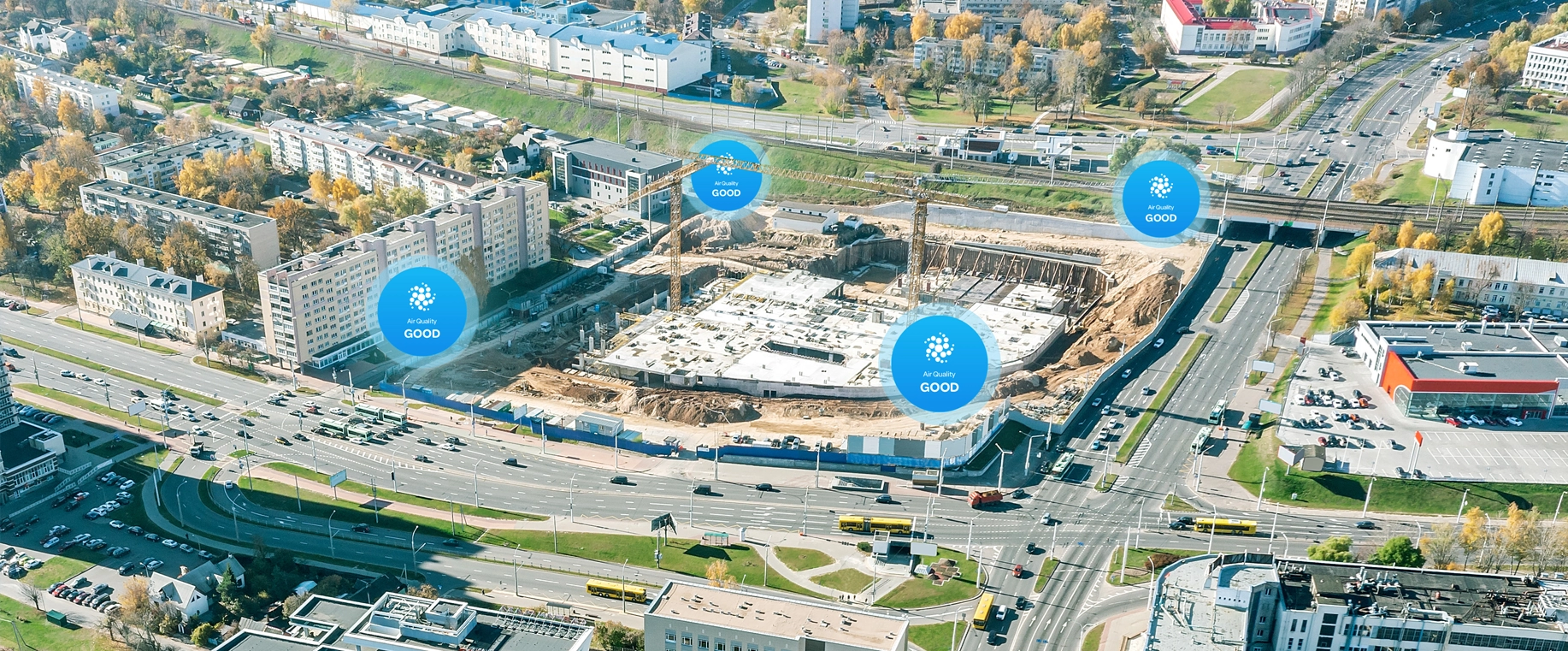
Perimeter monitoring, also called fenceline monitoring, measures air quality at the boundary of a site to see what is crossing it. For an operator, the fenceline is where permits, community agreements, and reputational questions all get settled, and where measured data either backs up a claim or leaves it hanging.
Through construction, the parameters that carry the most weight are coarse particulates (PM10) and total suspended particulates, the indicators tied to visible dust from earthwork and demolition. PM2.5 matters throughout, and it moves to the front once a facility runs, because diesel backup generators emit PM2.5 and nitrogen oxides during testing and operation. The reference points are the EPA's National Ambient Air Quality Standards (NAAQS) (opens in a new tab), which set ambient limits for PM10, PM2.5, and nitrogen dioxide that local permits and air districts frequently build on. It is worth keeping the scale honest, and honest means acknowledging it is contested. JLARC found data center generators contribute less than 4 percent of nitrogen oxide emissions in Northern Virginia, since they mostly run for testing. However, 2026 research from Virginia Commonwealth University (opens in a new tab) found generator emissions in parts of the region now rival power plant emissions, and DEQ has concluded the old assumption that generators run only rarely no longer holds. Either way, the permitting trend is toward proving the number with data rather than asserting it.
One more dataset belongs in the fenceline plan, and it is the only one that cannot be bought later: a baseline. A few months of measurement before ground is broken establishes what the air and sound around the site were like without the project. Once earthmoving starts, every dispute about dust, noise, or air quality turns into an argument about what was normal beforehand, and pre-construction data settles that argument in advance, for as long as the campus operates.
Wind is what gives a perimeter reading meaning. A PM10 spike at the eastern edge of a site says one thing when the wind is blowing from the site toward that monitor and something else entirely when the air is still or moving the other way. Measuring wind speed and direction next to the air data is what lets a reading be pinned to the site rather than to a passing truck, a neighboring field, or a nearby road, which is exactly the question a regulator or a resident will ask.
Noise belongs in the same deployment, and it is the harder one to pin down. Cooling systems and backup generators run continuously, and the complaint neighbors raise most is not a single loud event but a constant low-frequency hum. Local noise ordinances tend to set limits somewhere around 45 to 65 decibels and were written with ordinary noise in mind, so the steady low-frequency sound a data center produces can slip past them. Measuring sound continuously at the perimeter, next to the air data, gives a site and its neighbors a shared record to reason from.
The case for doing all of this continuously, rather than through the occasional survey, follows from how the conditions behave. They change hour to hour with weather, activity, and generator tests, so a quarterly snapshot rarely lands on the moment that matters, and a continuous record is the version that holds up when someone challenges it.
What to Monitor Across the Data Center Lifecycle
The parameters that matter shift as a project moves through its phases, but they shift within a set that one deployment covers, which is what makes monitoring a capital item rather than a construction expense. The same equipment reads differently at each phase; the reference points below are the ones commonly used to judge a value, not a complete statement of any site's obligations.
| Phase | What to monitor | What it tells you | Common reference point |
|---|---|---|---|
| Pre-construction baseline | PM10, PM2.5, sound, wind speed and direction | What the air and sound were like before the project, the comparison point every later dispute refers back to | No limit applies; this is the reference for everything after |
| Construction, off site | PM10 and TSP, PM2.5, sound, wind | Dust from earthwork and demolition, diesel exhaust, and whether either is crossing the boundary | NAAQS 24-hour PM10 of 150 µg/m³; 24-hour PM2.5 of 35 µg/m³ |
| Construction, on site | Respirable crystalline silica in the breathing zone | Worker exposure from concrete, stone, and sand work | OSHA PEL 50 µg/m³ (8-hour); action level 25 µg/m³ |
| Commissioning | Indoor particulates, temperature, relative humidity | Confirms the envelope is holding before IT load and warranty terms attach | ISO 14644-1 Class 8 |
| Operations, white space | Particulates, temperature, humidity, corrosive gases | Equipment life, corrosion risk, and whether warranty conditions are being met | ISO Class 8; ISA-71.04 severity level G1; RH below 60% |
| Operations, perimeter | PM2.5, nitrogen dioxide, sound, wind | Generator testing and runtime, continuous cooling noise, and the community record | NAAQS for PM2.5 and NO2; local noise ordinances, commonly 45 to 65 dB |
| Water, where the site touches it | Turbidity, TSS, dissolved oxygen, pH, conductivity | Sediment in stormwater during construction; cooling water discharge in operation | Site stormwater and discharge permit conditions |
Two things stand out. The same campus answers to several audiences at once, and they read different rows: equipment vendors and uptime teams read the white space, OSHA obligations attach to the breathing-zone samples, and regulators and neighbors read the fenceline record. And no row stands on its own. A particulate reading without wind, or a noise reading without a time stamp, invites the argument it was meant to end. The value is in one complete, continuous, time-stamped record.
How Aethair Supports Data Center Air Quality Monitoring
Aethair treats a data center as one monitoring problem with several zones rather than a separate box for each. Inside the facility, Aethair IAQ continuously measures particulates, temperature, humidity, and other indoor parameters in the white space and support areas, so a team sees in real time whether conditions are holding inside the ASHRAE envelope between corrosion assessments. At the boundary, Aethair PRO measures particulates (PM1, PM2.5, and PM10), temperature, pressure, humidity, light, and sound in one weather-resistant, solar-capable unit, with up to two gas sensors chosen for the site, such as nitrogen dioxide or sulfur dioxide. Aethair PRO also works indoors, which matters where a facility wants direct measurement of the corrosive gases named in the ASHRAE guidance. A unit configured with sulfur dioxide, nitrogen dioxide, or ozone sensors can run in the white space or support areas alongside Aethair IAQ, adding gas-level visibility between corrosion coupon assessments. And Thiamis brings third-party instruments, from a contractor's dust monitors to a meteorological station, into the same record. That reach extends past air: Thiamis also connects water quality sondes measuring parameters such as turbidity, total suspended solids, dissolved oxygen, pH, and conductivity, which matters on a campus with stormwater obligations during construction and cooling water discharge in operation.
Wind is the reason that weather station earns its place. A perimeter reading only means something when it is read against the wind, so wind data usually comes from a meteorological sensor integrated through Thiamis. A line of Aethair PRO units spaced along a boundary adds a second way to find a source: when a value climbs on one unit but not the others, the pattern across the fenceline points back toward where the dust or exhaust is coming from.
Every unit is independently 4G-connected, which matters more at a data center than almost anywhere else: perimeter monitoring should not depend on the site network of the facility it is monitoring, and construction-phase monitors need to work before the campus has any IT at all. All of it reports into Environet, where live and historical readings sit together and intelligent alerts flag a threshold crossing during a pour, a windy afternoon, or a generator test. For the documentation that permits, air districts, and community agreements ask for, Aethair Reports turns the record into clear reports on demand or on a schedule, and Noesis, Aethair's AI analysis tool, helps teams work through trends and exceedances in plain language. Aethair supplies the measurement and the documentation. The decisions about siting, controls, and compliance stay with the parties responsible for them.
The recommended configuration for this
Recommended
best match-

Industrial monitor for indoor and outdoor sites. Built-in sensors cover the essentials, and hot-swappable gas sensor cartridges and a differential-pressure option add more.
Built-inPM10PM2.5Total PM / Mass Conc.Equivalent Continuous Level (Leq)Gas 1

Aethair NO₂
Nitrogen Dioxide (NO₂)Four-electrode electrochemical sensing resolves NO₂ down to parts-per-billion, for roadside traffic,…
Also fits: Aethair O₃+NO₂
Gas 2
Free: one more gas sensor cartridge
MultiSense
Free: a MultiSense, stock or built to order
Expansion
Free: differential pressure
Also measures 9 more
Dew PointHeat IndexRelative HumidityIlluminance / LightParticle Count (by size)PM1Barometric PressureSound Pressure Level (SPL)Air Temperature
Not in this configuration 2
Wind SpeedWind Direction
Recommended
best match-
Industrial monitor for indoor and outdoor sites. Built-in sensors cover the essentials, and hot-swappable gas sensor cartridges and a differential-pressure option add more.
Built-inPM10PM2.5Total PM / Mass Conc.Equivalent Continuous Level (Leq)Gas 1
Aethair NO₂
Nitrogen Dioxide (NO₂)Four-electrode electrochemical sensing resolves NO₂ down to parts-per-billion, for roadside traffic,…
Also fits: Aethair O₃+NO₂
Gas 2
Free: one more gas sensor cartridge
MultiSense
Free: a MultiSense, stock or built to order
Expansion
Free: differential pressure
Also measures 9 more
Dew PointHeat IndexRelative HumidityIlluminance / LightParticle Count (by size)PM1Barometric PressureSound Pressure Level (SPL)Air Temperature -

Thiamis connects 1 instrument
A gateway that connects the third-party instruments you choose to the Aethair Platform.
-
 Wind DirectionWind Speed
R.M. Young ResponseONE weather instruments, with solid-state ultrasonic wind sensing and no moving parts.
Swap for
Also measures 3 more
Relative HumidityBarometric PressureAir Temperature -
Air Quality Monitoring for Data Center Sites, Inside and Out
See how Aethair IAQ, Aethair PRO, and Thiamis deliver continuous, calibrated data from the white space to the property line, and how Aethair Reports turns it into documentation operators, regulators, and equipment vendors can rely on.
Talk to Aethair About Data Center Monitoring (opens in a new tab)See Perimeter Monitoring Solutions →
Data Center Air Quality Monitoring: Frequently Asked Questions
What air quality standards apply inside a data center?
The reference points come from ASHRAE's technical committee for mission-critical facilities, TC 9.9. Its contamination guidelines recommend keeping the white space clean to ISO Class 8 under ISO 14644-1 and keeping corrosive gases within ISA-71.04 severity level G1, defined as copper corrosion below 300 angstroms per month and silver corrosion below 200 angstroms per month. ASHRAE also recommends holding relative humidity below 60 percent, because dust on circuit boards begins to promote corrosion once humidity climbs high enough for it to absorb moisture. Continuous temperature, humidity, and particulate monitoring is how a facility knows it is staying inside that envelope.
Does OSHA require silica monitoring on data center construction sites?
OSHA's respirable crystalline silica standard for construction, 29 CFR 1926.1153, applies to a data center build like any other construction project. It sets a permissible exposure limit of 50 micrograms per cubic meter of air as an 8-hour average, and an action level of 25 micrograms per cubic meter that triggers exposure assessment and medical surveillance obligations. Employers either follow the controls listed for each task in the standard's Table 1 or assess worker exposures directly. Silica is a worker exposure, sampled in a person's breathing zone, which is a separate question from the dust measured at the perimeter.
What is data center perimeter air quality monitoring?
Perimeter monitoring, also called fenceline monitoring, places continuous air quality monitors along the boundary of a site to measure what is leaving it. For a data center that usually means PM10 and PM2.5, gases such as nitrogen dioxide, and the wind conditions that determine whether a reading came from the site or from a road, a farm, or a neighbor. The result is a continuous, time-stamped record that supports permits, local air rules, and community reporting.
Are there requirements for data center backup generators?
Generally, yes. Backup generators are stationary emission sources, so depending on their size they need air permits from state or local agencies and must meet EPA engine emissions standards, usually as emergency units expected to run only for testing and outages. The specifics vary by jurisdiction, and states with large data center markets have begun tightening their rules.
What are Virginia's requirements for data center backup generators?
Virginia's Department of Environmental Quality revised its permitting guidance for data center generators: for permit applications submitted on or after July 1, 2026, new generators must meet emissions limits at least as stringent as EPA Tier 4 standards, which in practice points large units toward selective catalytic reduction and diesel particulate filters. Because Northern Virginia is the largest data center market in the world, its permitting decisions tend to preview what operators elsewhere will face.
Do building management system sensors already cover data center air quality?
Usually only part of it. Most facilities track temperature and humidity through the building management system, but those readings are tuned for control rather than documentation. They generally do not include particulate counts or corrosive gas measurement, and they rarely carry the calibration documentation that makes a record usable in a warranty discussion or a permit review. Aethair IAQ adds the parameters ASHRAE contamination guidance is written around, and Thiamis can bring the sensors already installed into the same record rather than replacing them.
Can air quality monitors also measure noise from a data center?
Some can. Aethair PRO carries a sound sensor alongside its particulate, gas, and environmental sensors, so a single unit at the perimeter records air quality and noise together, which matters at a facility where cooling and generators run around the clock. Standard sound measurement does not fully capture the low-frequency hum residents tend to report, so noise data reads best as one signal in a wider monitoring picture.