
Most environmental compliance programs have a data problem, but not the one you might expect. The issue is rarely a shortage of data. Modern monitoring systems generate continuous streams of sensor readings, alert logs, and system events. The challenge is converting that volume of raw information into documentation that satisfies a regulator, holds up in an audit, and can be produced quickly when it is needed.
EHS compliance reporting is the process of closing that gap. Done well, it transforms environmental data from a passive archive into an active compliance asset. Done poorly, or not at all, it leaves organizations exposed at precisely the moment defensible documentation matters most.
What Changed for EHS Reporting in 2026
Compliance reporting requirements are not static, and three regulatory developments are changing what EHS teams need to document this year.
OSHA electronic injury and illness submissions. The submission window for 2025 data opened January 2 and closed March 2, 2026 through OSHA's Injury Tracking Application. Establishments with 250 or more employees, and those with 20 to 249 employees in designated industries, must submit Form 300A summary data, while establishments with 100 or more employees in high-hazard industries must also submit detailed Form 300 and 301 data. Exposure-related illness entries in those submissions are only as defensible as the monitoring record behind them.
EPA HON fenceline monitoring expansion. The 2024 Hazardous Organic NESHAP extended fenceline monitoring beyond refineries to synthetic organic chemical and polymer facilities, with fenceline monitoring required at existing sources from July 15, 2026 and corrective action from July 15, 2027. Affected facilities are now producing an entirely new class of fenceline data with its own documentation obligations.
The tighter PM2.5 NAAQS moves toward implementation. The primary annual PM2.5 standard was lowered from 12.0 to 9.0 µg/m³ in 2024, and attainment designations, state implementation plans, and litigation over the revised standard are all working through the system in 2026. Organizations that benchmark internal reporting against the NAAQS should already be reporting against the 9.0 µg/m³ annual standard.
The Gap Between Data Collection and Compliance Documentation
Environmental monitoring generates data. Compliance requires documentation. These are not the same thing.
Raw sensor readings, time-stamped concentrations, device status logs, and threshold crossings are the inputs to compliance documentation. But a spreadsheet of PM2.5 readings does not, by itself, demonstrate regulatory compliance. A regulator or auditor reviewing your program wants to see something more specific: which standard was being monitored against, what the applicable threshold was, whether that threshold was exceeded, when the exceedance occurred, and what action was taken in response. They want to see a chain of custody from instrument to conclusion.
This is what makes environmental data defensible. Not volume, not visual dashboards, but traceable methodology: the ability to demonstrate that data was collected with calibrated instruments, processed according to documented logic, compared against identified regulatory thresholds, and acted upon in a timely and documented manner.
Organizations that treat data collection and compliance documentation as the same function consistently find gaps when documentation is requested. The data exists but is not organized in the format a regulator expects. Reports have to be assembled manually, under time pressure, from multiple disconnected systems. The process introduces errors and creates inconsistencies that erode credibility.
What Makes Environmental Data Defensible
Defensible environmental data documentation has four characteristics.
Instrument traceability. Data must be traceable to specific instruments with documented calibration histories. If a reading is questioned, you must be able to demonstrate that the sensor producing it was operating within spec at the time. This requires calibration records, sensor maintenance logs, and device identification tied to each data record.
Methodology transparency. The calculations applied to raw data, including averaging periods, unit conversions, and threshold comparisons, must be documented and reproducible. A compliance report that shows a result without documenting the underlying data, time period, and applied threshold is far less defensible than one that makes all three explicit.
Regulatory alignment. Documentation should explicitly identify which regulatory standard each monitored parameter is being evaluated against, and what the applicable limit is. OSHA PELs, NAAQS standards, WELL thresholds, and state-level requirements differ in both value and averaging period. A report that does not specify which standard applies to a given measurement leaves ambiguity that regulators will not resolve in your favor.
Documented response. Compliance documentation is not just about measurement. It is about demonstrating that your program responded appropriately when conditions warranted it. Alert logs, response records, and corrective action documentation are all part of a defensible compliance record.
Common EHS Compliance Reporting Requirements

Environmental compliance reporting requirements vary significantly by industry, facility type, and jurisdiction. The following frameworks represent the most common drivers for EHS compliance documentation programs. Understanding which frameworks apply to your organization is the first step toward building a reporting program that satisfies regulators and holds up under audit. In most cases, multiple frameworks apply simultaneously, and the most defensible programs are designed to meet all of them from a single, integrated data source.
OSHA Recordkeeping and Exposure Documentation: OSHA requires employers to assess and document employee exposures to regulated substances and physical agents where applicable standards require monitoring or where exposure must be evaluated to demonstrate compliance. For air quality, this includes maintaining records of exposure measurements, sampling methodology, and results for the duration of employment plus 30 years (per 29 CFR 1910.1020). Exposure assessments that rely on continuous monitoring data must demonstrate that the monitoring approach was appropriate for the substance and exposure scenario.
EPA Reporting Requirements: Facilities subject to EPA air quality regulations, including Title V major sources, facilities covered by NESHAP or NSPS standards, and sites operating under state implementation plans, have formal emissions reporting requirements with specific monitoring, record-keeping, and reporting intervals. For facilities subject to continuous emissions monitoring systems (CEMS), data management, validation, and reporting requirements are particularly demanding.
State and Local Air District Requirements: Many states and local air quality management districts impose requirements beyond federal minimums, including fence-line monitoring for industrial facilities, community notification thresholds, and expedited reporting for exceedances. These requirements are highly variable and should be reviewed against each facility's permit conditions.
ESG and Voluntary Disclosure Frameworks: Organizations reporting under GRI, SASB, TCFD, or CDP environmental frameworks face increasing expectations for quantified, auditable environmental data. While these are not regulatory requirements in most jurisdictions, they function as widely adopted reporting expectations for publicly traded companies, government contractors, and organizations with investor or customer ESG commitments.
Building a Repeatable Compliance Reporting Workflow
The organizations that manage EHS compliance reporting most effectively share a common characteristic: they treat it as a process, not a project. Compliance reports should not require a manual assembly effort each time they are needed. The underlying workflow, from data collection and processing through threshold comparison and report generation, should be repeatable, documented, and largely automated.
A well-designed compliance reporting workflow has five components.
1. Defined monitoring parameters and standards. Before any data is collected, the program should specify which parameters are being monitored, which instruments are measuring them, which regulatory standards apply, and what the action levels are. This forms the basis of every report the program will produce.
2. Continuous, calibrated data collection. Monitoring instruments should operate continuously in environments where ongoing compliance demonstration is required. Periodic spot checks are appropriate for formal exposure assessments but are insufficient as the primary basis for compliance documentation in regulated environments.
3. Automated threshold comparison and alerting. When data crosses a defined threshold, the program should generate an alert automatically, not rely on manual review. Documented alert records become part of the compliance record and demonstrate that the program was functioning as designed.
4. Structured report generation. Reports should be generated from the same data set used for operational monitoring, with consistent methodology, regulatory citations, and time-period definitions. Reports assembled manually from exports are prone to errors and version-control problems.
5. Documented response and corrective action. The program should include a process for documenting responses to threshold exceedances: what happened, when, what was done, and by whom. This closes the loop on each compliance event and creates an audit trail that supports regulatory defense.
The Role of Automation and AI in EHS Compliance Reporting
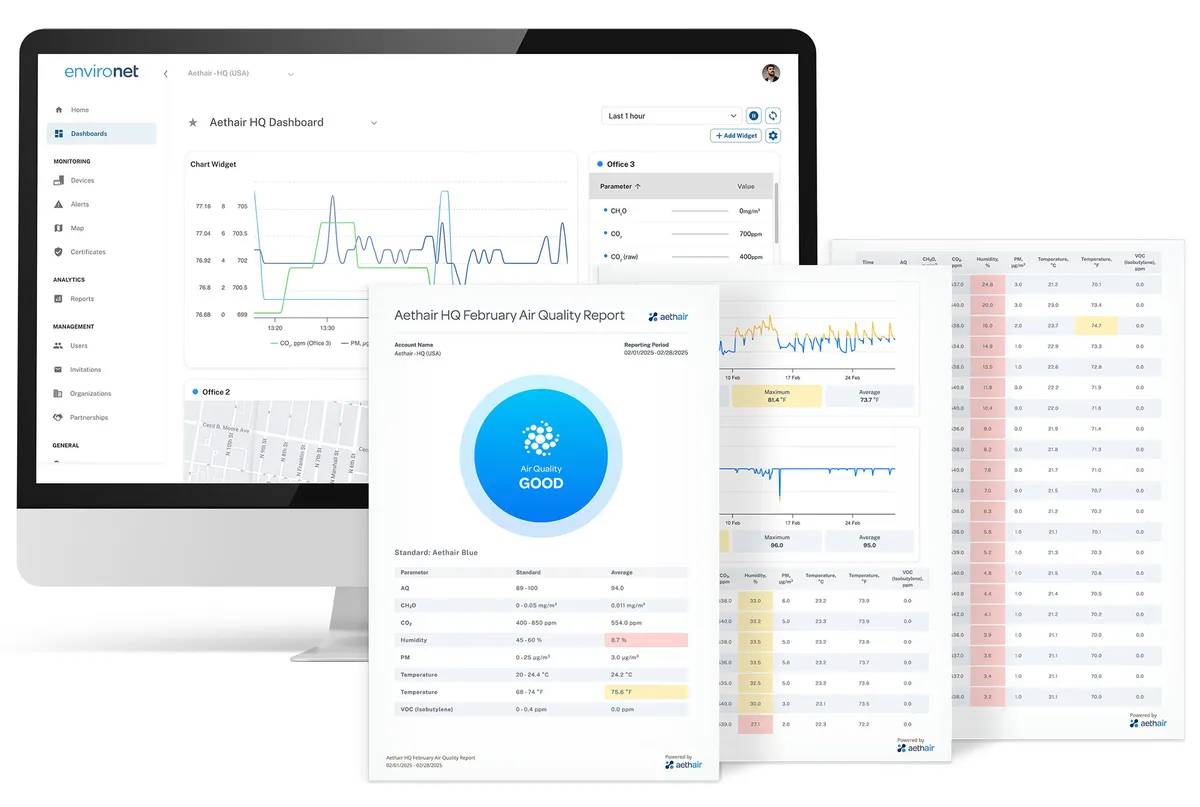
Manual compliance reporting is labor-intensive, error-prone, and slow. An EHS manager responsible for multiple facilities and dozens of regulated parameters cannot realistically maintain a defensible compliance record through manual data processing alone.
Automation addresses this in two ways. Platform-level automation handles the mechanical tasks: aggregating data from multiple devices, applying defined calculation methodologies, comparing results against stored regulatory thresholds, and producing formatted reports on a defined schedule. This removes the manual processing burden and ensures that reports are produced consistently, regardless of staff availability.
AI-assisted analysis adds a second layer. Rather than simply automating existing workflows, AI tools like Noesis can surface patterns in environmental data that manual review would miss, such as trends that may precede threshold exceedances or anomalies that suggest instrument issues, and generate plain-language summaries of complex data sets. This moves compliance reporting from a reactive documentation exercise to a proactive risk management function.
How Aethair Reports and Noesis Support Defensible Compliance Outputs
Aethair Reports automates air quality and environmental reporting, and Noesis adds AI-assisted analysis. Both are built for EHS teams that need to move from raw environmental data to audit-ready compliance documentation without manual processing.
Aethair Reports connects directly to data collected by Aethair IAQ, Aethair PRO, and third-party sensors integrated through Thiamis. Reports are generated with full methodology transparency, showing the raw data, the applied thresholds, the regulatory standards referenced, and the time periods covered. They can be configured to align with OSHA, NAAQS, WELL, EPA, and other applicable standards, and can be scheduled for automatic delivery to EHS managers, compliance officers, or external auditors.
This short Noesis demo, posted on LinkedIn (opens in a new tab), is just one example of how Noesis can speed up and optimize compliance workflows. Noesis allows EHS teams to query their environmental data in plain language, asking questions like "Did PM2.5 exceed the NAAQS 24-hour standard at any point last month?" and receiving structured, sourced responses rather than raw data exports. For teams managing large data volumes or multi-facility environments, this capability reduces the time required to produce compliance summaries from hours to seconds.
Generate Compliance Reports in Seconds
Aethair Reports and Noesis connect your environmental data to structured, audit-ready compliance outputs without manual processing. See how it works.
Schedule a call (opens in a new tab)Explore Aethair Reports →
EHS Compliance Reporting: FAQs
What makes environmental data defensible in an audit?
Four things, and volume is not one of them. Instrument traceability means every reading ties to a specific device with a documented calibration history, so a questioned value can be shown to have come from a sensor operating within spec. Methodology transparency means the averaging periods, unit conversions, and threshold comparisons applied to raw data are documented and reproducible. Regulatory alignment means each monitored parameter names the standard it is evaluated against and that standard's limit, since OSHA PELs, NAAQS, WELL, and state requirements differ in both value and averaging period. Documented response means alert logs and corrective action records show the program acted when conditions warranted it.
Is monitoring data the same as compliance documentation?
No, and treating them as the same is where most programs find gaps. Monitoring produces raw readings, time-stamped concentrations, device status logs, and threshold crossings. A spreadsheet of PM2.5 values does not by itself demonstrate compliance. An auditor wants to see which standard was being monitored against, what the applicable threshold was, whether it was exceeded, when, and what action followed, with a traceable chain from instrument to conclusion. Organizations that conflate the two end up assembling reports manually under time pressure from disconnected systems, which introduces errors that erode credibility.
What changed for EHS reporting in 2026?
Three developments. OSHA's electronic injury and illness submission window for 2025 data ran from January 2 to March 2, 2026 through the Injury Tracking Application, and exposure-related illness entries are only as defensible as the monitoring record behind them. The 2024 Hazardous Organic NESHAP extended fenceline monitoring beyond refineries to synthetic organic chemical and polymer facilities, with fenceline monitoring required at existing sources from July 15, 2026 and corrective action from July 15, 2027. And the primary annual PM2.5 NAAQS, lowered from 12.0 to 9.0 micrograms per cubic meter in 2024, is working through attainment designations and state implementation plans.
What is the current annual PM2.5 NAAQS?
9.0 micrograms per cubic meter, lowered from 12.0 in 2024. Attainment designations, state implementation plans, and litigation over the revised standard are all still working through the system, but organizations that benchmark internal reporting against the NAAQS should already be reporting against 9.0 rather than the older figure.
How long do OSHA exposure records have to be kept?
For the duration of employment plus 30 years, under 29 CFR 1910.1020. That covers exposure measurements, sampling methodology, and results. Exposure assessments built on continuous monitoring data also have to demonstrate that the monitoring approach was appropriate for the substance and the exposure scenario, which is a separate question from how long the record is retained.
Which frameworks drive EHS compliance reporting requirements?
Usually several at once. OSHA recordkeeping and exposure documentation applies where a standard requires monitoring or where exposure must be evaluated. EPA reporting covers Title V major sources, NESHAP and NSPS facilities, and sites under state implementation plans, with particularly demanding requirements where continuous emissions monitoring systems are involved. State and local air districts add requirements beyond federal minimums, including fenceline monitoring and community notification thresholds that vary by permit. ESG frameworks such as GRI, SASB, TCFD, and CDP are not regulatory in most jurisdictions but function as reporting expectations for public companies and government contractors. The most defensible programs are designed to satisfy all of the applicable ones from a single integrated data source.