
Fenceline air quality monitoring measures the dust and gases that cross the boundary of a construction site, remediation project, quarry, or industrial facility. Its job is to catch what leaves the site in real time and produce records that hold up with regulators and neighbors. There are several ways to equip for it, and the right one depends on the site, the pollutants involved, and how the data has to be reported.
No single tool is right for every boundary. Standalone monitoring stations, instrument kits assembled in pelican cases, and connected sensor networks each have a place, and each carries tradeoffs that show up once a site needs coverage at multiple points and documentation that stands up later. This article compares those approaches, what each does well, where each runs into limits, and what changes when every monitor is independently connected and backed by a platform.
Quick answer
Fenceline air quality monitoring is usually equipped one of three ways: a standalone near-reference station at a fixed point (such as the Aeroqual AQS 1), an instrument kit assembled in a pelican case (a dust monitor like a TSI DustTrak paired with gas detectors and a logger), or a network of small, individually connected monitors reporting to one platform (the approach Aethair PRO takes). Each fits a different site, budget, and reporting need. A connected network adds 4G LTE in every unit, so coverage does not depend on site WiFi or a shared gateway, along with calibration certificates and the platform tools that turn readings into audit-ready records.
How Fenceline Air Quality Monitoring Is Done Today
Three approaches show up most often on a site boundary.
Standalone near-reference stations. A single, well-built monitor placed at a fixed point, made by vendors such as Aeroqual, Vaisala, and Met One. Systems in this class typically ship with factory calibration and offer near-reference performance. The Aeroqual AQS 1 is one widely used example. It carries NIST-traceable factory calibration and measures PM1, PM2.5, PM4, PM10, and TSP along with up to three gases at a time (from a set that includes ozone, NO₂, CO, SO₂, hydrogen sulfide, methane, and VOCs). It uses a heated inlet to condition the sample against humidity, connects over WiFi and Ethernet with optional cellular, and can integrate meteorological sensors and report against ambient rules such as South Coast AQMD Rule 1466. Others in the category vary in the details, but the shape is the same: a dependable station for a fixed point.
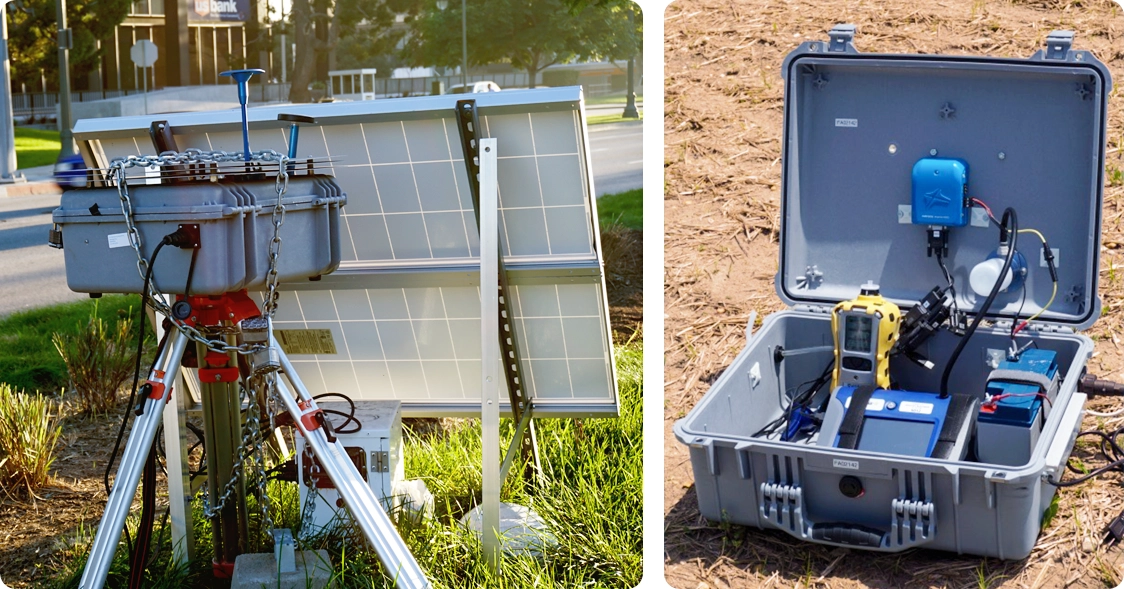
Instrument kits in pelican cases. A kit assembled by the team: a dust monitor such as a TSI DustTrak, one or more gas detectors, sometimes a weather station and a separate data logger, packed into a rugged case. This approach is flexible and uses instruments people already trust, which is a real advantage. The tradeoff is that the pieces are often disconnected, with data pulled off by hand and no shared platform tying them together. Adding a gateway such as Thiamis to the kit solves this by bringing the instruments' data into Environet so it all lands in one place.
Connected sensor networks. Small, individually connected monitors placed at several points and reporting to one platform, which is the approach Aethair PRO takes. Because each unit reports on its own, a whole boundary of monitors shows up together in Environet, where the same data feeds tools like Aethair Reports and Noesis AI analysis, with no separate feeds to stitch together by hand. Low-cost community sensors such as PurpleAir also fall in this category, though they are built for particulate awareness rather than the gas measurement and documentation most industrial fencelines require.
Where Some Approaches Run Into Limits
None of these are bad ways to monitor, but some of them can run into the same handful of limits when a site needs connected coverage across a whole boundary with records that hold up.
Cost limits how many points you can afford. Near-reference standalone stations are a significant investment, often running into the tens of thousands per fully configured unit. That usually means one monitor at the gate rather than several around the boundary, so the spatial picture is thin.
Connectivity is often tied to site infrastructure. Systems that depend on site WiFi or Ethernet, or on a shared gateway or hub, tie monitoring to that infrastructure. If the network or gateway goes down, the data goes with it, and a remote fenceline may have no coverage to join in the first place. Cellular is frequently an optional add-on rather than standard. Some networks go further and route every sensor through a single hub or base station over a short-range link such as WiFi, Zigbee, or LoRa, with only the hub carrying the uplink. That keeps the per-sensor cost down, but it concentrates the risk in one device: if the hub loses power or its connection, every sensor behind it can go quiet at once.
Data can end up disconnected. A pelican-case kit, in particular, often lacks a single platform, so readings live in separate tools, alerting is manual, and turning the data into a report is a job someone does by hand.
Off-grid power adds components. Running a mains-powered station without grid power means a separate solar power system, with panels, a charge controller, and batteries sized for the load.
These are limits of an approach, not knocks on any one product. A fixed near-reference station is exactly right for some programs; it is just a different tool than a distributed, connected one.
How a Connected Platform Changes Fenceline Monitoring
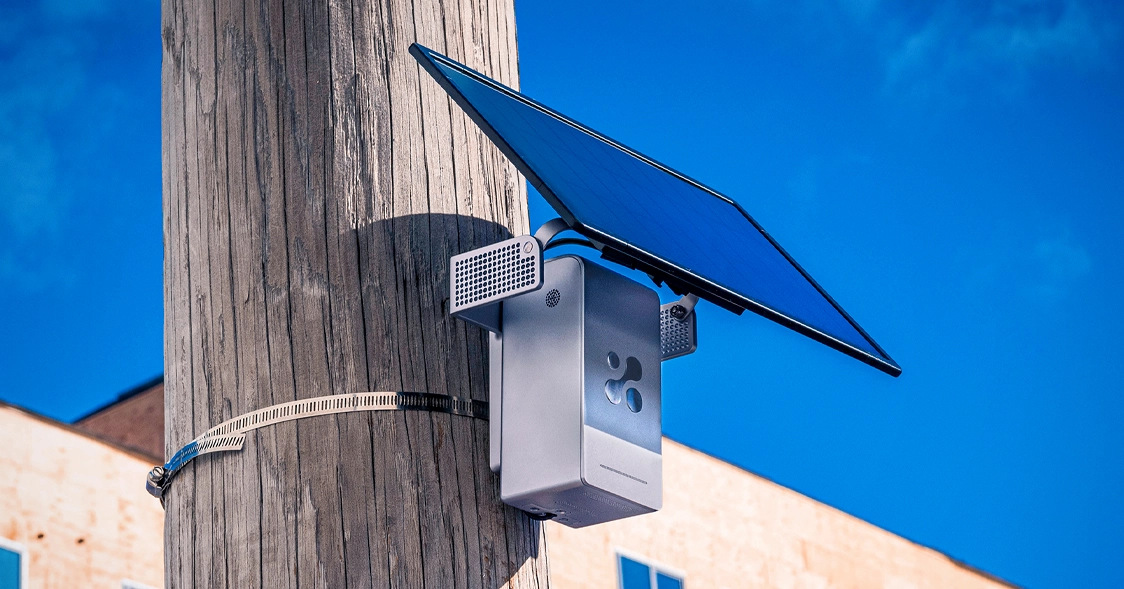
Aethair PRO approaches the boundary from the other direction: start with small, independently connected monitors, and back them with a platform.
Every unit connects on its own. 4G LTE is built into every Aethair PRO, so you power one on and it reports, with no site network to join and no shared gateway to stand up, which also means no single point of failure that can take a whole site offline.
Small size makes real boundary coverage affordable. An Aethair PRO is compact and light enough to mount almost anywhere and inexpensive enough to ship in numbers, so a perimeter can carry several units around the boundary instead of one at the gate, with units added or relocated as the site changes. A ring of monitors measures conditions directly at each point, which complements what a single station with wind speed and direction can tell you about where pollutants are heading.
You choose the configuration, and keep the gear you trust. Aethair PRO takes two hot-swappable, pre-calibrated gas sensor cartridges selected from a lineup that includes Carbon Dioxide (CO₂), Carbon Monoxide (CO), Nitric Oxide (NO), Nitrogen Dioxide (NO₂), Sulfur Dioxide (SO₂), Ozone (O₃), Methane (CH₄), and VOC (Total), with formaldehyde (CH₂O) through the MultiSense cartridge in its MultiSense socket, and they can be changed in the field. Where a site already runs instruments, such as a DustTrak or MiniRAE in a pelican case, Thiamis brings them onto the same platform, so nothing has to be ripped out at once. The customer chooses what fits on cost, functionality, and how the program needs to work.
Aethair devices include calibration certificates. A standalone station like the AQS 1 still has real strengths for a fixed ambient program, including its heated inlet, the PM4 respirable fraction, and near-reference ambient performance.
The Platform Behind Connected Monitoring
A monitor is only as useful as what happens to its data, and for many teams the platform is the reason to go connected. Environet is that platform, and Noesis and Aethair Reports are tools that work on top of it.
Environet is where the data lives. Live and historic readings from every unit come together in one place, with configurable dashboards, a map view of the site, and optional public-facing displays for community or tenant transparency, whether you run one monitor or a network around a large site. Its alerting watches readings against the thresholds you set and goes beyond a single instantaneous limit. Using custom statistical parameters computed over a time window, a rule can flag a sustained exceedance rather than a momentary spike, or combine parameters with a function. Alerts reach the right people by email, SMS, or webhook as soon as they trigger.
Noesis is the AI layer on the same data. Instead of exporting to a spreadsheet and building a query, a team can ask questions in plain language, for example how PM10 trended along a fenceline last week, and get an answer with the trend behind it. Noesis can also act on that data: it generates a formatted PDF report from a natural-language request in seconds, and it can set up an Environet alert from a plain-language prompt, so both the analysis and the follow-up happen without building anything by hand.
Aethair Reports turns the record into finished documentation, on demand or on a schedule, with transparent data lineage back to each reading, including a dedicated perimeter monitoring report for boundary programs.
The recommended configuration for this
Recommended
best match-

Industrial monitor for indoor and outdoor sites. Built-in sensors cover the essentials, and hot-swappable gas sensor cartridges and a differential-pressure option add more.
Built-inPM10PM2.5Gas 1
Free: one more gas sensor cartridge
Gas 2
Free: one more gas sensor cartridge
MultiSense
Free: a MultiSense, stock or built to order
Expansion
Free: differential pressure
Also measures 11 more
Dew PointHeat IndexRelative HumidityIlluminance / LightParticle Count (by size)PM1Total PM / Mass Conc.Barometric PressureEquivalent Continuous Level (Leq)Sound Pressure Level (SPL)Air Temperature
Build a Fenceline Program That Holds Up
Talk with an Aethair specialist about your boundary, the gases and particulate you need to measure, and the records you have to produce. We will map it to the right setup across Aethair PRO, Thiamis, and Environet.
Schedule a Demo (opens in a new tab)Compare Aethair Devices →
Choosing What Fits
Regulation is also expanding who needs this equipment. The EPA's 2024 HON rule extended fenceline monitoring beyond refineries to synthetic organic chemical and polymer facilities. Existing sources must begin fenceline monitoring by July 15, 2026 (chloroprene at neoprene plants from October 15, 2024), and corrective action applies from July 15, 2027. Facilities named in the 2025 and 2026 presidential exemptions have two more years. The compliance method under the rule is passive sampling with laboratory analysis, so continuous monitors do not replace it; their role is early warning and operational context between sampling periods.
The right answer depends on the site. A fixed, single-point program where near-reference performance, a PM4 respirable fraction, or a heated inlet is the priority is well served by a standalone station. A program that needs coverage at several points, deploys on remote or changing sites, or has to produce connected, defensible reports is where a connected network like Aethair PRO fits, and where existing instruments can come along through Thiamis. Many sites land on a mix, and the decision comes down to cost, functionality, and fit, which is the customer's call to make.
Approaches at a Glance
| Standalone station | Pelican-case / DIY kit | Connected network (Aethair) | |
|---|---|---|---|
| Typical use | Fixed, single-point ambient and fenceline | Flexible, team-assembled coverage | Distributed, multi-point coverage |
| Connectivity | Varies by station: sometimes retrieved by hand, often WiFi or wired Ethernet, cellular sometimes available as an upgrade | Often retrieved by hand; going live needs a gateway such as Thiamis | 4G LTE in every unit |
| Multi-point scaling | Cost and size limit density | Assembled kit by kit | Small, low-cost units, add or relocate freely |
| Third-party integration | Usually limited, if any; sometimes analog inputs or vendor-designated external sensors | Whatever you assemble | Open, via Thiamis |
| Calibration | NIST-traceable factory calibration | Depends on the instruments | Calibration certificates |
| Documentation and reporting | Vendor cloud and report templates | Often manual, no shared platform unless paired with Thiamis | Live data in Environet, Noesis AI, automated Aethair Reports |
Fenceline Air Quality Monitoring: FAQs
What equipment is used for fenceline air quality monitoring?
Three approaches are common. Standalone near-reference stations, such as the Aeroqual AQS 1, provide accurate fixed-point measurement. Instrument kits assembled in pelican cases pair a dust monitor like a TSI DustTrak with gas detectors and a data logger. Connected sensor networks use small monitors with their own cellular connections, such as Aethair PRO, placed at multiple points around a boundary and reporting to one platform. The right choice depends on the site, the pollutants involved, and how the data has to be reported.
How many monitors do I need around a site perimeter?
It depends on the size and shape of the boundary and where sensitive receptors are. A single station can watch one critical point, but conditions vary around a site, so many programs place several monitors around the perimeter to see where dust or gas is actually crossing the line. Small, connected monitors make that practical because each unit is inexpensive and reports on its own. Our perimeter air quality monitoring article covers boundary layout and program design in more detail.
Is the Aethair PRO a good alternative to a standalone system like the Aeroqual AQS 1?
For distributed, connected, and report-driven programs, yes. Aethair PRO covers fenceline work in a small, fully connected package, with a configurable gas-sensor setup and a platform that generates documentation. A standalone system like the AQS 1 remains an excellent choice for a fixed, single-point ambient program, especially where a PM4 respirable fraction, a heated inlet, or near-reference ambient performance is the priority. They suit different deployment styles.
Can I keep the DustTrak or instruments I already own?
Yes. Thiamis connects third-party instruments, including a TSI DustTrak, gas detectors, and weather stations, into the Aethair platform, so their data appears in Environet alongside Aethair PRO. Many sites unify the equipment they already have through Thiamis first, then add connected units where continuous coverage helps most.
Which approach works for remote or off-grid fencelines?
A monitor with built-in cellular is the simplest option for a remote boundary. Every Aethair PRO has 4G LTE built in and can run on solar power with the optional Solar Panel Bracket, so it reports from sites with no wired network or WiFi. Standalone stations typically connect over WiFi or Ethernet with cellular as an add-on, and off-grid power is provided by a separate solar power system sized for the load.
Can low-cost community sensors like PurpleAir cover a fenceline?
They can play a part. Low-cost particulate sensors are inexpensive enough to deploy densely and are widely used for community-facing PM awareness, and that visibility has real value around a site. Most industrial and construction fenceline programs also need gas measurement, documented calibration, and audit-ready reporting, which is where field-grade connected monitors or standalone stations come in. Some programs pair the two: dense particulate awareness for the community, with calibrated, connected monitors at the points where the record has to hold up.