
Few built environments have air quality requirements as demanding as a healthcare facility. A single hospital can contain operating rooms held at positive pressure, isolation rooms held at negative pressure, pharmacy cleanrooms compounding sterile and hazardous drugs, and laboratories where small shifts in air chemistry affect clinical outcomes. Healthcare air quality monitoring is how facilities confirm that each of these spaces is holding the conditions its function requires, and how they document that performance over time.
What makes this difficult is that the requirements are not uniform. A surgical suite, a negative-pressure isolation room, and a sterile compounding pharmacy each answer to different standards, hold different pressure relationships, and depend on different parameters, and any of them can drift out of range without an obvious sign. Meeting those requirements depends on knowing what each space needs, holding those conditions continuously, and keeping a record that proves they held.
Quick answer
Healthcare air quality monitoring is the continuous measurement of conditions in clinical spaces, including differential pressure, temperature, relative humidity, particulate matter, carbon dioxide, and volatile organic compounds. Requirements differ by room: operating rooms run positive pressure at high air change rates, airborne infection isolation rooms run negative pressure, and pharmacy cleanrooms must hold specific ISO particulate classes. Continuous monitoring confirms these conditions around the clock and creates the time-stamped record that spot checks cannot. Aethair monitors stream data into the Environet platform, and Aethair Reports turns it into clear, time-stamped documentation. See Aethair's healthcare monitoring solutions to learn more about how Aethair solutions can be applied in healthcare facilities and hospitals.
Hospital Indoor Air Quality Monitoring
Hospital air quality monitoring spans a wider range of spaces than almost any other building type, from operating rooms and airborne infection isolation wards to sterile compounding pharmacies, diagnostic laboratories, and general patient areas. Each of these spaces answers to its own standard, so an effective indoor air quality monitor for healthcare facilities has to track the right parameters in the right place and hold a continuous, time-stamped record for infection control, accreditation, and audit.
Aethair supports hospital air quality monitoring across all of these environments from a single platform: calibrated monitors stream real-time data into Environet, and Aethair Reports turns that data into date-stamped, defensible documentation aligned with the standard each space is held to.
What Healthcare Air Quality Monitoring Measures
Air quality in a clinical setting is not a single number. It is a set of related conditions, and the ones that matter depend on what happens in the room.
One of the most important parameters across healthcare is differential pressure, the pressure difference between a room and the spaces around it. Pressure relationships are what keep contaminated air contained in an isolation room or push clean air outward in a surgical suite, and they can reverse without anyone noticing if they are not watched continuously.
Temperature and relative humidity (RH) come next. Both affect patient comfort, infection control, and the integrity of stored materials and medications. Humidity that drifts too high encourages microbial growth, while humidity that drifts too low raises static and infection risk, which is why CDC environmental infection control guidance (opens in a new tab) and ASHRAE 170 both bound temperature and humidity in critical spaces.
Particulate matter (PM), measured by particle size or by ISO cleanliness class, indicates how effectively filtration and air changes are removing airborne particles. Carbon dioxide (CO2) is a practical proxy for ventilation adequacy in occupied general spaces. Volatile organic compounds (VOCs) are airborne chemical contaminants released by building materials, cleaning agents, and equipment. They are a secondary concern in most rooms but a primary one in IVF and embryology labs, where elevated VOC levels are associated with reduced fertilization, impaired embryo development, and lower pregnancy rates.
Air Quality Requirements by Healthcare Space
These conditions are not only design targets. Under The Joint Commission's environment-of-care standard EC.02.05.01 (opens in a new tab), ventilation systems in critical areas such as operating rooms, isolation rooms, and protective environments must provide appropriate pressure relationships, air change rates, filtration, temperature, and humidity. Its ventilation element of performance is among the most frequently cited for non-compliance (opens in a new tab), with more than a third of hospitals cited in 2022. DNV applies comparable expectations, and both accreditors reference the design requirements in ANSI/ASHRAE/ASHE Standard 170 (opens in a new tab). Standard 170 is incorporated into the FGI Guidelines for Design and Construction of Hospitals (opens in a new tab), which most U.S. states adopt or reference for healthcare construction. In practice, surveyors look for documented evidence that conditions held over time, which makes recorded history, not just real-time performance, part of what a facility has to be able to show. Retained trend data, alert logs that show deviations were caught and addressed, and sensor calibration records are what produce that evidence.
The table below summarizes the conditions commonly designed for in key clinical spaces. Exact values depend on the facility, the room's classification, and the edition of the standard in force, so treat these as the parameters to monitor rather than as facility-specific targets.
| Space | Pressure relationship | Minimum total air changes per hour | Temperature | Relative humidity | Primary parameters to monitor |
|---|---|---|---|---|---|
| Operating room / surgical suite | Positive (at least 0.01 in. w.g.) | 20 (at least 4 outdoor) | 68 to 75°F | 20 to 60% | Differential pressure, temperature, humidity, particulates |
| Airborne infection isolation room | Negative (at least 0.01 in. w.g.) | 12 new, 6 existing | Per design | Up to 60% | Differential pressure (continuous), temperature, humidity |
| Protective environment room | Positive (at least 0.01 in. w.g.) | 12 | Per design | Up to 60% | Differential pressure, particulates, temperature, humidity |
| Pharmacy cleanroom, sterile (USP 797) | Positive | 30 or more (ISO Class 7 buffer) | Per design | Up to 60% | Particulates (ISO class), differential pressure, temperature, humidity |
| Pharmacy cleanroom, hazardous (USP 800) | Negative (0.01 to 0.03 in. w.g.) | 12 or more, externally vented | Per design | Up to 60% | Differential pressure (negative), particulates, temperature, humidity |
| IVF / embryology laboratory | Positive (typical) | High-filtration design | Controlled | Controlled | Total VOCs, particulates, CO2, temperature, humidity |
Operating Rooms and Surgical Suites
Operating rooms are held at positive pressure relative to adjoining spaces so that air flows out of the room rather than into it. ANSI/ASHRAE/ASHE Standard 170 (opens in a new tab) specifies a minimum of 20 total air changes per hour (ACH), at least four of which must be outdoor air, along with staged filtration on the supply air. Temperature is typically maintained between 68 and 75 degrees Fahrenheit and relative humidity between 20 and 60 percent.
Because a share of that air is drawn from outside, the quality of the incoming outdoor air and the performance of the filtration that conditions it both affect what reaches the sterile field. Monitoring inside the room confirms the result; monitoring the intake or nearby outdoor air helps explain a particulate or gas excursion when one appears. This is where a more capable monitor is useful. Aethair PRO measures particulates and a configurable set of gases, and can be placed at the air intake or outdoors to complement the room's filtration and pressure controls. Continuous logging of pressure, temperature, and humidity remains the practical baseline for surgical suite monitoring.
Isolation and Protective Environment Rooms
These two room types are easy to confuse, and they function in opposite directions. Both are addressed in the CDC's Guidelines for Environmental Infection Control in Health-Care Facilities (opens in a new tab), the canonical reference for ventilation in specialized care areas.
An airborne infection isolation room is held at negative pressure relative to the corridor and adjoining spaces, commonly a difference of at least 0.01 inches of water gauge (a small pressure unit; 0.01 in. w.g. is roughly 2.5 pascals), with a minimum of 12 air changes per hour in new construction. The negative pressure draws air into the room rather than letting it escape, so airborne pathogens from a patient with an infection such as tuberculosis or measles stay contained and are exhausted or filtered rather than reaching the rest of the unit. That protection disappears the moment the pressure relationship reverses, so continuous differential pressure monitoring, often paired with a documented daily check, is the central measurement.
A protective environment room works the other way. It is held at positive pressure so clean, HEPA-filtered air flows outward, shielding a high-risk immunocompromised patient, such as a hematopoietic stem cell transplant or neutropenic patient, from airborne contaminants like Aspergillus spores. Some patients need protection in both directions at once, which is handled with an anteroom between the patient room and the corridor. As with isolation rooms, a lost or reversed differential is a direct risk, so the pressure relationship is monitored continuously.
Pharmacy Cleanrooms (USP <797> and <800>)
Sterile compounding under USP General Chapter <797> (opens in a new tab) is built around ISO cleanliness classes defined by ISO 14644-1 (opens in a new tab): the primary engineering control operates at ISO Class 5, housed within an ISO Class 7 buffer room with at least 30 air changes per hour. Hazardous drug compounding under USP General Chapter <800> (opens in a new tab), which governs drugs on the NIOSH List of Hazardous Drugs (opens in a new tab), adds a containment requirement: the buffer room is held at negative pressure, typically 0.01 to 0.03 inches of water gauge, and is externally vented so hazardous particles are contained rather than recirculated. Cleanroom air quality monitoring here centers on particulate counts, the correct pressure direction, and stable temperature and humidity.
IVF and Embryology Laboratories
IVF and assisted reproductive technology (ART) laboratories are a special case. Formal regulatory thresholds are limited, but the clinical literature consistently shows that airborne contamination affects results. VOCs and other chemical air contaminants are associated with reduced fertilization, impaired embryo development, and lower implantation and pregnancy rates. Clinics have reported improved outcomes after reducing lab VOC levels, and air quality control has been described as a major determinant of IVF success (opens in a new tab). Many labs target total VOC concentrations well below the range often cited as 400 to 800 parts per billion, and control particulates, CO2, temperature, and humidity tightly alongside. For IVF lab air quality, low and stable VOC levels are usually the parameter that matters most, which makes continuous VOC monitoring more useful here than in almost any other clinical space.
Why Continuous Monitoring Beats Periodic Spot Checks

A periodic spot check, whether a handheld reading or a quarterly certification, confirms conditions only for the moment it is taken. A pressure reversal during a busy shift, a humidity excursion overnight, or a gradual filtration decline can occur entirely between checks and leave no record that it happened.
Continuous monitoring changes that. It captures conditions around the clock, holds a time-stamped history, and can alert staff the moment a parameter drifts outside its target range, before a short excursion becomes a documented problem. For facilities that need to show how a critical space performed on a specific date, the difference between a single snapshot and a continuous record is the difference between an assumption and evidence.
This is also where building management system (BMS) data alone often falls short. A BMS may show a setpoint, but it does not always retain validated, independently measured history at the room level, and it rarely covers laboratory-specific parameters such as VOCs. Dedicated healthcare air quality monitoring fills that gap.
A continuous record is only useful if someone can act on it, which is why the output matters as much as the measurement. Rather than a binder of isolated readings, continuous monitoring can produce clear reports that show how each space performed across a chosen period, with exceedances and trends called out. Aethair Reports turns the underlying data into this kind of shareable, date-stamped documentation, so a facilities or infection-control team can review how a room behaved over a shift, a week, or a quarter instead of reconstructing it after the fact.
Three things separate continuous monitoring from spot checks in practice. Reliability: automated sensors record on a fixed interval and do not depend on someone being free to take a reading. Evidence: every value is time-stamped, so a facility can show what a room was doing at a specific hour on a specific day rather than inferring it. Data history: a continuous record builds a trend line that surfaces slow drifts, recurring overnight excursions, and the early signs of a failing filter or fan, none of which a single reading can reveal.
The Cost of Air Quality Failures in Healthcare
Air quality in a clinical space is a patient-safety issue before it is a compliance issue, and both sides carry real cost. Healthcare-associated infections (HAIs) are the clearest example: on any given day, about one in 31 hospital patients (opens in a new tab) has at least one, and U.S. acute-care hospitals recorded an estimated 687,000 HAIs in 2015. One widely cited analysis estimated that HAIs cost the United States health system roughly $9.8 billion a year (opens in a new tab), with surgical site infections among the most expensive categories. Hospital analyses put the cost of a single surgical site infection above $20,000, and one multi-hospital study (opens in a new tab) found that admissions with a surgical site infection carried roughly $30,000 in additional hospital cost and about 11 additional days of stay. Not every infection is environmental in origin, but ventilation and air quality are recognized contributing factors, which is why surgical suites carry the pressure, filtration, and air change requirements they do.
The risk is most acute for immunocompromised patients. Outbreaks of invasive aspergillosis, a serious fungal infection, have been repeatedly linked to construction and ventilation failures (opens in a new tab) that allowed unfiltered, spore-laden air to reach areas housing high-risk patients. In one documented case, elevated airborne fungal-spore counts in a protective-environment unit during hospital construction correlated with an outbreak of invasive aspergillosis (opens in a new tab). Other investigations describe contaminated or improperly positioned filters letting unfiltered air into patient areas. Airborne fungal control in these areas is treated as an infection-control priority by the U.S. Centers for Disease Control and Prevention (opens in a new tab).
There is operational exposure too. A room that drifts out of range can mean canceled procedures, remediation of a contaminated space, or a room taken offline until conditions are corrected and re-verified, and operating room time alone runs on the order of $37 per minute (opens in a new tab). A failure that surfaces during a survey, rather than in the facility's own records, also tends to cost more to resolve. Detecting and recording an excursion when it happens is almost always cheaper than reconstructing what went wrong afterward.
What to Look for in a Healthcare Air Quality Monitor
Choosing a healthcare air quality monitor comes down to matching the device to the spaces it will cover and to the way the facility needs to use the data. A few criteria matter most:
- Calibrated sensors with documented accuracy, so the readings stand up to scrutiny.
- Coverage of the right parameters for each space, including differential pressure for isolation, protective environment, and pressurized rooms, and VOCs for laboratories.
- Continuous data logging with retained history, not just a live display.
- Configurable alerts that notify the right people when a parameter drifts out of range.
- Reliable connectivity and centralized visibility, so a facility monitoring dozens of rooms sees them all in one place.
- Reporting that turns raw data into clear, shareable documentation.
A hospital air quality monitor that handles general patient and corridor spaces may not be the right fit for a pharmacy cleanroom or an operating room, and a facility with mixed environments often needs more than one device type working from a single platform.
How Aethair Supports Healthcare Environmental Monitoring
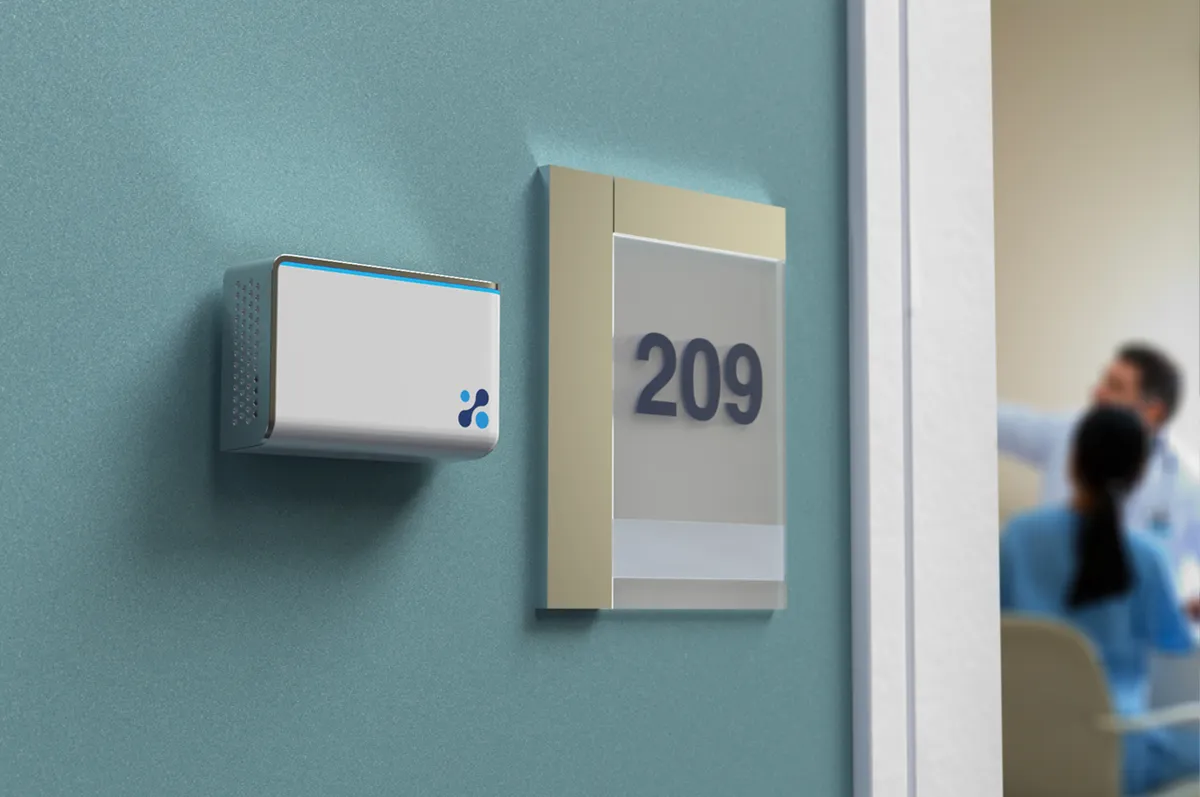
Aethair provides continuous, calibrated air quality monitoring built for environments where conditions have to be both maintained and documented. Aethair IAQ, a professional indoor air quality monitor, measures parameters such as particulate matter, CO2, VOCs, temperature, and humidity for indoor clinical and general spaces, while Aethair PRO extends monitoring to more demanding settings and supports differential pressure measurement for rooms where pressure relationships are critical. Both stream data into Environet, where readings from every monitored room are visible in one place, with configurable alerts that flag an excursion as it happens.
From there, Aethair Reports compiles the data into structured documentation that can be scheduled or generated on demand. Reports are customizable, so teams can set their own parameter limits and thresholds and tailor what each report contains. Noesis, Aethair's AI analysis engine, lets teams query their environmental data in plain language. For facilities that already operate other instruments, Thiamis brings third-party sensor data into the same record. The result is a single, defensible history of how each clinical space performed, room by room and over time.
Much of this is built to work without specialized air quality expertise. The underlying job (maintaining calibrated sensors across many rooms, tracking differential pressure, particulates, and VOCs, and keeping a continuous record) is complex and time-consuming to do by hand. Aethair is designed so the facility does not have to carry that complexity. Devices arrive calibrated and connect over built-in cellular capabilities, Environet presents every room in one view, and alerts surface only when something needs attention. Noesis lets a facilities or EHS lead ask plain-language questions of the data and get a summary in return, which reduces the manual analysis that would otherwise fall to a specialist. Aethair Reports then assembles audit-ready documentation on a schedule or on demand, so producing a defensible record does not hinge on one person's spreadsheet skills.
Aethair provides air quality monitoring and documentation tools designed to support healthcare environmental programs. Aethair does not certify compliance with the Joint Commission, DNV, or other regulatory, accreditation, or building-standard requirements; responsibility for meeting applicable standards rests with the facility and its qualified personnel.
The recommended configuration for this
Recommended
best match-

Industrial monitor for indoor and outdoor sites. Built-in sensors cover the essentials, and hot-swappable gas sensor cartridges and a differential-pressure option add more.
Built-inRelative HumidityParticle Count (by size)Air TemperatureGas 1
Free: one more gas sensor cartridge
Gas 2
Free: one more gas sensor cartridge
MultiSense
Free: a MultiSense, stock or built to order
Expansion

Aethair Diff. Pressure
Differential PressureA gauge sensor reads 0–10 kPa, with the higher-pressure side connected to its port.
Also measures 10 more
Dew PointHeat IndexIlluminance / LightPM1PM10PM2.5Total PM / Mass Conc.Barometric PressureEquivalent Continuous Level (Leq)Sound Pressure Level (SPL)
Environmental Monitoring for Healthcare
See how Aethair supports continuous air quality monitoring and documentation across hospital and clinical environments.
Schedule a call (opens in a new tab)See Solutions for Healthcare →
Healthcare Air Quality Monitoring: FAQs
What is healthcare air quality monitoring?
Healthcare air quality monitoring is the continuous measurement of environmental conditions in clinical spaces, including differential pressure, temperature, relative humidity, particulate matter, carbon dioxide, and volatile organic compounds. It gives facilities a documented record that critical rooms such as operating rooms, isolation rooms, and cleanrooms are holding the conditions their function requires.
What air quality parameters do hospitals need to monitor?
The core parameters are differential pressure between rooms, temperature, relative humidity, and particulate matter. Depending on the space, facilities also track carbon dioxide as a ventilation indicator and volatile organic compounds, which matter most in laboratories and sensitive clinical environments such as IVF labs.
What is the difference between an isolation room and a protective environment room?
An airborne infection isolation room is held at negative pressure so contaminated air stays inside and does not escape to adjoining spaces. A protective environment room is held at positive pressure so clean, filtered air flows outward and shields an immunocompromised patient from airborne contaminants. Both rely on continuous differential pressure monitoring to confirm the relationship is correct.
Why is continuous air quality monitoring better than periodic spot checks in healthcare?
A spot check confirms conditions only for the moment it is taken. A pressure reversal, humidity excursion, or filtration problem that occurs between checks can go undetected and undocumented. Continuous monitoring captures conditions around the clock and creates a time-stamped historical record that periodic testing cannot provide.
What should I look for in a healthcare air quality monitor?
Look for calibrated sensors with documented accuracy, the specific parameters each space requires, including differential pressure, continuous data logging with retained history, configurable alerts for excursions, and reporting that turns the data into clear documentation. Reliable connectivity and centralized multi-room visibility matter for facilities monitoring many spaces at once.