
For most of the last two decades, indoor air quality was a building-engineering problem. HVAC contractors handled it. Property managers focused on rent, retention, capital expenditure, and the systems they could see. Air sat in the background: invisible, intermittently complained about, and rarely measured.
That has changed. Tenant expectations, ESG disclosure pressures, evolving building standards, and a generation of occupants who came back to the office with new concerns about ventilation have all combined to move indoor air quality monitoring from a niche technical concern to a property management responsibility. The property manager who used to be asked about parking and HVAC service tickets is now expected to answer questions about CO₂ levels in conference rooms, wildfire smoke ingress, and how the building performs against the WELL Building Standard.
This article explains what indoor air quality means in a commercial building context, which parameters matter, which standards apply, what a credible monitoring program looks like in practice, and how to evaluate the equipment and software available to support one. It is written for the property managers, building operators, asset managers, sustainability leads, and facilities and EHS teams who share responsibility for the air inside commercial buildings.
Why Indoor Air Quality Became a Property Manager's Job
The shift happened from several directions at once.
Tenants began asking questions. The flight to quality in commercial real estate accelerated after 2020, with corporate occupiers concentrating demand in higher-quality buildings that match their ESG, wellness, and brand commitments. The shift has been a recurring theme in commercial real estate market commentary, and air quality data has become part of the conversation.
"What's the CO₂ in this space?" became a question that property managers had to answer with evidence rather than reassurance. A real-time dashboard, a monthly summary, and a clear response when something drifts out of range are now competitive features in the lease negotiation.
Investors and lenders began asking the same questions at the portfolio level. ESG-linked financing, sustainability-linked loans, and reporting frameworks including GRESB (opens in a new tab), the TCFD recommendations (opens in a new tab) (now consolidated under the ISSB (opens in a new tab)), and the CDP (opens in a new tab) climate disclosure system increasingly call for building-level environmental data, including indoor environmental quality. Property managers are now expected to source, validate, and report it.
Insurance underwriters started paying attention. In jurisdictions exposed to wildfire smoke or industrial emissions, outdoor pollutants infiltrate buildings through every active ventilation pathway, and indoor concentrations can remain elevated for hours after outdoor conditions improve. Climate-driven exposures and indoor environmental quality are increasingly factored into commercial property risk assessment.
Local regulations evolved. New York City's Local Law 97 (opens in a new tab), California Title 24 (opens in a new tab), and a growing list of state and municipal indoor air quality requirements for schools, healthcare facilities, and commercial offices have raised the regulatory floor. The patchwork has grown complex enough that property managers can no longer rely on a single building code interpretation to cover all of it.
And tenants kept asking. Workplace and tenant experience surveys now routinely measure perceptions of air quality alongside lighting, acoustics, and thermal comfort. Property managers who treat air quality as a building service that is measured, reported, and visibly maintained tend to see this reflected in tenant satisfaction and renewal conversations. Those who don't, increasingly hear about it.
What Indoor Air Quality Actually Means
For property managers approaching the topic for the first time, the term "indoor air quality" can feel imprecise. It is. There is no single measurement that defines air quality. There is a set of related parameters, each of which captures a different aspect of the indoor environment, and which together describe whether a space is healthy, comfortable, and compliant with applicable standards.
The parameters most commonly monitored in commercial buildings fall into four categories.
Particulate matter. PM1 (particles 1 micron and smaller), PM2.5 (fine particles 2.5 microns and smaller), and PM10 (particles up to 10 microns) are the standard particulate measurements in a commercial IAQ program. Sources include outdoor pollution that infiltrates the building envelope, wildfire smoke, construction activity, cooking, and resuspended dust from foot traffic and HVAC operation. PM2.5 is the parameter most frequently cited in IAQ guidance and certifications and is associated by the EPA with significant cardiovascular and respiratory health effects (opens in a new tab) at elevated concentrations. PM1, the finest fraction routinely measured, is increasingly tracked because of its ability to penetrate deeper into the respiratory system and reach the bloodstream.
Carbon dioxide. CO₂ is the canonical indicator of ventilation adequacy. Outdoor air now sits at approximately 430 ppm (opens in a new tab). Indoor CO₂ rises as a function of occupancy and ventilation. In a poorly ventilated, fully occupied conference room, levels can exceed 2,000 ppm within an hour. Most major IAQ standards, including the WELL Building Standard (opens in a new tab) and ASHRAE 62.1 (opens in a new tab), set CO₂ thresholds or use CO₂ as a control variable for demand-controlled ventilation. For property managers, CO₂ data is also one of the most useful operational signals available. A trend that climbs through the workday and stays elevated overnight points to a ventilation problem.
Volatile organic compounds. VOCs (opens in a new tab) are emitted from many sources. Building materials, furniture, paints and adhesives, cleaning products, printers and copiers, and consumer goods are the typical office contributors. In mixed-use buildings, manufacturing tenants, laboratories, print shops, salons, dry cleaners, and any space that stores or processes chemicals can add significantly to the indoor VOC load. Continuous monitoring also serves a leak-detection function in these environments, surfacing unusual VOC excursions that may indicate a process problem or a chemical storage issue. Total VOCs (tVOC) is the composite indicator most commonly reported. Formaldehyde, one of the most common and best-characterized indoor VOCs, is often monitored separately and has its own thresholds in several frameworks.
Thermal and hygrometric parameters. Temperature, relative humidity, and barometric pressure are not pollutants but are critical inputs to occupant comfort, mold prevention, and the interpretation of other IAQ measurements. Humidity in particular interacts with particulate matter, VOC off-gassing, and microbial growth, and most credible IAQ programs include it in their core measurement set.
A property manager evaluating an indoor air quality monitoring program should expect, at minimum, continuous data on PM1, PM2.5, PM10, CO₂, tVOC, formaldehyde, temperature, humidity, and pressure. These nine parameters together form the working baseline that most credible commercial IAQ programs should target.
It is worth noting that the broader category of indoor environmental quality extends beyond air. The WELL Building Standard (opens in a new tab) treats Light and Sound as separate concepts from Air, each with its own monitoring and design requirements. Property managers pursuing whole-building wellness certification, or operating in buildings where acoustic and lighting comfort are part of the tenant experience promise, often deploy sensors that capture sound and illuminance alongside the air quality parameters above. Those measurements are outside traditional IAQ scope but increasingly sit in the same dataset.
Regulatory and Voluntary Standards Property Managers Should Know
Indoor air quality in commercial buildings sits at the intersection of multiple frameworks, none of which alone covers the full picture. Property managers building a monitoring program should be familiar with the most commonly invoked ones.
OSHA General Industry
The Occupational Safety and Health Administration regulates workplace exposure to specific air contaminants through 29 CFR 1910.1000 and the Table Z permissible exposure limits (opens in a new tab). OSHA does not set a comprehensive indoor air quality standard for offices, but the General Duty Clause (opens in a new tab) requires employers to maintain a workplace free from recognized hazards.
ASHRAE 62.1
ASHRAE Standard 62.1 (opens in a new tab) is the most widely referenced ventilation standard for commercial buildings in the United States. It defines minimum outdoor air ventilation rates, addresses CO₂ as a control parameter, and is incorporated by reference in many building codes. Compliance with 62.1 is a baseline expectation for buildings pursuing third-party certifications.
The WELL Building Standard
WELL is among the most prescriptive voluntary frameworks focused on indoor environmental quality. The WELL v2 Air concept (opens in a new tab) sets concentration thresholds for PM2.5, VOCs, formaldehyde, and other pollutants, and uses CO₂ in its ventilation requirements. Performance is verified by on-site testing with annual reporting, and continuous monitoring earns points under the A08 optimization.
LEED v5
The U.S. Green Building Council's LEED program (opens in a new tab) includes indoor environmental quality credits for occupant comfort and low-emission materials. In LEED v5 O+M, the Indoor Air Quality Performance credit awards up to 10 points for continuous indoor air monitoring (LEED v4.1 required at least one air quality evaluation a year). LEED is less prescriptive than WELL on air quality, but far more widely adopted across commercial portfolios.
EPA Reference Values
The Environmental Protection Agency publishes the National Ambient Air Quality Standards (NAAQS) (opens in a new tab), which apply to outdoor air. NAAQS are not indoor air standards, but they are commonly used as reference values for indoor concentrations, particularly during outdoor pollution events such as wildfires.
State and Local Requirements
Several states and cities have introduced indoor air quality regulations, especially for schools and healthcare facilities. New York City's Local Law 97 (opens in a new tab) focuses primarily on energy use, but its HVAC implications interact with indoor air quality. California Title 24 (opens in a new tab) and a growing list of jurisdiction-specific rules add to the patchwork. Property managers should review their portfolio jurisdictions specifically.
Voluntary Disclosure Frameworks
GRI (opens in a new tab), SASB (opens in a new tab), TCFD (opens in a new tab), GRESB (opens in a new tab), and CDP (opens in a new tab) all have data requirements that increasingly include indoor environmental quality metrics. For property managers reporting to investors or under sustainability-linked financing, IAQ data is no longer purely operational. It is reportable.
No single regulatory authority sets a complete indoor air quality standard for commercial buildings. Property managers operate inside a stack of overlapping frameworks. The most defensible programs monitor against the strictest applicable one and document compliance against the broader set.
Common Indoor Air Quality Problems in Commercial Buildings
Property managers tend to encounter the same set of indoor air quality issues across portfolios. Recognizing them is most of the work.
Inadequate ventilation is the most common, by a wide margin.
HVAC systems are designed to deliver a specified outdoor air rate per occupant, but real-world operation often falls short. Outdoor air dampers get adjusted to reduce energy costs. Demand-controlled ventilation logic gets misconfigured. Conference rooms designed for eight occupants are routinely packed with twenty.
The result is a CO₂ profile that climbs steadily through the day and occupant complaints of stuffiness and fatigue. The cognitive performance impacts documented by the Harvard COGfx study (Allen et al., 2016) (opens in a new tab) then show up in productivity and tenant feedback.
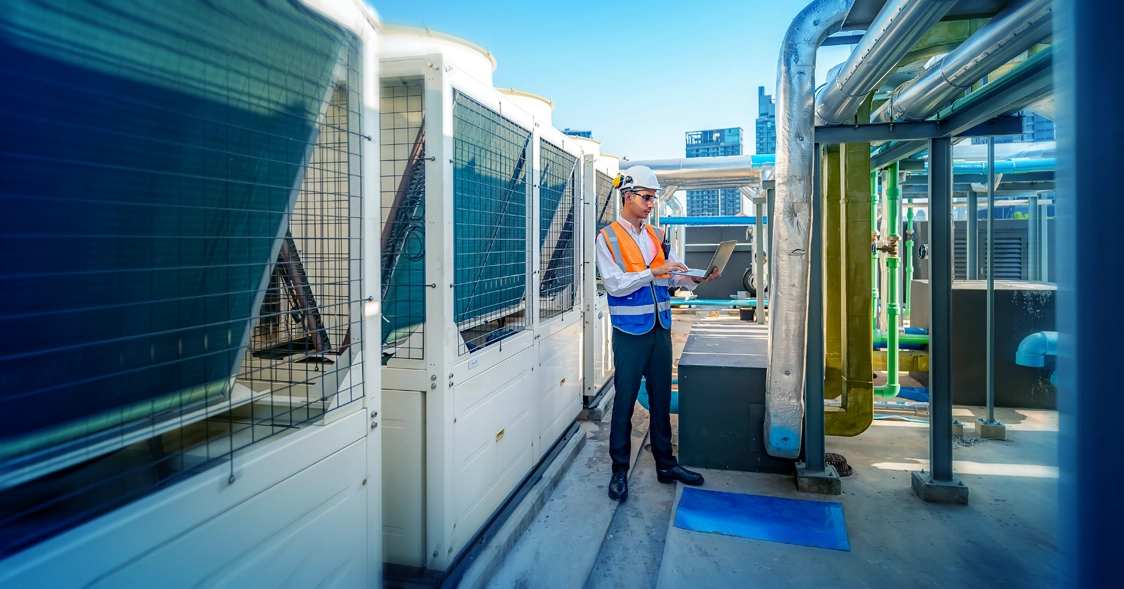
HVAC filtration shortfalls are a related issue. Filters degrade between change-outs. MERV ratings appropriate for normal conditions may be inadequate during wildfire smoke events or in buildings near construction. Property managers without continuous PM monitoring tend to discover filtration problems only after tenants complain, by which point the cumulative exposure has already happened.
Smoke ingress from outdoor sources is now a recurring concern, particularly in regions exposed to wildfires. Even with sealed building envelopes, smoke infiltrates through every active ventilation pathway. The indoor PM2.5 concentration during a wildfire smoke event can rise to many times normal baseline levels if filtration is inadequate or the HVAC system is set to draw in significant outdoor air, and can remain elevated for hours after outdoor conditions improve. Property managers in wildfire-exposed regions are increasingly expected to have a documented smoke response protocol.
Off-gassing from building materials and furnishings is a slow-moving problem that shows up in VOC and formaldehyde data. New construction, recent tenant improvements, and freshly installed furniture can elevate VOC levels for weeks or months. Without monitoring data, the property manager has no evidence to either reassure tenants or pursue remediation.
Microbial growth, mold, and humidity-related issues are often invisible until they become structural. Humidity sensors are an early-warning system. Sustained relative humidity above 60% in conditioned spaces is a known precondition for mold growth per the EPA (opens in a new tab), and continuous data identifies these conditions long before visible damage develops.
Occupant complaints without identifiable causes are perhaps the most difficult category.
A tenant reports a headache, dizziness, or smell in a specific zone. Without continuous, granular data, the property manager has no way to investigate. With it, the response is faster, more credible, and more often resolvable.
What an Indoor Air Quality Monitoring Program Looks Like
A credible commercial IAQ monitoring program has five components.
1. Defined parameters and target ranges. The program begins by specifying what is being measured, which standards apply, and what the action thresholds are. For most commercial buildings, this means PM1/PM2.5/PM10, CO₂, tVOC, formaldehyde, temperature, humidity, and pressure, evaluated against credible reference values as applicable.
2. Sensor placement strategy. Sensors should be placed in occupied zones at breathing-zone height, with coverage that reflects how the building is actually used. A single device in a mechanical room measures the mechanical room. A program designed for tenant-facing reporting needs coverage in conference rooms, open offices, lobbies, fitness centers, food service areas, and any space subject to specific tenant or regulatory interest. Density should scale with occupancy patterns and building risk, with additional devices in high-occupancy zones, near outdoor air intakes, and in spaces with known sensitivity.
3. Continuous data collection. Spot measurements are appropriate for one-time investigations but inadequate for ongoing programs. Continuous monitoring, sampled at intervals of one to five minutes per device, captures the patterns that intermittent testing misses: occupancy-driven CO₂ peaks, transient particulate events, and the daily and weekly cycles that characterize building operation.
4. Data infrastructure. Devices must connect to a platform that aggregates measurements, stores history, generates alerts when thresholds are crossed, and produces reports on a defined schedule. The platform is as important as the sensors. A well-instrumented building with poor data infrastructure produces unusable data; a modestly instrumented building with strong data infrastructure produces actionable reports.
5. Response and documentation workflow. When thresholds are crossed, the program should generate an alert, route it to the appropriate operations contact, and document the response. For property managers, this is the difference between a monitoring program that produces data and one that produces a defensible record.
A common failure mode in commercial IAQ programs is component three without component five. Continuous data is collected, but nobody is responsible for acting on it, and there is no documented workflow when something exceeds a threshold. The result is a dataset that exists but does not improve operations or stand up to scrutiny.
Choosing Indoor Air Quality Monitoring Equipment
Property managers evaluating IAQ monitoring equipment should focus on a few characteristics that separate credible programs from cosmetic ones.
Calibration and reference accuracy. A sensor that is not calibrated against a reference instrument is producing data of uncertain quality. Look for devices that are calibrated to a documented reference, ideally against established reference instruments. Devices that include calibration verification are dramatically more useful than devices that do not.
Parameter coverage. Many low-cost IAQ devices measure two or three parameters. A commercial-grade program needs all nine of the standard parameters listed above, and the cost difference between a multi-parameter commercial device and a consumer-grade sensor is recovered quickly in operational utility.
Connectivity. Cellular (4G LTE) connectivity is preferable to Wi-Fi for commercial deployments. Wi-Fi-dependent devices require integration with tenant or building network infrastructure, which creates security review burdens and ongoing IT support overhead. Cellular devices deploy independently, connect over a carrier network, and continue operating during building network outages.
Data ownership and export. The data produced by IAQ sensors is the property manager's most important deliverable. Devices and platforms that lock data into proprietary formats, or that do not provide structured export capabilities, create long-term dependency on a single vendor. Look for platforms that support API access, structured exports, and standard report formats.
Update and maintenance model. Sensors degrade. Calibrations drift. Firmware needs updates. Evaluate how the equipment manufacturer handles these realities: are calibrations recoverable in-field, or do devices need to be returned? Are firmware updates pushed automatically, or do they require manual intervention? Are there documented end-of-life expectations for the device?
Reporting and AI capabilities. The trend in commercial IAQ programs has been a steady move from raw data toward actionable reporting. AI-assisted tools that surface trends, generate compliance summaries, and answer plain-language questions from the data are increasingly viewed as a meaningful operational advantage, particularly for property managers responsible for multiple buildings.
The right equipment choice depends on the building, the relevant standards, and the integration requirements with existing property management systems. But the underlying logic is the same: data quality, parameter coverage, and reporting capability are more important than sensor count.
The Business Case for Continuous Indoor Air Quality Monitoring

Property managers who invest in continuous indoor air quality monitoring tend to make the case on four grounds.
The first is tenant retention.
Documented indoor environmental quality has become a tenant procurement criterion. Property managers who can produce real-time dashboards, monthly reports, and credible response data to tenant questions hold a competitive advantage in the lease renewal conversation. Indoor environmental quality has begun to appear in tenant RFPs, particularly from corporate occupiers with their own ESG and employee wellness mandates.
The second is operational efficiency. A continuous IAQ dataset is also a continuous HVAC performance dataset. CO₂ that fails to clear overnight indicates a ventilation issue. PM trends that rise during specific times point to filtration problems or outdoor infiltration pathways. Property managers using this data to inform maintenance and operational decisions can identify HVAC efficiency opportunities and resolve occupant complaints more quickly than building operators relying on periodic spot checks.
The third is ESG and disclosure. For property owners with sustainability commitments, ESG-linked financing, or institutional investors with environmental reporting requirements, IAQ data is part of the disclosure expectation. Building this data infrastructure proactively, rather than scrambling when an investor request arrives, is dramatically less expensive.
The fourth is regulatory and liability exposure. The General Duty Clause, the increasing number of jurisdiction-specific IAQ requirements, and the long history of sick-building and indoor environmental quality disputes all create exposure that a documented monitoring program substantially reduces. A continuous IAQ record is far easier to defend than reconstructed estimates after an incident, and the cost of producing that record drops considerably once the data infrastructure is in place.
The cost of a credible IAQ monitoring program in a commercial building is now modest relative to the value it produces.
The barrier is rarely the price of the sensors. It is the organizational decision to treat indoor air quality as a property management function and to assign someone to own it.
Aethair IAQ for Commercial Buildings
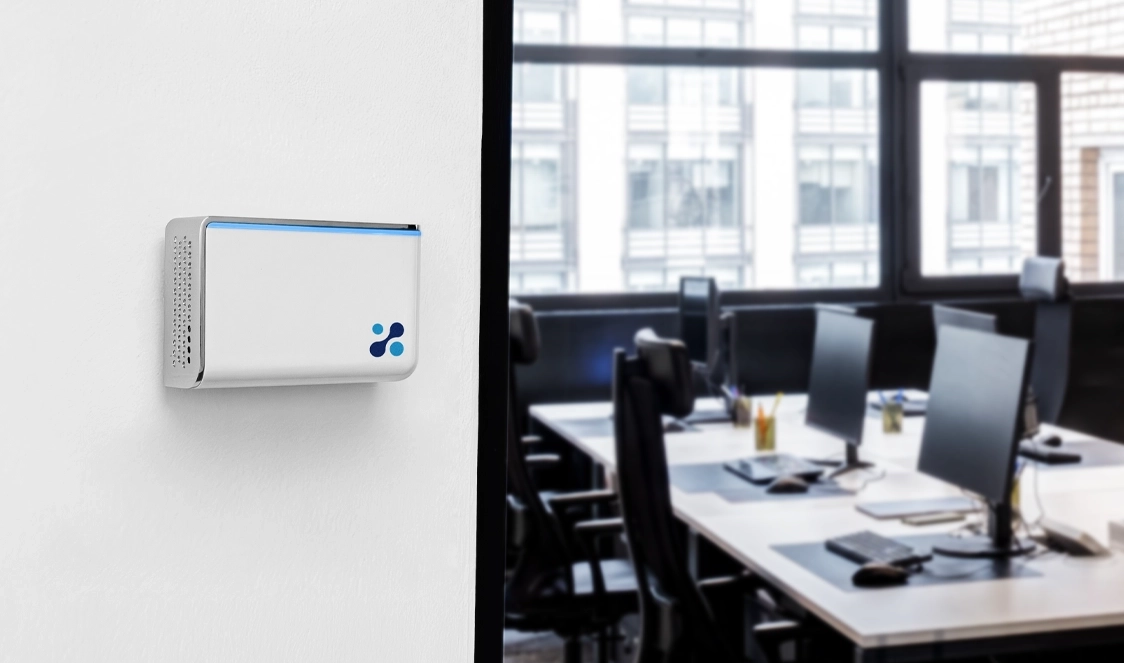
This article has been written to be platform-agnostic, but property managers evaluating equipment options will eventually arrive at the question of what to buy.
Aethair IAQ is a commercial-grade indoor air quality device designed specifically for commercial buildings and property portfolios.
Aethair IAQ measures all nine of the standard commercial IAQ parameters discussed above (PM1, PM2.5, PM10, tVOC, formaldehyde, CO₂, temperature, humidity, and pressure). Devices ship calibrated against reference instruments, with performance correlation above 90%. They connect over 4G LTE cellular without relying on tenant or building networks, and stream data continuously to Environet, Aethair's web-based monitoring platform with built-in AI analytics and reporting.
For property managers, the practical value is the workflow that follows the data. Aethair Reports generates audit-ready compliance and ESG documentation directly from the underlying measurements, with thresholds configurable per parameter to align with WELL, ASHRAE, OSHA, EPA, or internal program requirements. Real-time alerts can be configured on any parameter, so the operations contact is notified the moment a threshold is crossed rather than at the next reporting cycle. Noesis, Aethair's AI tool, lets property managers query their building data in plain language, surfacing trends, identifying issues, and producing tenant-facing summaries without manual analysis.
Aethair's full indoor air quality monitoring solution is in use across commercial office buildings, mixed-use developments, healthcare facilities, and educational campuses. Property managers ready to evaluate the platform against their portfolio can request a demo to see how Aethair IAQ deploys in commercial buildings and what the reporting workflow looks like in practice.
Aethair PRO for Outdoor and Specialty Monitoring
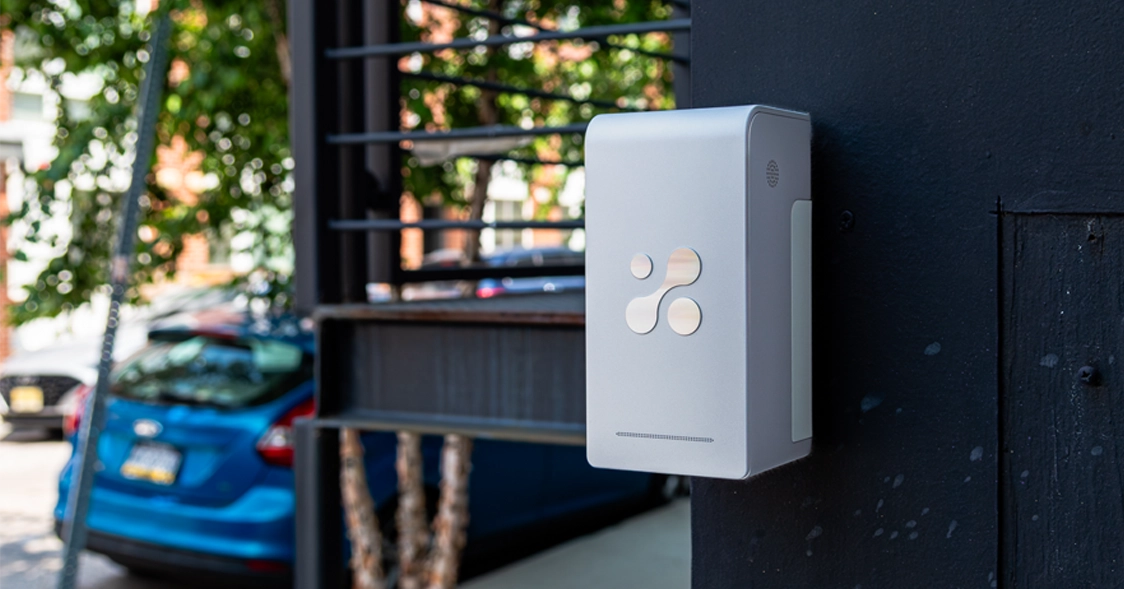
Aethair IAQ covers the core indoor air quality monitoring parameters for occupied commercial spaces. Some commercial properties have monitoring needs that extend beyond standard indoor air, and Aethair PRO is designed for those scenarios.
Aethair PRO measures PM1, PM2.5, PM10, temperature, pressure, humidity, sound, and light, and includes two configurable swappable gas sensors that support gases including CO, NO, NO₂, O₃, SO₂, H₂S, and others. The same 4G LTE cellular connectivity and the same Environet platform integration apply, so a portfolio can mix IAQ and PRO devices without managing two separate systems.
Common applications in commercial buildings include:
- Rooftop and perimeter outdoor monitoring. A PRO unit positioned at an outdoor air intake or on the roof provides the outdoor reference data that gives indoor measurements operational meaning. During wildfire smoke events, outdoor monitoring is what tells the building operator when to switch HVAC into recirculation and when filtration is keeping up.
- Loading docks, parking garages, and vehicle areas. CO and NO₂ are the parameters that matter in spaces with vehicle traffic or combustion equipment, and they sit outside the standard IAQ parameter set.
- Mixed-use buildings with industrial or laboratory tenants. Mixed-use developments often combine office, residential, retail, and light industrial space in the same envelope. PRO's configurable gas sensors handle the parameters specific to those tenant types without requiring multiple device families.
- Construction and renovation zones inside occupied buildings. Tenant improvement work generates dust and VOCs that can migrate into occupied space. A PRO unit deployed at the construction boundary provides documentation that the rest of the building is being protected.
- Acoustic and lighting parameters for tenant-wellness programs. PRO's sound and light measurements support WELL concepts beyond Air and are increasingly requested in tenant-wellness reporting.
For property managers running a single monitoring program across diverse building types, the combination of Aethair IAQ for occupied indoor spaces and Aethair PRO for outdoor, transitional, and specialty zones gives full-building coverage with one platform and one reporting workflow.
The recommended configuration for this
Aethair IAQ only
one monitor, nothing to add-

Aethair IAQ built-in sensors
Compact plug-in monitor with every sensor built in, nothing to add. Ideal for straightforward indoor air quality monitoring.
Built-inFormaldehyde (CH₂O)Carbon Dioxide (CO₂)Relative HumidityPM1PM10PM2.5Barometric PressureAir TemperatureVOC (Total)Also measures 4 more
Dew PointHeat IndexParticle Count (by size)Total PM / Mass Conc.
Recommended
best match-

Industrial monitor for indoor and outdoor sites. Built-in sensors cover the essentials, and hot-swappable gas sensor cartridges and a differential-pressure option add more.
Built-inRelative HumidityPM1PM10PM2.5Barometric PressureAir TemperatureGas 1

Aethair CO₂ (dual NDIR)
Carbon Dioxide (CO₂)Dual-thermopile NDIR (non-dispersive infrared) sensing measures CO₂ with no chemical consumables, for…
Also fits: Aethair CO₂ (self-calibrating NDIR)
Gas 2

Aethair VOC (ppm PID)
VOC (Total)A 10.6 eV photoionization detector (PID) ionizes volatile organic compounds for direct ppm readings across a…
Also fits: Aethair VOC (ppb PID), Aethair MultiGas+, Aethair VOC (ppb PID, wide range)
MultiSense

Aethair MultiSense
Formaldehyde (CH₂O)Simultaneous electrochemical detection of sulfur dioxide, nitrogen dioxide, and formaldehyde at…
Expansion
Free: differential pressure
Also measures 9 more
Dew PointHeat IndexIlluminance / LightParticle Count (by size)Total PM / Mass Conc.Equivalent Continuous Level (Leq)Sound Pressure Level (SPL)Nitrogen Dioxide (NO₂)Sulfur Dioxide (SO₂)
Air Quality Monitoring Built for Commercial Buildings
Aethair delivers continuous, calibrated indoor and outdoor air quality data for property managers, ready for tenant transparency, ESG reporting, and compliance documentation.
Indoor Air Quality Monitoring for Commercial Buildings: FAQs
What is indoor air quality monitoring for commercial buildings?
Indoor air quality monitoring for commercial buildings is the continuous measurement of pollutants and environmental parameters in occupied spaces. The standard parameter set covers PM1, PM2.5, PM10, CO₂, total VOCs, formaldehyde, temperature, humidity, and pressure. The data is used to verify ventilation performance, document compliance with applicable standards, support ESG reporting, and respond to tenant questions about the indoor environment.
Are commercial buildings required to monitor indoor air quality?
There is no single federal indoor air quality standard that mandates monitoring in commercial office buildings in the United States. OSHA's General Duty Clause requires employers to maintain a workplace free from recognized hazards, and OSHA regulates specific contaminants through 29 CFR 1910.1000. Several states and cities have introduced indoor air quality requirements for specific building types, including schools and healthcare facilities. Voluntary frameworks like the WELL Building Standard and LEED do not require continuous monitoring for certification, but both reward it: WELL through its A08 optimization, and LEED v5 O+M with up to 10 points for continuous indoor air monitoring. In practice, monitoring is increasingly expected by tenants, lenders, and insurers even where no specific regulation applies.
What is an acceptable CO₂ level in an office building?
ASHRAE 62.1 uses CO₂ as a proxy for ventilation adequacy rather than setting a hard ceiling. A common operational target is to keep indoor CO₂ within roughly 700 ppm of outdoor concentrations. WELL v2 accepts 900 ppm (or 500 ppm above outdoor) as one way to meet its ventilation precondition, and awards points under Enhanced Ventilation Design for 750 ppm (or 350 ppm above outdoor). Outdoor concentrations now sit at approximately 430 ppm, which puts a typical indoor target in the 800 to 1,000 ppm range for well-ventilated commercial spaces. Sustained levels above 1,200 ppm generally indicate undersupplied ventilation relative to occupancy.
Where should indoor air quality sensors be placed in a commercial building?
The guiding principle is to measure where people actually breathe. That means sensors at breathing-zone height in occupied zones, with the density of devices scaled to occupancy and to the spaces that matter most to tenants and regulators. High-occupancy meeting rooms, open work areas, lobbies, fitness centers, and food service zones are typical priorities. Devices near outdoor air intakes give context on what the building is taking in. Sensors in mechanical rooms tell you about the mechanical room, not the tenant experience. The right answer is rarely a single device per floor.
How does indoor air quality monitoring support ESG and WELL reporting?
Continuous indoor air quality data is used in both ESG disclosures and building certifications. Frameworks including GRI, SASB, GRESB, and CDP increasingly request indoor environmental quality metrics for commercial real estate portfolios. The WELL Building Standard requires the core pollutants to be measured at least once a year and reported annually, and awards points for continuous monitoring that shares the data with occupants. A monitoring program that captures the right parameters at the right intervals, with documented response when thresholds are crossed, satisfies most reporting requirements with a single dataset.