
Indoor air quality is one of the most consequential and most frequently overlooked elements of workplace environmental health. The EPA estimates that Americans spend approximately 90 percent of their time indoors, where concentrations of some pollutants can be two to five times higher than outdoor levels. For EHS professionals responsible for worker health, regulatory compliance, and operational continuity, assuming indoor air is clean without measuring it carries real risk.
Indoor air quality monitoring gives EHS teams the data they need to identify problems before they become liabilities, and to document conditions before a regulator or surveyor asks.
Why Indoor Air Quality Monitoring Parameters Matter for EHS Compliance
Workplace air quality is not just a comfort issue. It is a regulatory and liability issue with direct consequences for worker health, productivity, and organizational risk.
OSHA does not currently maintain a single comprehensive indoor air quality standard for general industry, but it does regulate exposure to specific airborne contaminants through Permissible Exposure Limits (PELs) under 29 CFR 1910.1000, and it applies the General Duty Clause to environments where known hazards, including poor IAQ, go unaddressed. ASHRAE Standard 62.1 establishes minimum ventilation rates and indoor air quality procedures widely adopted by building codes and certification programs. For healthcare, education, and other regulated settings, additional sector-specific standards apply.
Beyond compliance, the operational case for monitoring is well-established. Elevated CO₂ levels correlate with reduced cognitive performance. Excess humidity drives mold growth. Elevated VOC concentrations from cleaning products, furnishings, and building materials contribute to a range of acute and chronic health effects. These are not theoretical concerns. They are recurring findings in building investigations and occupant complaint reviews.
Key Indoor Air Quality Monitoring Parameters
Effective indoor air quality monitoring programs cover a defined set of parameters tied to occupant health risk, regulatory requirements, and building performance. The following are the most relevant for commercial, industrial, and institutional settings.
| Parameter | What it indicates | Common reference threshold |
|---|---|---|
| Carbon dioxide (CO₂) | Ventilation adequacy | ASHRAE 62.1 and WELL; concern above ~1,000 ppm |
| Particulate matter (PM2.5, PM10) | Respirable particle load | PM2.5 carries the greatest respiratory risk; NAAQS informs benchmarks |
| TVOC and formaldehyde | Chemical off-gassing | WELL and related frameworks set formaldehyde limits |
| Temperature and relative humidity | Comfort and mold risk | ASHRAE: 30–60% RH for occupied spaces |
| Carbon monoxide (CO) | Combustion safety | OSHA PEL 50 ppm (8-hour TWA) |
- Carbon Dioxide (CO₂): CO₂ is the primary proxy indicator for ventilation adequacy in occupied spaces. Elevated CO₂, above 1,000 ppm and particularly above 1,500 ppm, signals that fresh air exchange is insufficient for the occupant load. ASHRAE 62.1 and the WELL Building Standard both establish CO₂ thresholds as part of their ventilation requirements.
- Particulate Matter (PM2.5 and PM10): Fine and coarse particulate matter originate from both outdoor infiltration and indoor sources including cooking, equipment, and cleaning activities. PM2.5, particles 2.5 microns and smaller, poses the greatest respiratory health risk due to its ability to penetrate deep into lung tissue. OSHA regulates total and respirable particulate matter exposure, and NAAQS standards define acceptable outdoor concentrations that inform indoor benchmarks.
- Volatile Organic Compounds (VOCs): VOCs are emitted by many indoor sources, including adhesives, paints, cleaning agents, office equipment, and synthetic furnishings. Exposure to elevated VOC concentrations is associated with headaches, respiratory irritation, and for certain compounds, longer-term health effects. Total VOC (TVOC) monitoring, combined with targeted monitoring for specific compounds such as formaldehyde (CH₂O), provides a more complete picture of indoor chemical exposure.
- Temperature and Relative Humidity: Temperature and humidity are foundational comfort and compliance parameters. ASHRAE recommends indoor relative humidity between 30 and 60 percent for occupied spaces. Humidity outside this range creates conditions favorable to mold growth, dust mite proliferation, and chemical off-gassing, and can itself be a citation risk in regulated environments.
- Carbon Monoxide (CO): In facilities with combustion equipment, attached parking, or loading dock proximity, CO monitoring is a direct safety requirement. CO is odorless, colorless, and rapidly dangerous at elevated concentrations. OSHA's PEL for CO is 50 ppm as a time-weighted average (TWA).
Continuous Monitoring vs. Periodic Testing
Many organizations rely on periodic IAQ testing, a walkthrough or manual sample collection at set intervals, to assess indoor air conditions. This approach has significant limitations when used as a primary compliance or safety strategy.
Periodic testing captures a snapshot. Air quality conditions vary substantially by time of day, occupant density, outdoor air conditions, and operational activity. A morning sample taken before peak occupancy will not reflect afternoon CO₂ levels in a crowded conference room. A quarterly survey will not detect a ventilation failure that develops between visits.
Continuous monitoring addresses this gap by providing a persistent data stream that captures real conditions as they change. When thresholds are exceeded, whether a CO₂ spike, a PM2.5 surge, or a humidity excursion, teams are alerted in real time, not weeks later when a report is reviewed. Trend analysis on continuous data also supports root cause investigation and documentation for regulatory or audit purposes.
For EHS teams managing multi-facility environments or regulated spaces such as healthcare facilities, continuous monitoring is increasingly the expectation rather than the exception.
What to Look for in an IAQ Monitoring System
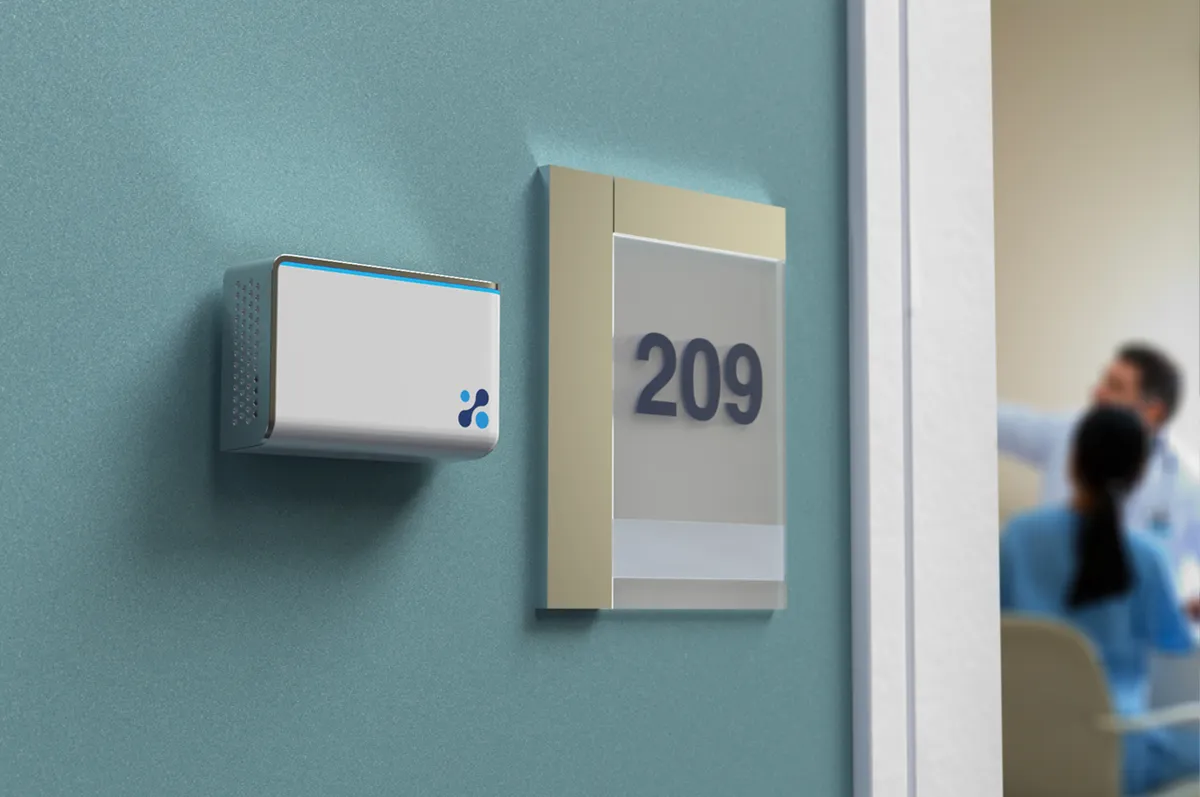
Selecting an indoor air quality monitoring system involves more than choosing sensors. The right system integrates hardware, connectivity, and software into a workflow that supports both operational response and compliance documentation.
Key evaluation criteria include:
- Sensor accuracy and calibration: Industrial-grade sensors with factory calibration and documented drift characteristics provide data that holds up under scrutiny. Consumer-grade devices may produce plausible-looking readings with significant accuracy limitations.
- Connectivity and reliability: Continuous monitoring requires a reliable data transmission path. Systems with native cellular (4G LTE) connectivity eliminate dependence on facility Wi-Fi infrastructure and maintain data continuity even during network disruptions.
- Platform integration: Sensor data has limited value in isolation. Look for systems that integrate with an analytics and reporting platform, one that can aggregate data across multiple devices and locations, configure threshold alerts, and produce structured compliance outputs.
- Scalability: A system deployed in one building should be extensible to an entire portfolio without architectural changes or data fragmentation.
- Audit-ready reporting: In regulated environments, you need to produce reports quickly that show the underlying data and the thresholds applied.
How Aethair IAQ and Aethair PRO Support Indoor Air Quality Monitoring
Aethair delivers Environmental Intelligence through field-grade monitoring devices designed for continuous, unattended operation across many indoor environments. Aethair IAQ is purpose-built for commercial and institutional settings, measuring CO₂, PM1, PM2.5, PM10, TVOC, formaldehyde, temperature, and relative humidity. It covers the core parameters relevant to workplace IAQ compliance and occupant health, and is well suited for commercial building air quality monitoring across offices, healthcare facilities, educational institutions, and multi-tenant buildings.
Aethair PRO extends monitoring into more complex environments. It includes PM1, PM2.5, PM10, temperature, pressure, humidity, sound, and light, along with two configurable hot-swappable gas sensors supporting gases including CO, NO, NO₂, and others relevant to industrial, laboratory, and mixed-use environments. A full list of supported gas sensors is available on the Aethair PRO product page, and can be expanded to include more. Both devices operate on 4G LTE, so data capture continues without reliance on facility networks.
All data from both devices flows directly into Environet, Aethair's web-based monitoring console, where EHS teams can view real-time conditions across every deployed device, configure threshold alerts, and generate structured reports for compliance and internal documentation. Noesis, Aethair's AI analysis tool, allows teams to query their data in plain language, surface trends and anomalies, and generate reports on demand. This connects measured environmental data to clear next actions and documented outcomes.
The recommended configuration for this
Recommended
best match-

Industrial monitor for indoor and outdoor sites. Built-in sensors cover the essentials, and hot-swappable gas sensor cartridges and a differential-pressure option add more.
Built-inRelative HumidityPM10PM2.5Air TemperatureGas 1

Aethair MultiGas+
Carbon Monoxide (CO)VOC (Total)Metal-oxide semiconductor (MOS) sensing tracks carbon monoxide, methane, and total VOC from a compact…
Gas 2

Aethair CO₂ (dual NDIR)
Carbon Dioxide (CO₂)Dual-thermopile NDIR (non-dispersive infrared) sensing measures CO₂ with no chemical consumables, for…
Also fits: Aethair CO₂ (self-calibrating NDIR)
MultiSense

Aethair MultiSense
Formaldehyde (CH₂O)Simultaneous electrochemical detection of sulfur dioxide, nitrogen dioxide, and formaldehyde at…
Expansion
Free: differential pressure
Also measures 12 more
Dew PointHeat IndexIlluminance / LightParticle Count (by size)PM1Total PM / Mass Conc.Barometric PressureEquivalent Continuous Level (Leq)Sound Pressure Level (SPL)Methane (CH₄)Nitrogen Dioxide (NO₂)Sulfur Dioxide (SO₂)
Continuous Air Quality Monitoring for EHS Teams
Aethair IAQ and Aethair PRO deliver continuous, calibrated air quality monitoring with native cellular connectivity and full Environet integration. See how they work:
Schedule a call (opens in a new tab)See Aethair IAQ →See Aethair PRO →
Indoor Air Quality Monitoring: FAQs
What parameters should you monitor for indoor air quality?
Core indoor air quality parameters include PM2.5 and PM10, carbon dioxide (CO₂) as a ventilation indicator, total volatile organic compounds (TVOCs), formaldehyde, carbon monoxide (CO), temperature, and relative humidity. Higher-risk settings may add ozone, nitrogen dioxide, or radon. Together these cover particulates, gases, and the conditions that influence pollutant behavior and occupant comfort.
What are acceptable indoor air quality levels?
There is no single legal indoor air quality standard in the United States. Common reference points include the EPA's PM2.5 NAAQS (9.0 µg/m³ annual and 35 µg/m³ over 24 hours), ASHRAE Standard 62.1 for ventilation, and a working target of roughly 1,000 ppm or lower for CO₂ as a ventilation proxy. OSHA enforces permissible exposure limits only for specific contaminants, such as 50 ppm for carbon monoxide and 5,000 ppm for carbon dioxide, which are 8-hour time-weighted-average limits for industrial exposure rather than comfort targets.
Which standards apply to indoor air quality?
Indoor air quality in US workplaces is shaped by three kinds of reference: OSHA permissible exposure limits under 29 CFR 1910.1000 (enforceable for listed contaminants), ASHRAE Standard 62.1 for ventilation, and voluntary frameworks such as the WELL Building Standard and LEED. Because OSHA has no comprehensive indoor air quality standard, most programs combine these references.
Does OSHA require indoor air quality monitoring?
OSHA has no general indoor air quality monitoring mandate. However, substance-specific standards, including those for silica, lead, and benzene, require exposure assessment and recordkeeping, and the General Duty Clause applies to recognized hazards. Many employers monitor indoor air quality voluntarily to manage risk and document conditions.