
Children breathe more air relative to their body size than adults, spend most of their day indoors, and do it in some of the most densely occupied buildings around. The EPA notes (opens in a new tab) that the typical school holds roughly four times as many occupants as an office building for the same floor space, and that as many as half of U.S. schools have problems linked to indoor air quality. Yet the air in a classroom is rarely measured with anything more than a teacher's sense that the room has gotten stuffy by mid-morning.
Indoor air quality in schools sits at the meeting point of three concerns that are usually handled by different people: student health, academic performance, and the facilities budget. This article walks through the standards that actually apply to schools, what is worth measuring and why, and how to build the case for continuous monitoring in terms a superintendent or board will recognize.
Quick answer
No single federal standard governs indoor air quality in schools. The EPA's IAQ Tools for Schools program is the common framework, classroom ventilation follows ASHRAE Standard 62.1, and a growing set of states now require carbon dioxide monitoring in classrooms. The parameters worth watching are CO2 as a ventilation indicator, fine particulates, volatile organic compounds, temperature, and humidity. The return on monitoring comes through attendance, which drives funding in many states, through measurable effects on student performance, and through energy and maintenance savings. Continuous data is what turns "the room feels stuffy" into something a district can see, act on, and document.
Why Indoor Air Quality in Schools Is Different
A school building is a hard case for air quality. Classrooms pack thirty or more people into a room sized for far fewer, occupancy swings from empty to full and back several times a day, and a large share of the country's school buildings are decades old with HVAC systems near or past the end of their service life. When ventilation cannot keep up, the people in the room are the main source of the problem, because exhaled carbon dioxide (CO2) and everything else that comes with a crowded space builds up faster than the system clears it.
The occupants are also more vulnerable than the working-age adults in an office. Children's lungs are still developing, they inhale more air per kilogram of body weight, and roughly one school-age child in twelve has asthma, which makes them sensitive to particulates, mold, and other triggers that a healthy adult might not notice. Teachers and staff spend their full careers in these buildings.
The result is a setting where the stakes are high and the visibility is usually low. Most classrooms have no instrument reading the air at all, so a ventilation problem announces itself through afternoon drowsiness, a complaint, or a spike in absences, long after the point where it could have been caught and corrected.
The issue has drawn national attention before. During the pandemic, the federal government directed billions of dollars in relief funding toward school HVAC and ventilation upgrades, and the EPA's guidance on healthy school environments (opens in a new tab) put ventilation and filtration at the center of that work. That spending acknowledged a problem that predates and outlasts any single virus: the air in many school buildings had gone unmeasured for years.
The Standards That Apply to Schools

There is no single federal law that sets indoor air quality limits for schools the way OSHA sets workplace exposure limits for industry. Instead, schools operate under a patchwork of federal guidance, design standards, and a growing layer of state requirements. Knowing which is which matters, because only some of them carry the force of a code.
| Framework | What it is | What it covers |
|---|---|---|
| EPA IAQ Tools for Schools | Voluntary federal guidance | A program for finding and fixing IAQ problems through walkthroughs, maintenance, and source control |
| ASHRAE Standard 62.1 | Consensus ventilation standard | Minimum outdoor air rates for classrooms and other spaces; often adopted into building codes |
| State codes and laws | Enforceable, varies by state | Ventilation rates, and in some states classroom CO2 monitoring |
| EPA IAQ science and AQI | Reference information | Particulate and pollutant context, including wildfire smoke guidance for schools |
EPA IAQ Tools for Schools
The EPA's Indoor Air Quality Tools for Schools (opens in a new tab) program is the closest thing to a national reference. It is voluntary, but it is widely used: among districts that run a formal IAQ management program, the large majority base it on this guidance. The program centers on practical steps such as walkthrough inspections, preventive maintenance, moisture and mold control, and ventilation checks, and it includes free planning tools for matching ventilation equipment to a building. What it does not do is set numeric limits or require measurement, which is the gap continuous monitoring fills.
ASHRAE Standard 62.1
Ventilation design in classrooms generally follows ASHRAE Standard 62.1 (opens in a new tab), the consensus standard for ventilation in most building types. For a classroom, it specifies a minimum amount of outdoor air per person plus an amount per square foot of floor area, which for a typical classroom works out to roughly 15 cubic feet per minute of outdoor air per student. Many state and local building codes adopt 62.1 by reference, which is how a consensus standard becomes an enforceable design requirement. The catch is that 62.1 governs how a system is designed, not whether it still delivers that air years later, and studies of real classrooms regularly find ventilation falling short of the design rate.
State Requirements and Classroom CO2 Monitoring
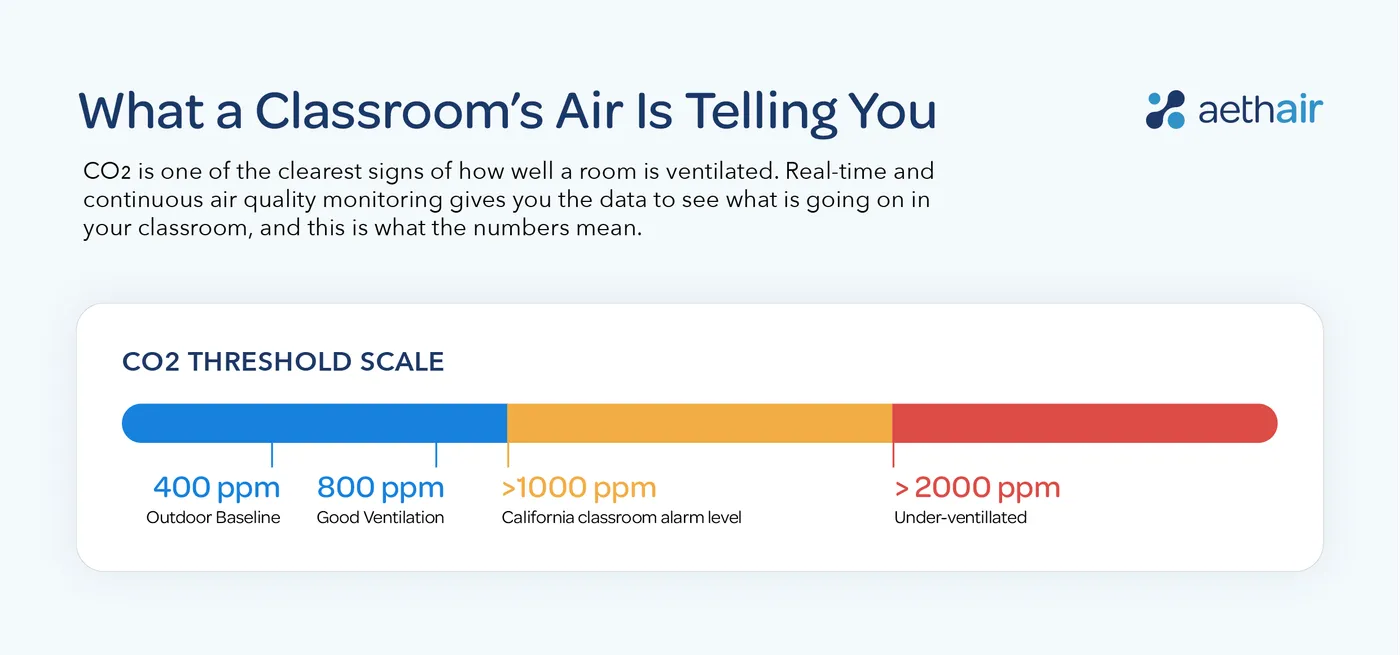
The fastest-moving part of this picture is at the state level. The Environmental Law Institute's database of state IAQ laws (opens in a new tab) tracks dozens of school-specific provisions, and several states have moved beyond ventilation design into measurement. California is the clearest example: under its building and energy codes, newly constructed classrooms must include carbon dioxide monitors that alarm at 1,100 ppm. The rule rests on the idea that a high CO2 reading is a reliable sign a room is under-ventilated. The direction of travel is toward measurement rather than design intent alone, and a monitoring program put in place now tends to anticipate where requirements are heading.
What to Monitor in a Classroom
The shorthand "air quality" covers several distinct conditions, and in a school setting a handful of them carry most of the weight. The single most useful is carbon dioxide, with particulates, volatile organic compounds, temperature, and humidity rounding out the picture.
| Parameter | What it tells you | Common reference point |
|---|---|---|
| Carbon dioxide (CO2) | How well the room is ventilated for its occupancy | Below ~1,000 ppm; 800 ppm marks good ventilation |
| Fine particulates (PM2.5) | Smoke, traffic, and outdoor pollution getting in | EPA AQI categories for daily decisions |
| Volatile organic compounds (VOCs) | Off-gassing from furnishings, cleaning, art and shop materials | No single classroom limit; watch for trends and spikes |
| Temperature and humidity | Comfort, plus mold risk when humidity stays high | Roughly 30 to 60% relative humidity |
Carbon dioxide is worth dwelling on, because it is easy to misread. At the levels found in classrooms it is not a poison; it is a stand-in for ventilation. People exhale CO2 constantly, so when a room's level climbs it means fresh outdoor air is not arriving fast enough to dilute what the occupants produce, and whatever else builds up in stale air is building up alongside it. That is why CO2 anchors so much school guidance. A common target is to keep it below about 1,000 ppm, with 800 ppm often cited as a marker of good ventilation. Readings drifting toward 2,000 ppm and beyond, which real classrooms reach more often than people expect, signal a poorly ventilated room.
Fine particulate matter (PM2.5, particles 2.5 micrometers across or smaller) is the parameter that matters most on bad-air days. Wildfire smoke, nearby traffic, and idling buses at drop-off all push particulates up, and because children's lungs are sensitive, a school often needs to decide whether to keep activities indoors well before the outdoor air looks obviously hazardous.
Volatile organic compounds (VOCs, gases released by many materials and products) round out the indoor sources. They come from new furniture and flooring, cleaning supplies, dry-erase markers, and the solvents and paints in art rooms and shop classes, and while there is no single classroom limit for them, a monitor that tracks VOC trends will catch the spike after a room is cleaned or refinished over a weekend. Temperature and humidity close the list: beyond comfort, humidity that stays too high feeds mold and dust mites, both common asthma triggers, which ties this parameter directly back to attendance.
Why Continuous Monitoring Beats Spot Checks
Classroom air is not steady. A room can start the day clean and reach two or three times the recommended CO2 level by the end of a packed afternoon period, then drop back over lunch when it empties. A consultant walking through with a handheld meter once a quarter sees one moment out of thousands, and the odds that the moment is the bad one are low. The problems that affect students happen on a daily cycle that periodic testing is structurally unable to see.
Continuous monitoring changes what a district can know and do. A fixed sensor in the room records around the clock, so the afternoon CO2 climb, the Monday-morning VOC spike from weekend cleaning, and the slow humidity drift in a room with a failing damper all show up as patterns rather than going unnoticed. That record is also what makes a response possible: a facilities team can see which rooms run hot, prioritize HVAC work where the data points, and confirm afterward that the fix held. The difference between continuous and periodic monitoring is the same difference covered in our overview of the types of air quality monitors, and in a school it is the difference between reacting to complaints and managing a building.
The ROI of School Air Quality Monitoring
For a district weighing where to spend limited dollars, indoor air quality monitoring has to be justified like any other investment. The case is stronger than it first appears, because the returns land in three separate budgets.
The first is attendance, and it is the most direct. In many states, district funding is tied to average daily attendance, so every avoidable sick day is lost revenue as well as lost instruction. Asthma alone is one of the leading causes of school absence, accounting for millions of missed school days nationally each year, and asthma is sensitive to exactly the conditions monitoring tracks: particulates, mold driven by high humidity, and poor ventilation. Studies of classroom ventilation have repeatedly found that better-ventilated rooms with lower CO2 see fewer absences, which means air quality is, in part, an attendance-funding question.

The second is academic performance, which is harder to put a dollar figure on but well supported in the research. Reviews of classroom studies have linked higher ventilation rates and lower CO2 to better scores on standardized math and reading tests, and controlled studies have found that bringing CO2 down from very high levels toward about 900 ppm improves the speed and accuracy with which students complete work. For a school whose core mission is learning, ventilation that demonstrably affects test performance is not a side issue.
The third is operations: energy and maintenance. Continuous CO2 data is what makes demand-controlled ventilation practical: a building can bring in outdoor air based on how many people are actually in a room rather than running fans flat out on a fixed schedule, which can cut the energy spent heating and cooling that air. Monitoring also catches ventilation faults, humidity problems, and filtration failures early, when they are a maintenance ticket rather than a mold remediation project or an emergency HVAC replacement. Set against those numbers, the monitoring itself is a modest line item, which is what makes the return compelling.
Key Takeaways
Indoor air quality in schools is governed by guidance and design standards rather than a single enforceable limit. The main references are the EPA's IAQ Tools for Schools program and ASHRAE Standard 62.1, alongside a rising number of state requirements, some of which now mandate classroom CO2 monitoring. The parameters that matter most are CO2 as a ventilation indicator, fine particulates, VOCs, temperature, and humidity. Continuous monitoring is what turns those parameters from an occasional snapshot into a usable record, and the investment is justified by its effect on attendance, student performance, and operating costs at the same time.
How Aethair Supports Air Quality Monitoring in Schools
Aethair gives schools a way to see and document classroom conditions continuously rather than guessing at them. Aethair IAQ is a wall-mounted monitor built for occupied indoor spaces. Its calibrated sensors run around the clock and measure the parameters that matter in a classroom: CO2, fine particulates, VOCs, temperature, and relative humidity. A single classroom, a building, or every campus in a district can be covered with the same hardware.
The data reports into Environet, the web-based platform at the center of Aethair's environmental intelligence approach, where live and historical readings sit together and are visible from a desktop or a phone. Facilities staff can watch conditions in real time, work back through trends to find the rooms that run hot or stuffy, and set Intelligent Alerts against thresholds such as a CO2 limit, so the right person is notified when a room crosses a line rather than learning about it from a complaint. Aethair Reports turns that record into clear documentation on demand or on a schedule, which is useful for board updates, parent communication, and any state requirement a district has to answer to. Because every figure traces back to a calibrated reading, the documentation holds up, and the decisions about what to do with it stay with the district.
The recommended configuration for this
Aethair IAQ only
one monitor, nothing to add-

Aethair IAQ built-in sensors
Compact plug-in monitor with every sensor built in, nothing to add. Ideal for straightforward indoor air quality monitoring.
Built-inCarbon Dioxide (CO₂)Relative HumidityPM2.5Air TemperatureVOC (Total)Also measures 8 more
Formaldehyde (CH₂O)Dew PointHeat IndexParticle Count (by size)PM1PM10Total PM / Mass Conc.Barometric Pressure
Recommended
best match-

Industrial monitor for indoor and outdoor sites. Built-in sensors cover the essentials, and hot-swappable gas sensor cartridges and a differential-pressure option add more.
Built-inRelative HumidityPM2.5Air TemperatureGas 1

Aethair CO₂ (dual NDIR)
Carbon Dioxide (CO₂)Dual-thermopile NDIR (non-dispersive infrared) sensing measures CO₂ with no chemical consumables, for…
Also fits: Aethair CO₂ (self-calibrating NDIR)
Gas 2

Aethair VOC (ppm PID)
VOC (Total)A 10.6 eV photoionization detector (PID) ionizes volatile organic compounds for direct ppm readings across a…
Also fits: Aethair VOC (ppb PID), Aethair MultiGas+, Aethair VOC (ppb PID, wide range)
MultiSense
Free: a MultiSense, stock or built to order
Expansion
Free: differential pressure
Also measures 10 more
Dew PointHeat IndexIlluminance / LightParticle Count (by size)PM1PM10Total PM / Mass Conc.Barometric PressureEquivalent Continuous Level (Leq)Sound Pressure Level (SPL)
Air Quality Monitoring for Schools and Universities
See how Aethair supports continuous indoor air quality monitoring and clear reporting across classrooms, buildings, and campuses.
Talk to Aethair About School Monitoring (opens in a new tab)See Solutions for Education →
Indoor Air Quality in Schools: Frequently Asked Questions
What standards apply to indoor air quality in schools?
There is no single federal indoor air quality standard for schools. The EPA's IAQ Tools for Schools program is the most widely used framework, and most districts that run a formal program base it on that guidance. Ventilation design generally follows ASHRAE Standard 62.1, which sets minimum outdoor air rates for classrooms. A growing number of states add their own requirements, and several now require carbon dioxide monitoring in classrooms under building or energy codes.
What is a good CO2 level for a classroom?
Carbon dioxide is used as a proxy for how well a classroom is ventilated, not as a toxic gas at these levels. A common target is to keep CO2 below about 1,000 ppm, and some guidance, including California's, points to 800 ppm as a marker of good ventilation. California's classroom monitoring rules require an alarm at 1,100 ppm. Readings climbing well above these levels usually mean the room is bringing in too little outdoor air for the number of people in it.
What should schools monitor besides CO2?
Carbon dioxide is the most useful single indicator, but a fuller picture includes fine particulates (PM2.5), volatile organic compounds, temperature, and relative humidity. Particulates matter on wildfire smoke and high-pollution days and around drop-off traffic. Humidity matters because levels that stay too high encourage mold and dust mites, both of which are linked to asthma. Temperature and humidity together also shape comfort, which affects how well students concentrate.
Does indoor air quality really affect student performance?
The research points consistently in one direction. Reviews of classroom studies have found that higher ventilation rates and lower CO2 are associated with better performance on standardized tests and fewer absences, though the size of the effect varies by study. Reducing CO2 from very high levels toward 900 ppm has been linked to measurable gains in the speed and accuracy of schoolwork. The evidence is strong enough that ventilation is now treated as an academic issue, not only a facilities one.
How does air quality monitoring pay for itself in a school?
The return shows up in a few places. In many states, district funding is tied to attendance, so fewer sick days and asthma absences protect revenue directly. Continuous CO2 data lets a district ventilate based on actual occupancy rather than running fans at full rate all day, which can lower energy use. Monitoring also catches ventilation and humidity problems early, before they turn into mold remediation or emergency HVAC repairs. The monitoring itself is a small line item against those costs.