
OSHA air quality standards are the regulatory backbone of workplace exposure management in the United States, yet the framework is narrower, older, and more fragmented than many EHS teams expect. The Occupational Safety and Health Administration (OSHA) regulates specific contaminants through permissible exposure limits (PELs), substance-specific standards, and the General Duty Clause, all shaped by decisions made more than five decades ago. For employers operating in general industry, construction, maritime, and mixed-use environments, the practical question is not whether OSHA regulates air quality, but how its overlapping standards apply to a given facility, which limits are legally enforceable, and what documentation can defend an exposure assessment during an inspection.
Understanding OSHA's Role in Workplace Air Quality

OSHA derives its authority from the Occupational Safety and Health Act of 1970, which directs the agency to set and enforce standards protecting workers from recognized hazards. Air quality, in OSHA's regulatory vocabulary, is not a single topic but a collection of exposures: toxic gases, vapors, fumes, dusts, mists, and particulates. Each is addressed either through a substance-specific standard or through the air contaminants rule at 29 CFR 1910.1000 (opens in a new tab). Where no specific standard applies, OSHA falls back on Section 5(a)(1) of the OSH Act (opens in a new tab), commonly called the General Duty Clause, which requires employers to furnish a workplace "free from recognized hazards" likely to cause death or serious physical harm. That clause is the regulatory backstop for indoor air quality, heat stress, and emerging contaminants not yet covered by formal rulemaking. OSHA cites it routinely in enforcement actions where no specific PEL applies.
OSHA is not the only agency shaping air quality policy. The EPA regulates outdoor ambient air under the Clean Air Act (opens in a new tab) and sets the National Ambient Air Quality Standards (NAAQS) (opens in a new tab), while NIOSH, housed in the CDC, publishes advisory Recommended Exposure Limits (RELs) (opens in a new tab) based on current research. OSHA PELs remain the enforceable floor for workplace exposure in the United States, and they are generally less protective than NIOSH RELs or ACGIH Threshold Limit Values.
OSHA Air Quality Standards: General Industry vs. Construction
OSHA's workplace air quality regulations are organized primarily by sector, with distinct rule sets for general industry and construction. The substantive PELs often align across sectors, but the implementing requirements and documentation obligations differ.
General Industry (29 CFR 1910)
General industry employers are governed by 29 CFR Part 1910, Subpart Z (opens in a new tab), which covers toxic and hazardous substances. The foundational rule is 29 CFR 1910.1000 (opens in a new tab), which incorporates three tables of air contaminant limits:
- Table Z-1 lists PELs for roughly 500 substances, mostly as 8-hour time-weighted averages (TWAs), with ceiling limits or short-term exposure limits (STELs) for select chemicals.
- Table Z-2 provides additional limits for specific substances, including acceptable ceiling concentrations and peak exposure allowances.
- Table Z-3 covers mineral dusts, including the exposure limit for particulates not otherwise regulated (PNOR).
Table Z-1 in 29 CFR 1910.1000 sets 8-hour time-weighted-average limits for roughly 500 air contaminants. A representative selection of commonly referenced substances:
| Substance | PEL | Limit Type |
|---|---|---|
| Ammonia (NH₃) | 50 ppm | 8-hour TWA |
| Carbon dioxide (CO₂) | 5,000 ppm | 8-hour TWA |
| Carbon monoxide (CO) | 50 ppm | 8-hour TWA |
| Chlorine (Cl₂) | 1 ppm | Ceiling |
| Hydrogen chloride (HCl) | 5 ppm | Ceiling |
| Nitric oxide (NO) | 25 ppm | 8-hour TWA |
| Nitrogen dioxide (NO₂) | 5 ppm | Ceiling |
| Ozone (O₃) | 0.1 ppm | 8-hour TWA |
| Phosgene (COCl₂) | 0.1 ppm | 8-hour TWA |
| Sulfur dioxide (SO₂) | 5 ppm | 8-hour TWA |
| Particulates not otherwise regulated | 15 mg/m³ total; 5 mg/m³ respirable | 8-hour TWA |
Representative subset. See the complete Table Z-1 (opens in a new tab) on osha.gov for the full list of 500+ substances. Several Table Z-1 entries (formaldehyde, benzene, silica, lead, asbestos, and others) are superseded by substance-specific standards in Subpart Z.
Table Z-2 establishes different limit structures for specific substances, combining an 8-hour TWA with acceptable ceiling concentrations and, for most substances, an acceptable peak concentration above the ceiling for a defined duration.
| Substance | 8-hour TWA | Ceiling | Peak (max duration) |
|---|---|---|---|
| Benzene* | 10 ppm | 25 ppm | 50 ppm (10 min) |
| Beryllium and beryllium compounds* | 2 μg/m³ | 5 μg/m³ | 25 μg/m³ (30 min) |
| Cadmium fume* | 0.1 mg/m³ | 0.3 mg/m³ | – |
| Cadmium dust* | 0.2 mg/m³ | 0.6 mg/m³ | – |
| Carbon disulfide | 20 ppm | 30 ppm | 100 ppm (30 min) |
| Carbon tetrachloride | 10 ppm | 25 ppm | 200 ppm (5 min in any 4 hr) |
| Chromic acid and chromates* | – | 1 mg/10 m³ | – |
| Ethylene dibromide | 20 ppm | 30 ppm | 50 ppm (5 min) |
| Ethylene dichloride | 50 ppm | 100 ppm | 200 ppm (5 min in any 3 hr) |
| Fluoride (as dust) | 2.5 mg/m³ | – | – |
| Formaldehyde | See 29 CFR 1910.1048 | – | – |
| Hydrogen fluoride | 3 ppm | – | – |
| Hydrogen sulfide (H₂S) | – | 20 ppm | 50 ppm (10 min, once per shift) |
| Mercury | – | 1 mg/10 m³ | – |
| Methyl chloride | 100 ppm | 200 ppm | 300 ppm (5 min in any 3 hr) |
| Methylene chloride | See 29 CFR 1910.1052 | – | – |
| Organo (alkyl) mercury | 0.01 mg/m³ | 0.04 mg/m³ | – |
| Styrene | 100 ppm | 200 ppm | 600 ppm (5 min in any 3 hr) |
| Tetrachloroethylene | 100 ppm | 200 ppm | 300 ppm (5 min in any 3 hr) |
| Toluene | 200 ppm | 300 ppm | 500 ppm (10 min) |
| Trichloroethylene | 100 ppm | 200 ppm | 300 ppm (5 min in any 2 hr) |
*Superseded by substance-specific standards where those apply: benzene by 1910.1028 (1 ppm TWA, 5 ppm STEL), beryllium by 1910.1024, cadmium by 1910.1027, chromic acid by 1910.1026 (Chromium VI). Table Z-2 values continue to apply only in sectors or operations not covered by the substance-specific rule. See the complete Table Z-2 (opens in a new tab) on osha.gov.
Table Z-3 regulates mineral dusts, with exposure limits expressed in mg/m³, mppcf (millions of particles per cubic foot), or formula-based values tied to silica content.
| Substance | PEL (Respirable) | PEL (Total Dust) | Notes |
|---|---|---|---|
| Crystalline silica (respirable quartz) | 10 mg/m³ ÷ (%SiO₂ + 2) | – | Formula-based limit. Cristobalite and tridymite use ½ the calculated value. Superseded in most sectors by 29 CFR 1910.1053 and 1926.1153: 50 μg/m³ TWA, 25 μg/m³ action level. |
| Amorphous silica (diatomaceous earth) | – | 80 mg/m³ ÷ (%SiO₂), or 20 mppcf | Formula-based limit |
| Mica, soapstone, talc (non-asbestiform) | – | 20 mppcf | Use quartz limit if ≥1% crystalline silica |
| Portland cement | – | 50 mppcf | – |
| Graphite (natural) | – | 15 mppcf | – |
| Coal dust (<5% SiO₂) | 2.4 mg/m³ | – | Higher-silica coal dust uses formula-based limit |
| Inert or nuisance dust (PNOR) | 5 mg/m³ | 15 mg/m³ | Same limit appears in Table Z-1 |
mppcf = millions of particles per cubic foot (mppcf × 35.3 ≈ particles per m³; count-based, not mass-based). See the complete Table Z-3 (opens in a new tab) on osha.gov for the full list and footnotes.
Beyond the general contaminants rule, OSHA has issued substance-specific standards for higher-hazard exposures, including respirable crystalline silica (29 CFR 1910.1053) (opens in a new tab), lead (1910.1025) (opens in a new tab), benzene (1910.1028) (opens in a new tab), formaldehyde (1910.1048) (opens in a new tab), asbestos (1910.1001) (opens in a new tab), and dozens of others. These standards typically include an action level, a PEL, exposure assessment requirements, engineering controls, medical surveillance triggers, and recordkeeping obligations.
Construction (29 CFR 1926)
Construction employers fall under 29 CFR Part 1926 (opens in a new tab). The analog to 1910.1000 is 29 CFR 1926.55 (opens in a new tab), which covers gases, vapors, fumes, dusts, and mists and references a parallel table of exposure limits that largely mirrors Table Z-1 with sector-specific modifications. Construction also has its own respirable crystalline silica rule at 29 CFR 1926.1153 (opens in a new tab), issued alongside the general industry version in 2016. It establishes the same PEL and action level as the general industry standard, but adds a set of engineering control specifications through Table 1 that lets contractors meet the standard by following specified control methods for common tasks such as concrete cutting, drilling, and grinding.
Permissible Exposure Limits for Common Air Contaminants
Understanding which PELs apply is the practical core of OSHA air quality compliance. The following limits are among those most relevant to EHS teams across industrial and commercial settings:
| Substance | OSHA PEL | Limit Type | Citation |
|---|---|---|---|
| Carbon monoxide (CO) | 50 ppm | 8-hour TWA | Table Z-1 |
| Nitrogen dioxide (NO₂) | 5 ppm | Ceiling | Table Z-1 |
| Sulfur dioxide (SO₂) | 5 ppm | 8-hour TWA | Table Z-1 |
| Ozone (O₃) | 0.1 ppm | 8-hour TWA | Table Z-1 |
| Hydrogen sulfide (H₂S) | 20 ppm ceiling; 50 ppm peak (10 min, once per 8-hour shift) | Ceiling / Peak | Table Z-2 |
| Benzene | 1 ppm TWA; 5 ppm STEL | 8-hour TWA / STEL | 29 CFR 1910.1028 |
| Formaldehyde (CH₂O) | 0.75 ppm TWA; 2 ppm STEL | 8-hour TWA / STEL | 29 CFR 1910.1048 |
| Respirable crystalline silica | 50 μg/m³ TWA (25 μg/m³ action level) | 8-hour TWA | 29 CFR 1910.1053 and 1926.1153 |
| Lead | 50 μg/m³ TWA (30 μg/m³ action level) | 8-hour TWA | 29 CFR 1910.1025 |
| Particulates not otherwise regulated (PNOR) | 15 mg/m³ total dust; 5 mg/m³ respirable | 8-hour TWA | Tables Z-1 and Z-3 |
For reference, NIOSH recommends a more protective 35 ppm TWA and 200 ppm ceiling for carbon monoxide, one example of a broader pattern.
Most Table Z-1 PELs were adopted in 1971 from the 1968 ACGIH Threshold Limit Values and have not been updated since. OSHA acknowledges this directly on its Annotated PEL Tables (opens in a new tab), which publish the enforceable OSHA PEL alongside the more current California OSHA PEL, NIOSH REL, and ACGIH TLV for each substance. Many employers voluntarily align internal action levels with these more protective values, particularly where reputational risk or ESG disclosure obligations are material. EHS teams managing multi-site operations often set internal thresholds closer to the NIOSH or ACGIH numbers rather than defaulting to the regulatory minimum.
Recommended Monitoring Configuration for OSHA PEL Gases
Several of the gases in the tables above are measurable by real-time sensor technology, so they can be tracked continuously between formal industrial hygiene sampling events. Substances such as benzene, lead, asbestos, and speciated respirable crystalline silica stay with certified sampling and laboratory analysis.
Recommended
best match-

Industrial monitor for indoor and outdoor sites. Built-in sensors cover the essentials, and hot-swappable gas sensor cartridges and a differential-pressure option add more.
Gas 1

Aethair O₃+NO₂
Nitrogen Dioxide (NO₂)Ozone (O₃)Four-electrode electrochemical sensing measures oxidizing gases (ozone plus nitrogen dioxide) and reports one…
Gas 2

Aethair CO (electrochemical)
Carbon Monoxide (CO)An amperometric electrochemical CO cell with a solid, non-aqueous electrolyte (the long-life, low-power…
Also fits: Aethair MultiGas+, Aethair CO (ppb, four-electrode)
MultiSense

Custom MultiSense built to order
Carbon Dioxide (CO₂)Sulfur Dioxide (SO₂)Hydrogen Sulfide (H₂S)Built to order for the MultiSense socket with the Aethair CO₂ (dual NDIR) cartridge's sensor (0-5000 ppm, 1 ppm resolution), the Aethair SO₂ cartridge's sensor (0-100 ppm, 5 ppb resolution), and the Aethair H₂S cartridge's sensor (0-50 ppm, 5 ppb resolution).
Expansion
Free: differential pressure
Also measures 13 more
Dew PointHeat IndexRelative HumidityIlluminance / LightParticle Count (by size)PM1PM10PM2.5Total PM / Mass Conc.Barometric PressureEquivalent Continuous Level (Leq)Sound Pressure Level (SPL)Air Temperature
Not in this configuration 6
Ammonia (NH₃)Chlorine (Cl₂)Mercury (Hg)Nitric Oxide (NO)Hydrogen Fluoride (HF)Hydrogen Chloride (HCl)
Recommended
best match-
Industrial monitor for indoor and outdoor sites. Built-in sensors cover the essentials, and hot-swappable gas sensor cartridges and a differential-pressure option add more.
Gas 1
Aethair O₃+NO₂
Nitrogen Dioxide (NO₂)Ozone (O₃)Four-electrode electrochemical sensing measures oxidizing gases (ozone plus nitrogen dioxide) and reports one…
Gas 2
Aethair CO (electrochemical)
Carbon Monoxide (CO)An amperometric electrochemical CO cell with a solid, non-aqueous electrolyte (the long-life, low-power…
Also fits: Aethair MultiGas+, Aethair CO (ppb, four-electrode)
MultiSense
Custom MultiSense built to order
Hydrogen Sulfide (H₂S)Sulfur Dioxide (SO₂)Carbon Dioxide (CO₂)Built to order for the MultiSense socket with the Aethair H₂S cartridge's sensor (0-50 ppm, 5 ppb resolution), the Aethair SO₂ cartridge's sensor (0-100 ppm, 5 ppb resolution), and the Aethair CO₂ (dual NDIR) cartridge's sensor (0-5000 ppm, 1 ppm resolution).
Expansion
Free: differential pressure
Also measures 13 more
Dew PointHeat IndexRelative HumidityIlluminance / LightParticle Count (by size)PM1PM10PM2.5Total PM / Mass Conc.Barometric PressureEquivalent Continuous Level (Leq)Sound Pressure Level (SPL)Air Temperature -

Thiamis connects 2 instruments
A gateway that connects the third-party instruments you choose to the Aethair Platform.
-
 Chlorine (Cl₂)Ammonia (NH₃)Nitric Oxide (NO)
RAE Systems (Honeywell) portable gas detectors.
-

AMETEK Brookfield Specialty Air Analyzers
Mercury (Hg)Jerome portable single-gas analyzers by AMETEK Brookfield (formerly AMETEK Arizona Instrument).
Also measures 4 more
Methane (CH₄)Combustible (LEL)Oxygen (O₂)VOC (Total) -
Not coveredHydrogen Fluoride (HF)Hydrogen Chloride (HCl)no supported configuration measures these yet
Build a configuration for all 12 OSHA PEL parameters →
Solutions judged against OSHA PEL:
Landfill, Biogas & Odor
Methane, H₂S, and odor complaint response
Occupational Safety & Industrial Hygiene
Worker exposure, confined space, and heat stress
Oil & Gas / Petrochemical
Fence-line VOC, H₂S, and methane leak detection
OSHA's Approach to Indoor Air Quality in Office Environments
OSHA has no comprehensive indoor air quality standard for office environments, and the history explains why. The agency issued a notice of proposed rulemaking on indoor air quality (opens in a new tab) on April 5, 1994, covering sick building syndrome, building-related illness, and environmental tobacco smoke. After an extended public comment period, OSHA formally withdrew the proposal (opens in a new tab) on December 17, 2001. It cited insufficient record evidence for the non-smoking portions of the rule and the spread of state and local smoke-free workplace laws in the intervening years. Without a dedicated IAQ standard, OSHA addresses indoor air complaints in three ways. It applies the General Duty Clause where a recognized indoor hazard could cause serious harm. It enforces substance-specific PELs (formaldehyde, carbon monoxide, or asbestos, for example) where those contaminants are present in offices. And its Indoor Air Quality overview (opens in a new tab) and Technical Manual reference ASHRAE Standard 62.1 for ventilation, temperature, and humidity, even though ASHRAE 62.1 is not itself an OSHA rule.
The practical implication is that common indoor parameters, including CO₂ as a ventilation proxy, relative humidity, temperature, and total volatile organic compounds (TVOCs), are not covered by OSHA PELs. Employers managing commercial office space typically align with ASHRAE 62.1, the WELL Building Standard, or LEED thresholds to address occupant complaints and support healthy-building certifications, even though those thresholds fall outside OSHA's direct enforcement authority.
OSHA and Outdoor Air Quality: Heat and Wildfire Smoke
Just as OSHA has no single indoor air quality standard, it has no ambient outdoor-air quality standard for worksites. The permissible exposure limits in 29 CFR 1910.1000 apply to workplace air whether the work happens indoors or outdoors, but there is no OSHA equivalent of the EPA's outdoor NAAQS for protecting workers from environmental conditions such as heat and wildfire smoke. As with indoor air, OSHA has historically relied on the General Duty Clause to address these hazards, and two of them are now moving toward more specific rules.
Heat. In 2024 OSHA proposed a federal Heat Injury and Illness Prevention in Outdoor and Indoor Work Settings (opens in a new tab) standard, its first dedicated heat rule. As of mid-2026 it remains a proposal rather than a final rule, structured around two triggers: an initial heat trigger at a heat index of 80°F and a high-heat trigger at 90°F, each carrying its own water, rest, shade, and acclimatization requirements. Until it is finalized, OSHA addresses heat hazards through a National Emphasis Program and the General Duty Clause. Heat index is derived from temperature and relative humidity, both captured by continuous environmental monitors.
Wildfire smoke. There is no federal wildfire smoke standard, but California's Cal/OSHA rule at Section 5141.1 (opens in a new tab), in effect since 2021, sets the clearest worker-protection trigger in the country: when the current Air Quality Index for PM2.5 reaches 151 or higher and employees may be exposed to wildfire smoke, employers must provide NIOSH-approved respirators such as N95s for voluntary use and train workers on smoke hazards. Both triggers rest on parameters that can be measured continuously: heat index from temperature and humidity, and wildfire smoke from real-time PM2.5. That is why outdoor employers increasingly pair these thresholds with on-site outdoor air quality, perimeter, and wildfire smoke monitoring instead of relying on a fixed regulatory station miles away.
How Continuous Monitoring Supports OSHA Documentation
Most OSHA air quality standards were written around periodic industrial hygiene sampling: a calibrated pump, a sorbent tube or filter, and a laboratory analysis producing a single time-weighted average. That approach remains valid. It is also increasingly insufficient on its own.
For substance-specific standards with exposure assessment, action level, and re-monitoring requirements, such as silica, lead, and benzene, episodic sampling creates gaps in documentation and delays in corrective action. Continuous monitoring closes those gaps for the parameters it can cover. Calibrated real-time sensors capture minute-by-minute concentrations, compute rolling TWAs automatically, and flag exceedances as they occur rather than weeks later when laboratory results return. For regulated gases and particulates measurable by real-time sensor technology, continuous data supports a defensible argument that exposures remain below applicable thresholds between formal industrial hygiene sampling events, and it provides a date-stamped record of when corrective actions were taken.
OSHA's recordkeeping expectations reinforce the case for continuous data. 29 CFR 1910.1020 (opens in a new tab), the access to employee exposure and medical records standard, requires employers to retain exposure monitoring records for 30 years, and the 29 CFR 1904 injury and illness recordkeeping rule requires employers to log work-related illnesses tied to airborne exposures. Inspections following a complaint or an incident frequently turn on whether the employer can produce historical exposure data, not whether sampling was technically accurate on a given day.
How Aethair PRO and Thiamis Support OSHA Compliance Monitoring
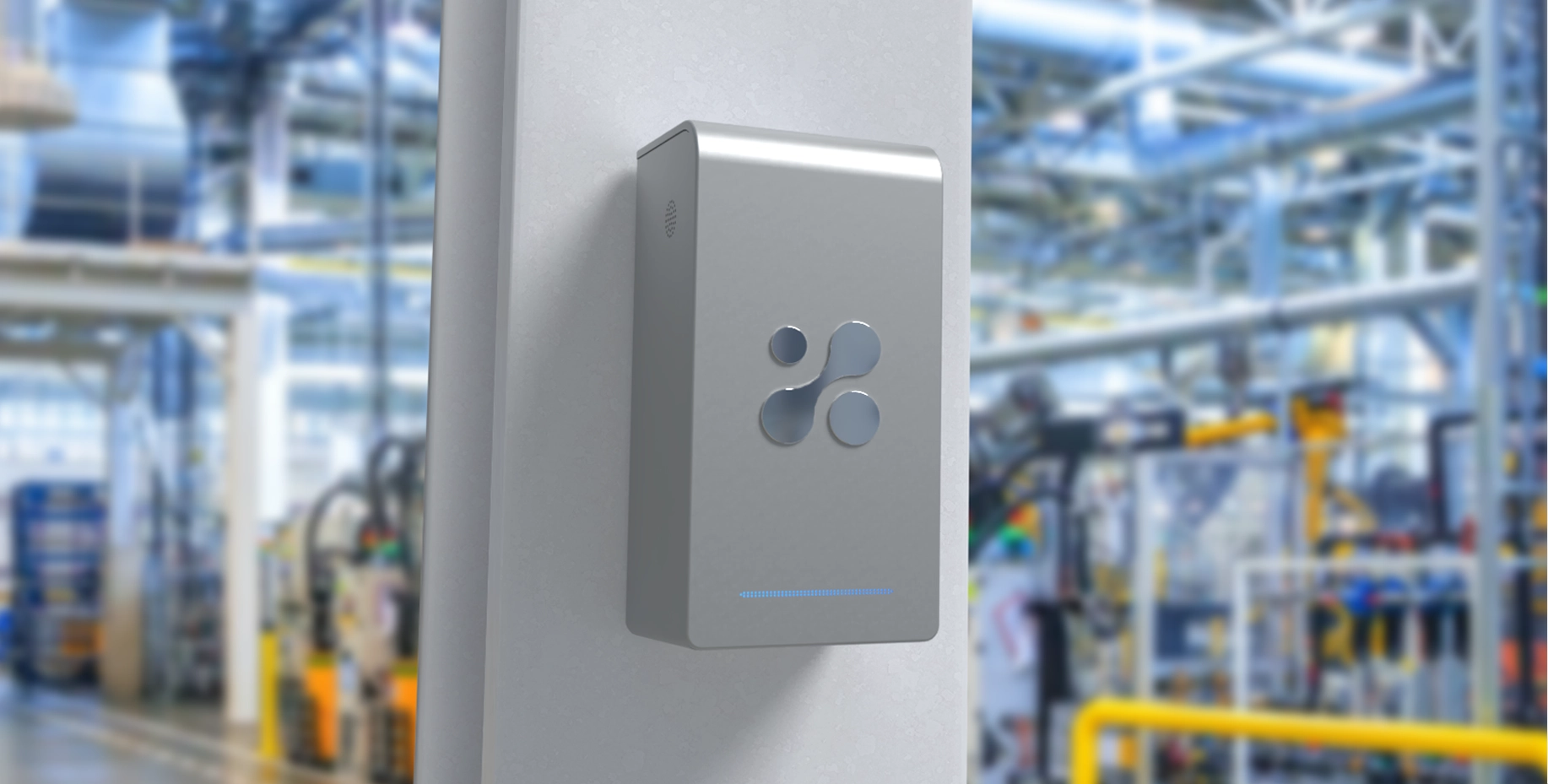
Aethair PRO is an industrial-grade air quality monitor built for environments where OSHA compliance documentation matters. It continuously measures regulated particulate fractions (PM1, PM2.5, PM10, and TSP), and each unit supports configurable gas sensor modules that can be provisioned for carbon monoxide, carbon dioxide, nitric oxide, nitrogen dioxide, sulfur dioxide, ozone, hydrogen sulfide, methane, formaldehyde, and volatile organic compounds at ppm or ppb resolution. Devices also capture temperature, humidity, barometric pressure (with optional differential pressure), ambient light, and noise for contextual analysis. Each unit is factory-calibrated, connects over 4G LTE or Ethernet, and feeds data directly into Environet, Aethair's cloud analytics platform.
Thiamis extends coverage by integrating field-grade and regulatory-grade sensors across parameter types that fall outside Aethair's native sensor suite. For facilities with existing monitoring infrastructure or specialized measurement needs, Thiamis aggregates the data so all readings land in one system of record.
Environet handles the compliance documentation layer. It computes averages and exposure times, flags exceedances against configurable thresholds, and generates audit-ready reports using real data and limits set by the user. Noesis, Aethair's AI analysis engine, allows EHS teams to query exposure data in plain language and produce summary reports on demand. Aethair Reports delivers structured outputs formatted for internal review, regulator inquiries, or ESG disclosures, and can be scheduled to generate automatically on a daily or weekly basis.
Several substances regulated by OSHA, including benzene, lead, asbestos, and the speciated respirable fraction of crystalline silica, fall outside the continuous-sensor scope and are typically addressed through certified industrial hygiene sampling with laboratory analysis. For the parameters that can be monitored in real time, Environet retains continuous sensor readings alongside data from third-party instruments connected through Thiamis. EHS teams get one web console rather than a patchwork of separate systems.
Continuous monitoring does not replace certified industrial hygiene sampling where OSHA requires it. It complements that work by providing the continuous, defensible record of workplace air quality that modern EHS compliance depends on.
Industrial-Grade Monitoring for OSHA Compliance
See how Aethair PRO and Thiamis deliver continuous, calibrated air quality data built for defensible OSHA documentation.
Schedule an OSHA Compliance Demo (opens in a new tab)Explore Aethair PRO →
OSHA Air Quality Standards: FAQs
Does OSHA have an indoor air quality standard?
No. OSHA has no comprehensive indoor air quality standard for office environments. It proposed an IAQ rule in 1994 and formally withdrew it in 2001. OSHA instead addresses indoor air through the General Duty Clause, through substance-specific PELs where contaminants such as formaldehyde or carbon monoxide are present, and through guidance that references ASHRAE Standard 62.1 for ventilation, temperature, and humidity. Common parameters such as CO₂, TVOCs, and humidity fall outside OSHA PELs, so employers typically align with ASHRAE 62.1, the WELL Building Standard, or LEED.
What is 29 CFR 1910.1000?
29 CFR 1910.1000 is OSHA's air contaminants standard for general industry. It sets permissible exposure limits for roughly 500 substances across three tables: Table Z-1 (mostly 8-hour time-weighted averages), Table Z-2 (ceilings and peak limits for specific substances), and Table Z-3 (mineral dusts). It is the foundational rule employers reference when no substance-specific standard applies.
What are OSHA permissible exposure limits (PELs), and who sets them?
A permissible exposure limit is the maximum concentration of an air contaminant a worker may be exposed to under OSHA rules, usually as an 8-hour time-weighted average, with ceiling or short-term limits for certain substances. OSHA sets and enforces PELs under the authority of the Occupational Safety and Health Act of 1970. Most Table Z-1 PELs were adopted in 1971 from 1968 ACGIH values and remain the enforceable floor for workplace exposure.
What is the OSHA PEL for carbon monoxide?
OSHA's permissible exposure limit for carbon monoxide is 50 ppm as an 8-hour time-weighted average, listed in Table Z-1 of 29 CFR 1910.1000. NIOSH recommends a more protective 35 ppm time-weighted average and a 200 ppm ceiling, which some employers adopt as an internal action level.
Does OSHA require air quality monitoring?
OSHA does not impose a single blanket air monitoring requirement, but many substance-specific standards, including those for silica, lead, and benzene, require exposure assessment, periodic monitoring, and recordkeeping. Employers must also retain exposure records for 30 years under 29 CFR 1910.1020. Continuous monitoring complements certified industrial hygiene sampling by providing a date-stamped record of conditions between formal sampling events.
How do OSHA PELs differ from NIOSH RELs and ACGIH TLVs?
OSHA PELs are legally enforceable limits. NIOSH Recommended Exposure Limits and ACGIH Threshold Limit Values are advisory and generally more protective, reflecting more current research. Because most OSHA PELs date to 1971, OSHA publishes Annotated PEL Tables that list the enforceable PEL alongside California OSHA, NIOSH, and ACGIH values. Many EHS teams adopt internal thresholds closer to the more protective references.
Does OSHA have outdoor air quality standards?
OSHA has no ambient outdoor-air quality standard for worksites. Its permissible exposure limits under 29 CFR 1910.1000 apply to workplace air whether work is indoors or outdoors, but outdoor environmental hazards such as heat and wildfire smoke are addressed through the General Duty Clause and emerging rules. OSHA proposed a federal heat standard in 2024, built around heat-index triggers of 80°F and 90°F, that remains unfinalized as of 2026, and states such as California regulate wildfire smoke through Cal/OSHA Section 5141.1.
At what AQI is wildfire smoke protection required for workers?
Under California's Cal/OSHA Section 5141.1, wildfire smoke protections apply when the current Air Quality Index for PM2.5 is 151 or higher and workers may reasonably be exposed. At that point employers must provide NIOSH-approved respirators such as N95s for voluntary use and train workers on smoke hazards. There is no equivalent federal standard, so outside California the General Duty Clause governs outdoor smoke exposure.