
Of all the air quality parameters EHS professionals manage, PM2.5 (fine particulate matter) carries some of the most significant health consequences and some of the most clearly defined regulatory expectations. It is invisible to the naked eye, present in virtually every environment, and capable of reaching concentrations that pose serious respiratory risk with no visible warning sign.
For EHS managers, industrial hygienists, and facility operators, understanding what PM2.5 is, how it behaves, and how to monitor it accurately is foundational to both worker protection and regulatory compliance.
What PM2.5 Is and How It Is Measured
Particulate matter (PM) is a broad category describing solid particles and liquid droplets suspended in air. The classification system is based on aerodynamic diameter, essentially the size of the particle. PM10 describes particles 10 micrometers or smaller in diameter. PM2.5 describes the subset of those particles that are 2.5 micrometers or smaller, roughly 30 times smaller than a human hair. PM1, particles 1 micrometer or smaller, is an increasingly monitored subset of PM2.5, relevant in environments with fine combustion emissions or ultrafine industrial aerosols.
The significance of particle size is physiological. Larger particles are generally captured by the nose and upper respiratory tract. PM2.5 and PM1 bypass these natural defenses and penetrate into the lower airways and deep lung tissue. At sufficient concentrations and exposure durations, this translates into measurable health consequences.
PM2.5 is measured using two primary methods. Gravimetric sampling, the regulatory reference method, collects particles on a filter over a defined period and weighs the deposit to calculate a mass concentration (typically expressed in micrograms per cubic meter, µg/m³). Optical particle sensors use light scattering to estimate particle mass concentration in real time. Most continuous monitoring sensors use optical methods, which provide the responsiveness required for operational monitoring and alerting, while gravimetric sampling remains the standard for regulatory reporting and calibration reference.
Health Effects of PM2.5 Exposure
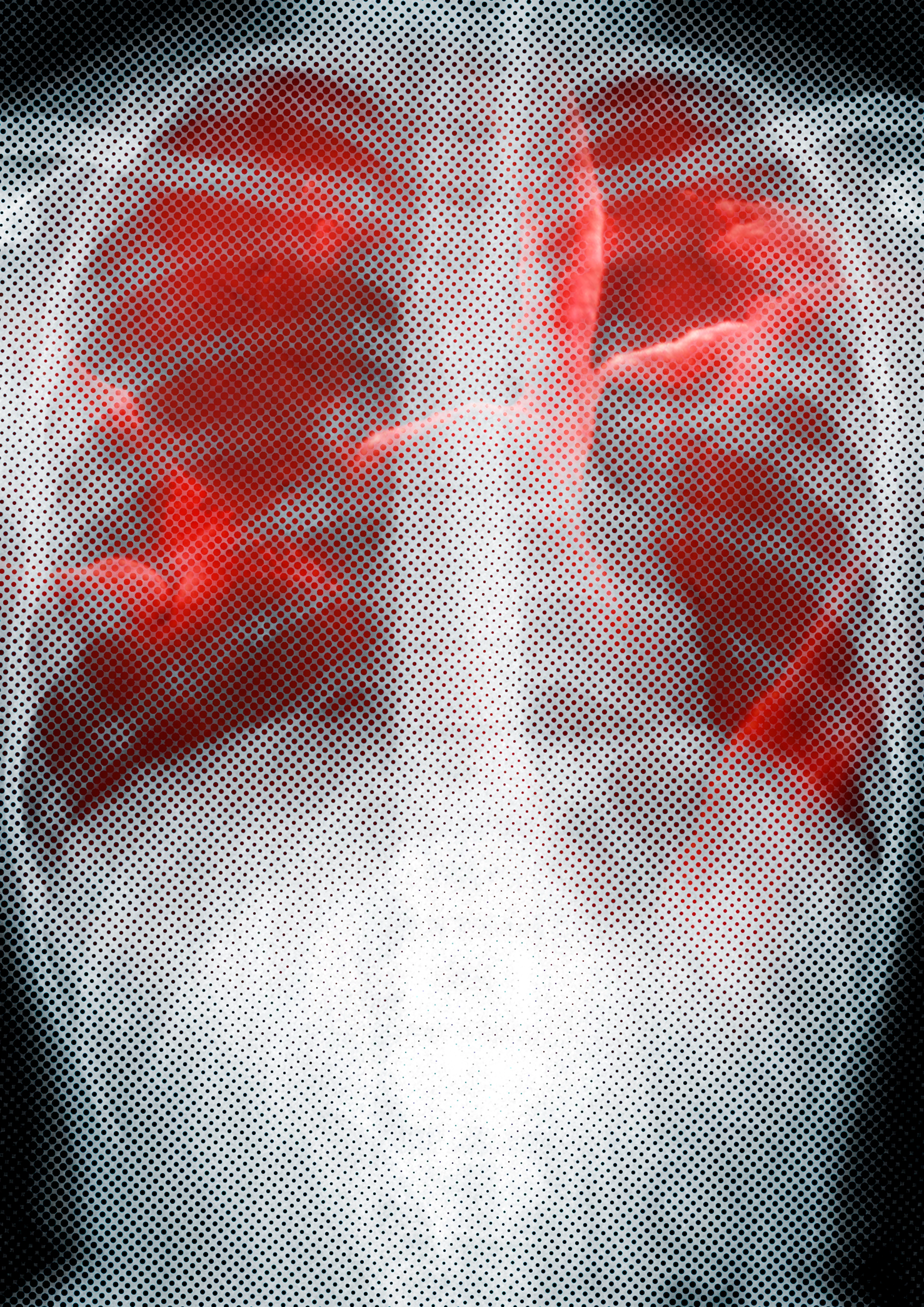
The health effects of PM2.5 exposure are well-documented across a large body of epidemiological and clinical research. Acute effects at elevated concentrations include respiratory irritation, coughing, reduced lung function, and exacerbation of asthma and other existing respiratory conditions. Cardiovascular effects, including increased risk of heart attack and arrhythmia, have been documented in occupational and population-level studies. Chronic exposure at lower concentrations is associated with accelerated decline in lung function, increased risk of respiratory disease, and premature mortality in susceptible populations. The EPA's Integrated Science Assessment for Particulate Matter identifies both short-term and long-term PM2.5 exposure as causally associated with cardiovascular and respiratory effects.
These effects are not limited to industrial settings. Office workers, healthcare staff, school occupants, and building residents face PM2.5 exposure from both outdoor infiltration and indoor sources, particularly in facilities near transportation corridors, construction activity, or with inadequate filtration.
Regulatory Standards for PM2.5
EPA's NAAQS PM2.5 Standards

The EPA's National Ambient Air Quality Standards (NAAQS) establish the primary regulatory benchmarks for PM2.5 in outdoor air. The current primary NAAQS are:
- Annual standard: 9 µg/m³ (annual arithmetic mean, averaged over three years), revised in 2024 from the previous 12 µg/m³ standard
- 24-hour standard: 35 µg/m³ (98th percentile of daily concentrations, averaged over three years)
NAAQS standards apply to ambient (outdoor) air quality and form the basis for state implementation plans and local air district requirements. While these apply to outdoor air, they are often used as reference benchmarks when evaluating indoor PM2.5 concentrations, particularly in settings with significant outdoor air infiltration. Demonstrating performance against these benchmarks starts with continuous outdoor and ambient air quality monitoring at the site itself.
OSHA Particulate Matter Standards

OSHA regulates particulate matter exposure in the workplace through PELs established under 29 CFR 1910.1000 (General Industry). The existing OSHA PELs for nuisance dust (15 mg/m³ for total particulate and 5 mg/m³ for respirable particulate, as 8-hour TWAs) are widely considered outdated relative to current health evidence. Because particulate hazards vary widely by composition and toxicity, OSHA's general nuisance dust limits should not be treated as protective for all exposures. Respirable crystalline silica, for example, is regulated far more strictly under OSHA's Respirable Crystalline Silica Standard (29 CFR 1910.1053 and 1926.1153), which establishes a PEL of 50 µg/m³ as an 8-hour TWA.
EHS programs should be calibrated to the most protective applicable standard for the specific exposures present in each environment, not just the broadest OSHA threshold.
Indoor vs. Outdoor PM2.5 Sources
PM2.5 sources in the workplace environment fall into two broad categories: outdoor infiltration and indoor generation.
Outdoor sources include vehicle exhaust, industrial emissions, wildfire smoke, and secondary particulate formation from atmospheric chemistry. In facilities near highways, construction zones, or industrial operations, outdoor PM2.5 infiltration can be a significant contributor to indoor concentrations, particularly in buildings with inadequate filtration or high air exchange rates.
Indoor sources include combustion processes (gas cooking, equipment with open flame or exhaust), printing and copying equipment, cleaning activities, construction and renovation work within occupied spaces, and resuspension of settled dust from floors and surfaces.
Understanding the relative contribution of indoor and outdoor sources is essential for designing effective controls and interpreting monitoring data. A sustained indoor PM2.5 elevation that correlates with outdoor air quality events points to an infiltration and filtration problem. An elevation that tracks facility operational patterns points to an indoor generation problem.
Continuous vs. Time-Weighted Average Monitoring
The choice between continuous real-time monitoring and time-weighted average (TWA) sampling methods has meaningful implications for how PM2.5 data is used and what it can support.
TWA sampling (personal sampling cassettes or area monitors collected over a defined shift) produces an integrated average suitable for OSHA compliance assessment and occupational exposure documentation. It is the standard approach for formal exposure assessment programs.
Continuous monitoring provides real-time data at intervals of seconds to minutes. The data allows immediate identification of exceedances, trend analysis, and source attribution. It supports operational decision-making, triggering alerts, informing ventilation adjustments, and documenting the full time-series of conditions rather than a single averaged value.
For most EHS programs, the optimal approach combines periodic regulatory sampling for formal exposure documentation with continuous monitoring for operational awareness and early warning. Continuous data also adds value at the perimeter level for industrial sites, where exceedances at the fence line may trigger permit-driven response actions, stakeholder notification, or regulatory review depending on the jurisdiction. Perimeter monitoring is increasingly relevant at data centers, where construction dust and diesel generator emissions draw community scrutiny at the property line.
How Aethair IAQ and Aethair PRO Measure PM2.5
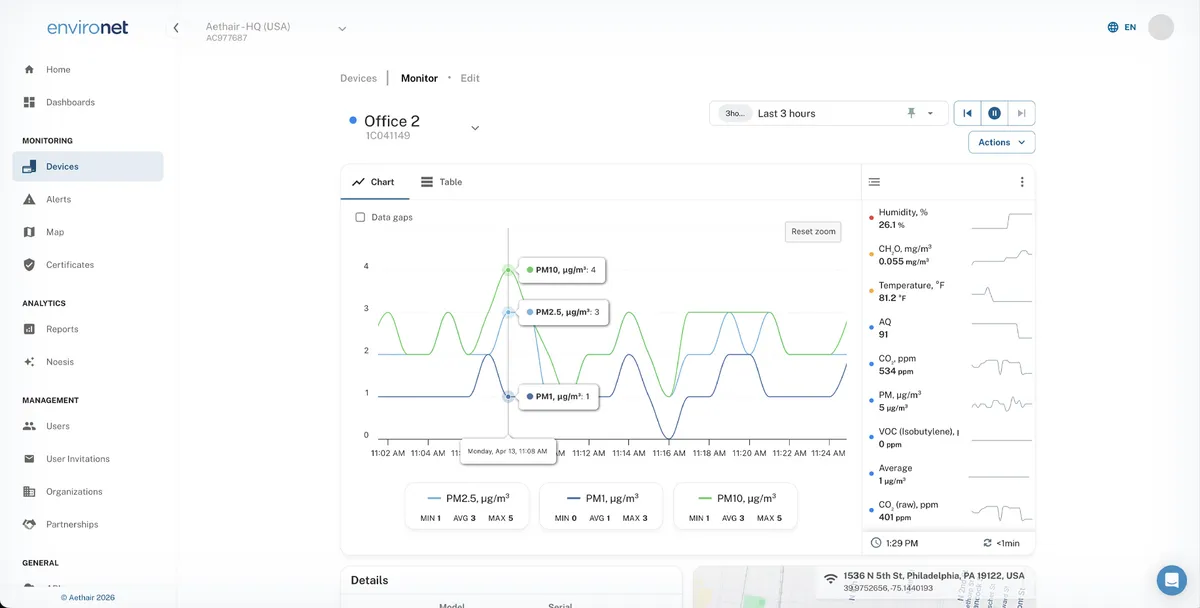
Both Aethair IAQ and Aethair PRO include optical particle sensors that measure PM1, PM2.5, and PM10 continuously. Aethair IAQ is designed for indoor environments, including commercial offices, healthcare facilities, educational settings, and institutional spaces, where it operates unobtrusively and continuously without Wi-Fi dependence. Aethair PRO is built for more demanding conditions: industrial facilities, perimeter monitoring deployments, and outdoor or semi-enclosed environments where ruggedized hardware and broader sensor configurations are required.
Both devices transmit data to Environet in real time, where threshold-based alerts, trend visualization, and structured compliance reporting are available across every deployed device. For EHS teams managing multiple sites or monitoring for regulatory exceedances, Environet provides a single view of PM2.5 conditions with the data lineage needed to support audit defense.
The recommended configuration for this
Recommended
best match-

Industrial monitor for indoor and outdoor sites. Built-in sensors cover the essentials, and hot-swappable gas sensor cartridges and a differential-pressure option add more.
Built-inPM2.5Gas 1
Free: one more gas sensor cartridge
Gas 2
Free: one more gas sensor cartridge
MultiSense
Free: a MultiSense, stock or built to order
Expansion
Free: differential pressure
Also measures 12 more
Dew PointHeat IndexRelative HumidityIlluminance / LightParticle Count (by size)PM1PM10Total PM / Mass Conc.Barometric PressureEquivalent Continuous Level (Leq)Sound Pressure Level (SPL)Air Temperature
Aethair IAQ only
one monitor, nothing to add-

Aethair IAQ built-in sensors
Compact plug-in monitor with every sensor built in, nothing to add. Ideal for straightforward indoor air quality monitoring.
Built-inPM2.5Also measures 12 more
Formaldehyde (CH₂O)Carbon Dioxide (CO₂)Dew PointHeat IndexRelative HumidityParticle Count (by size)PM1PM10Total PM / Mass Conc.Barometric PressureAir TemperatureVOC (Total)
Monitor PM2.5 with Accuracy and Reliability
Aethair IAQ and Aethair PRO measure PM1, PM2.5, and PM10 continuously, feeding calibrated data directly into Environet for real-time visibility and compliance reporting.
Schedule a PM2.5 Monitoring Demo (opens in a new tab)See Aethair PRO →See Aethair IAQ →
PM2.5 Monitoring: FAQs
What is the NAAQS limit for PM2.5?
As of the EPA's 2024 reconsideration, the primary annual PM2.5 National Ambient Air Quality Standard is 9.0 µg/m³, lowered from the previous 12.0 µg/m³, while the 24-hour PM2.5 standard remains 35 µg/m³. These are health-based ambient air standards evaluated as multi-year averages, not workplace exposure limits.
Does OSHA set a PM2.5 exposure limit?
OSHA has no permissible exposure limit specific to PM2.5. The closest workplace limit is the Table Z-1 PEL for Particulates Not Otherwise Regulated (PNOR), at 5 mg/m³ for the respirable fraction and 15 mg/m³ for total dust, both as 8-hour time-weighted averages. These limits are far higher than ambient health benchmarks, so many EHS teams monitor PM2.5 against EPA or WHO guidance rather than the OSHA PNOR limits.
What PM2.5 level is considered unhealthy?
On the EPA Air Quality Index, updated in 2024, a 24-hour PM2.5 concentration above 35.4 µg/m³ falls into the Unhealthy for Sensitive Groups category, and above 55.4 µg/m³ is Unhealthy for the general population. Lower concentrations fall into the Good and Moderate categories, with the Good range topping out at 9.0 µg/m³.
How is PM2.5 monitored?
Regulatory PM2.5 measurement uses gravimetric reference methods, which weigh particulate collected on a filter. Real-time monitoring uses optical methods that estimate concentration from light scattering, reporting minute-by-minute values. Continuous optical monitors support both occupant awareness and a date-stamped compliance record between any required reference sampling.