
The WELL Building Standard is a voluntary framework focused specifically on occupant health and well-being, and its footprint has expanded alongside the rollout of ESG disclosure requirements such as the EU's Corporate Sustainability Reporting Directive (opens in a new tab) and rising tenant demand for healthy buildings: CBRE's 2024 Americas Office Occupier Sentiment Survey (opens in a new tab) found that nearly half of corporate occupiers are willing to pay a premium for buildings with health and wellness features. WELL produces a measured, defensible record at certification; continuous environmental intelligence extends that record into the years between visits. That real-time view of indoor conditions supports operational risk management, tenant transparency, and recertification readiness. Aethair's platform is built for both, with WELL-aligned thresholds for verification and continuous data for the operational reality in between.
Where OSHA sets legal floors for workplace exposure and ASHRAE 62.1 defines ventilation rates, WELL raises the bar around occupant experience. It asks how a building performs from the perspective of the people who spend their days inside it, and it holds operators accountable through measured thresholds, documented practices, and on-site performance testing by an approved agent. For facility managers, commercial real estate operators, and sustainability leads evaluating or pursuing certification, the practical questions are what the WELL Air concept actually requires, how those requirements are verified, and where continuous air quality monitoring fits in a framework historically built around point-in-time testing.
What the WELL Building Standard Is and How It Works
The WELL Building Standard (opens in a new tab) is a performance-based rating system for buildings, interior spaces, and communities, published by the International WELL Building Institute (IWBI) and administered through Green Business Certification Inc. (GBCI). According to IWBI (opens in a new tab), more than 6 billion square feet of real estate across roughly 100,000 locations in 137 countries was engaged with the standard as of mid-2025, which makes WELL the most widely adopted framework focused specifically on occupant health and well-being. The current iteration, WELL v2, is organized into ten concepts: Air, Water, Nourishment, Light, Movement, Thermal Comfort, Sound, Materials, Mind, and Community. Within each concept, the standard defines preconditions (features every certified project must meet) and optimizations (optional features that contribute to scored certification levels of Bronze, Silver, Gold, and Platinum).
WELL differs from regulatory standards in two important ways. First, participation is voluntary. Project teams opt in to pursue certification, and no operator is required to comply. Second, certification rests on measured performance in the built space, supplementing documentation review with on-site testing of air, water, light, thermal, and acoustic conditions. Where LEED has historically emphasized the design and construction phase, WELL emphasizes the occupied building. Performance is verified on site, with calibrated instruments, by an approved WELL Performance Testing Agent employed by an IWBI-approved Performance Testing Provider. Initial certification is valid for three years, with annual reporting required during the term and full recertification at the end of each three-year cycle.
The Air Concept in WELL v2
Air is the first concept in WELL v2 and contains the largest number of features, with four preconditions and ten optimizations. As in every WELL concept, projects can earn up to 12 points from Air toward overall certification. The concept's stated goal is to maintain indoor air quality at a level that supports occupant health and cognitive performance, through a combination of pollutant thresholds, ventilation requirements, source control practices, and ongoing awareness.
Preconditions
Every WELL-certified project must satisfy the Air preconditions, which function as the floor beneath any certification level. These include:
- A01 Air Quality. Maximum concentrations for key pollutants including PM2.5, PM10, carbon monoxide, ozone, formaldehyde, total volatile organic compounds, and radon, verified through on-site performance testing.
- A02 Smoke-Free Environment. Prohibition of smoking and vaping within the building and within defined distances of entries, operable windows, and air intakes.
- A03 Ventilation Design. Ventilation rates and outdoor air delivery aligned with ASHRAE 62.1 or a comparable local standard, with documentation of system design and commissioning.
- A04 Construction Pollution Management. Practices during construction or renovation that limit ingress of dust, VOCs, and other contaminants into occupied zones.
Optimizations
Beyond the preconditions, projects earn points toward certification levels by pursuing Air optimizations A05 through A14: Enhanced Air Quality (stricter pollutant thresholds), Enhanced Ventilation Design, Operable Windows, Air Quality Monitoring and Awareness, Pollution Infiltration Management, Combustion Minimization, Source Separation, Air Filtration, Enhanced Supply Air, and Microbe and Mold Control. Each optimization specifies its own measurement or documentation requirements, and several call for ongoing monitoring rather than one-time verification.
A08 Air Quality Monitoring and Awareness is particularly relevant for operators thinking about the post-certification reality. It awards points for installing indoor air quality sensors that continuously measure a defined set of parameters from the WELL pollutant list, calibrating or replacing those sensors at least every three years, and making the data accessible to occupants through digital displays in common areas or through web or app-based channels.
Parameters Monitored Under WELL Air Quality Requirements
The parameters that matter most for WELL air quality verification and ongoing compliance fall into a few broad categories. Several reflect public-health research behind their inclusion in the standard: the link between elevated indoor CO₂ and cognitive performance, for example, comes out of Harvard's COGfx research (Allen et al., 2015) (opens in a new tab), which found measurable effects on workers' decision-making at concentrations common in office environments. Exact thresholds vary by feature and by WELL v2 version, and project teams should consult the current WELL Building Standard documentation (opens in a new tab) for active values.
| Parameter | WELL v2 Limit | Why WELL Measures It | Typical Measurement Approach |
|---|---|---|---|
| PM2.5 | 15 µg/m³ | Fine particulate with documented effects on cardiovascular and respiratory health | Optical or gravimetric sampling; continuous sensors for ongoing monitoring |
| PM10 | 50 µg/m³ | Coarse particulate from construction, outdoor infiltration, and resuspension | Optical sensors or size-selective sampling |
| Carbon dioxide (CO₂) | 900 ppm (A03 monitoring option) | Proxy for ventilation adequacy and occupant density; linked to cognitive performance | Continuous NDIR sensors |
| Carbon monoxide (CO) | 9 ppm | Combustion byproduct regulated under WELL's A01 Air Quality precondition | Electrochemical sensors or laboratory analysis |
| Nitrogen dioxide (NO₂) | A05 enhanced threshold | Combustion-related pollutant from outdoor infiltration, vehicles, and gas appliances; included in the A05 Enhanced Air Quality threshold | Electrochemical or chemiluminescence sensors |
| Ozone (O₃) | 51 ppb | Secondary pollutant from outdoor infiltration and some indoor equipment | UV photometric or electrochemical sensors |
| Formaldehyde (CH₂O) | 50 µg/m³ | Common indoor VOC from building materials and furnishings | Passive sampling with laboratory analysis, or continuous sensors |
| TVOCs | 500 µg/m³ | Aggregate indicator of volatile organic compounds from materials, cleaning products, and occupant activity | Photoionization detectors or laboratory analysis |
| Radon | 4 pCi/L | Radioactive soil gas; WELL requires testing in regularly occupied spaces at or below grade against a 4 pCi/L threshold | Alpha-track passive sampling or continuous radon monitor |
| Relative humidity | — | Influences microbial growth, thermal comfort, and pollutant behavior | Integrated temperature and humidity sensors |
The WELL performance verification process historically covers these parameters through on-site instrument measurements taken by a trained agent, typically over a defined window and across multiple occupied zones. Pass or fail is determined by whether measured values sit below the applicable threshold for the relevant WELL feature at the time of the visit.
The Recommended Monitoring Configuration for WELL v2
A08 Air Quality Monitoring and Awareness rewards sensors that continuously measure parameters from the WELL pollutant list, are calibrated or replaced at least every three years, and share their data with occupants. Most office projects monitor the indoor set; a building that also tracks the combustion gases in A01 needs gas sensors as well.
Aethair IAQ only
one monitor, nothing to add-

Aethair IAQ built-in sensors
Compact plug-in monitor with every sensor built in, nothing to add. Ideal for straightforward indoor air quality monitoring.
Built-inFormaldehyde (CH₂O)Carbon Dioxide (CO₂)PM10PM2.5VOC (Total)Also measures 8 more
Dew PointHeat IndexRelative HumidityParticle Count (by size)PM1Total PM / Mass Conc.Barometric PressureAir Temperature
Not in this configuration 3
Carbon Monoxide (CO)Ozone (O₃)Radon
Recommended
best match-

Industrial monitor for indoor and outdoor sites. Built-in sensors cover the essentials, and hot-swappable gas sensor cartridges and a differential-pressure option add more.
Built-inPM10PM2.5Gas 1

Aethair MultiGas+
Carbon Monoxide (CO)VOC (Total)Metal-oxide semiconductor (MOS) sensing tracks carbon monoxide, methane, and total VOC from a compact…
Gas 2

Aethair CO₂ (dual NDIR)
Carbon Dioxide (CO₂)Dual-thermopile NDIR (non-dispersive infrared) sensing measures CO₂ with no chemical consumables, for…
Also fits: Aethair CO₂ (self-calibrating NDIR)
MultiSense

Custom MultiSense built to order
Ozone (O₃)Formaldehyde (CH₂O)Built to order for the MultiSense socket with the Aethair O₃+NO₂ cartridge's sensor (0-20 ppm, 15 ppb resolution) and the Aethair MultiSense cartridge's sensor (0-10 ppm, 10 ppb resolution).
Expansion
Free: differential pressure
Also measures 12 more
Dew PointHeat IndexRelative HumidityIlluminance / LightParticle Count (by size)PM1Total PM / Mass Conc.Barometric PressureEquivalent Continuous Level (Leq)Sound Pressure Level (SPL)Air TemperatureMethane (CH₄)
Not in this configuration 1
Radon
Build a configuration for all 8 WELL v2 parameters →
Solutions judged against WELL v2:
Healthcare Air Monitoring
Clinical air quality, pressurization, and patient safety
HVAC & Building Management
Monitor ventilation and filtration, with data for your BMS
Indoor Air Quality
Offices, schools, homes, and public buildings
School Air Monitoring
Classroom CO₂, particulates, and campus IAQ
Performance Verification and the Role of Continuous Monitoring
WELL certification rests on performance verification conducted by an approved WELL Performance Testing Agent using calibrated instruments, carried out on site during a scheduled visit coordinated through IWBI. Results are submitted to IWBI for review, and certification is granted, denied, or returned for corrective action based on the measured values. Initial certification is valid for three years, with annual reporting required during the term and full recertification at the end of each cycle, which keeps certification anchored in measured building performance over time rather than in design documents alone.
That structure has a practical consequence. By default, WELL does not require buildings to track indoor air quality continuously between testing events. The exceptions are optimizations and pathways that explicitly call for ongoing sensor data, most notably A08 Air Quality Monitoring and Awareness. A building can pass verification on the day of testing and, depending on which optimizations and pathways the project pursued, operate for the following three years with periodic reporting but no continuous IAQ data collection. Ventilation equipment can drift, occupancy patterns can shift, construction in adjacent spaces can introduce new contaminant sources, and outdoor air quality can change materially, none of which will appear in a certification record that depends on a snapshot in time.
Most certification frameworks are built this way, with verification at defined intervals rather than continuous operational oversight. Ongoing monitoring fills the gap. Calibrated indoor air quality sensors capture conditions minute by minute, compute rolling averages against WELL thresholds or internal action levels, and produce a date-stamped record of how a building has actually performed between certification events rather than how it performed on a single day. For operators pursuing WELL and for the occupants who benefit from the certification, continuous monitoring turns WELL's point-in-time verification into an ongoing picture of building performance.
The same logic applies to OSHA, ASHRAE, and other frameworks that rely on periodic testing.
Public Transparency and Occupant-Facing Dashboards

WELL explicitly values transparency. The A08 Air Quality Monitoring and Awareness optimization rewards projects that make indoor air quality data visible to occupants, through digital displays in common areas or through web or app-based channels. For operators, the optimization is a way to translate certification into an experience occupants can see day to day.
Public-facing displays serve several purposes at once. They support the WELL optimization directly. They also reinforce a building's commitment to occupant health as a visible differentiator in leasing and tenant retention. Facility teams get early signals when conditions move outside normal ranges, without a manual check of a backend system. The same data feeds ESG disclosures and WELL recertification records, which reduces the number of parallel reporting systems an operator has to maintain.
Air Quality Sensors for WELL Certification: How Aethair Supports Verification
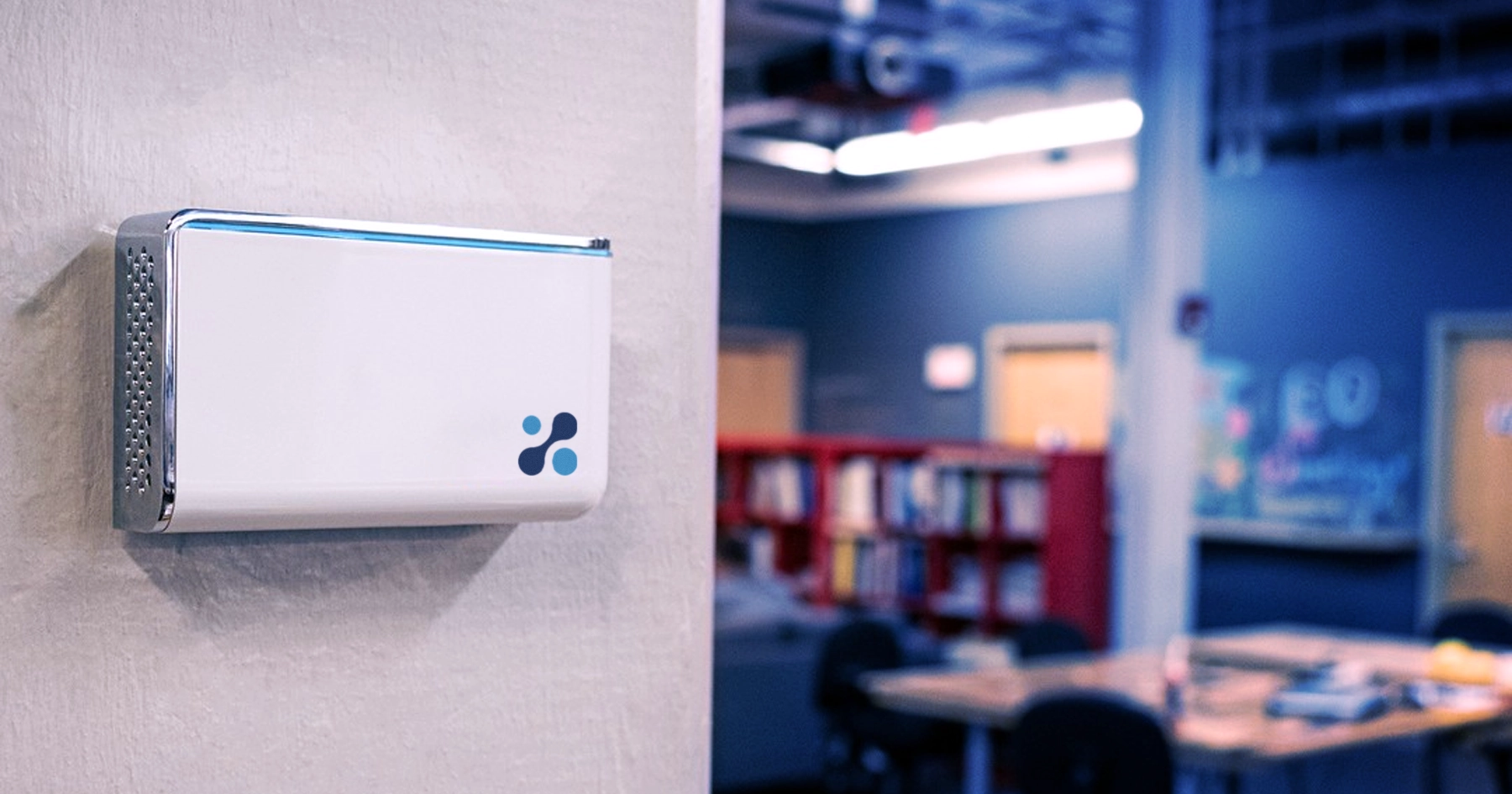
Aethair IAQ is a calibrated indoor air quality monitoring device, built for accuracy and reliability in occupied buildings such as offices, commercial real estate, and mixed-use environments, including those pursuing WELL certification. Each unit measures PM1, PM2.5, PM10, total volatile organic compounds (tVOCs), formaldehyde, CO₂, temperature, humidity, and pressure. Devices ship pre-calibrated and accurate, connect over 4G LTE, and stream data continuously into Environet, Aethair's cloud-based data analytics and management platform.
Calibration has to be documented for A08, which asks for proof of calibration or replacement at least every three years. Each Aethair IAQ is calibrated against reference instruments and ships with a calibration certificate, so the certification file starts with a known calibration state. Where a project also monitors carbon monoxide or ozone, Aethair PRO adds pre-calibrated gas sensor cartridges that swap in the field without recalibration or downtime.
Environet is where WELL-relevant documentation comes together. Thresholds can be configured to match the active WELL v2 values for A01 Air Quality and A05 Enhanced Air Quality, so continuous readings are compared against the same limits an approved WELL Performance Testing Agent applies on site. Exceedances are flagged in real time, rolling averages are computed automatically, and Aethair Reports structures collected data into outputs that can be used for defensible documentation, tenant communications, or internal review. Noesis, Aethair's AI analysis engine, allows sustainability and facility teams to query historical data in plain language and produce summary reports on demand.
For the public-facing layer that A08 Air Quality Monitoring and Awareness calls for, Aethair Dashboards provides real-time, occupant-facing displays of current conditions, configurable for lobbies, tenant portals, and shared spaces. Aethair Dashboards, Environet, and Aethair Reports all draw from the same real-time data streamed from a building's devices: Aethair Dashboards aggregates and in some cases averages that data for occupant-facing visibility, Aethair Reports organizes it into structured outputs, and Environet is the full data platform with access to all of it. What occupants see in the lobby and what certification records show come from a single source.
Formal WELL performance verification by an approved agent remains the process that determines certification. Continuous monitoring extends that picture across the three years between visits and supports documentation that certification bodies, tenants, and ESG reporting can rely on.
Learn More About Continuous Environmental Monitoring for WELL Projects
Aethair pairs calibrated continuous monitoring with audit-ready reporting. WELL projects get real-time visibility and the structured documentation certification bodies, tenants, and ESG frameworks can rely on.
Schedule a call (opens in a new tab)Explore Aethair Reports →See Indoor Air Monitoring Solutions →
Key Takeaways
- The WELL v2 Air concept includes four preconditions (A01 to A04) and ten optimizations (A05 to A14), all administered by IWBI through GBCI.
- Certification rests on measured performance verified on site by an approved WELL Performance Testing Agent. Initial certification is valid for three years, with annual reporting during the term and full recertification at the end of each cycle.
- WELL does not by default require continuous IAQ tracking between testing events, except where specific optimizations such as A08 Air Quality Monitoring and Awareness are pursued.
- Continuous environmental intelligence extends WELL's point-in-time verification into a real-time view of building performance. That supports operational risk management, tenant transparency, and recertification readiness.
- Aethair IAQ feeds continuous data into Environet with WELL-aligned thresholds, structured documentation through Aethair Reports, and occupant-facing visibility through Aethair Dashboards, all from a single calibrated source.
WELL Building Standard Air Quality: FAQs
What are the WELL v2 air quality thresholds?
Under WELL v2 Feature A01 (Air Quality), commonly cited performance limits include PM2.5 at or below 15 µg/m³, PM10 at or below 50 µg/m³, carbon monoxide at or below 9 ppm, and ozone at or below 51 ppb. Formaldehyde must be at or below 50 µg/m³ (with benzene at or below 10 µg/m³ and toluene at or below 300 µg/m³), verified by laboratory testing, or total volatile organic compounds at or below 500 µg/m³ where continuous TVOC monitoring is used. Because WELL is updated through periodic addenda, project teams should confirm active values against the current WELL v2 documentation.
What are the WELL CO₂ requirements, and is there a CO₂ limit?
CO₂ is not among WELL v2's air quality thresholds; WELL uses it as a ventilation indicator. The A03 Ventilation Design precondition can be met in four ways. One is to show with sensor data that occupiable spaces stay at or below 900 ppm (or no more than 500 ppm above outdoor levels). The others involve designing and balancing ventilation to ASHRAE 62.1 or an equivalent standard. The A06 Enhanced Ventilation Design optimization awards points for holding 750 ppm (or 350 ppm above outdoor levels), and the A08 Air Quality Monitoring and Awareness optimization adds points for continuous sensors that track CO₂ among other pollutants and share the data with occupants. Continuous, calibrated CO₂ monitoring is the most reliable way to demonstrate and maintain adequate ventilation between performance tests. Confirm active requirements against the current WELL v2 documentation.
Do you need air quality monitors for WELL certification?
WELL certification is verified through on-site performance testing by an approved WELL Performance Testing Agent, so continuous monitors are not strictly required for initial certification. However, the A08 Air Quality Monitoring and Awareness optimization awards points for installing indoor air quality sensors that continuously measure WELL pollutants, are calibrated or replaced at least every three years, and make data accessible to occupants. What WELL does require, under A01, is that the core pollutants are measured at least once a year and the results reported annually. Continuous monitoring also helps maintain and document performance across the three years between certification cycles.
Is there a WELL Building Standard formaldehyde limit?
Yes. Under WELL v2 Feature A01, formaldehyde is limited to 50 µg/m³ or lower, verified by laboratory testing of occupiable spaces. As with all WELL thresholds, project teams should confirm the active value against current WELL v2 documentation, since the standard is updated through periodic addenda.