
Environmental intelligence is the practice of converting real-world environmental data into actionable, defensible decisions. It combines continuous monitoring, data management, and AI analysis so raw sensor readings become insight a team can act on and document.
For decades, environmental monitoring meant collecting data and hoping someone had time to review it. Sensor readings piled up in spreadsheets. Compliance reports were assembled manually. By the time a problem was identified, it had often already become a liability.
Environmental intelligence changes that equation entirely.
What Is Environmental Intelligence?
Environmental Intelligence converts real-world environmental data into actionable, defensible decisions. It is not just data visualization. It is decision support built on traceable logic and verifiable data lineage.
The process follows three steps:
Capture: Field-grade devices continuously measure environmental conditions including air quality, gases, particulate matter, temperature, and more. Aethair hardware is designed for continuous operation with native connectivity and enterprise-grade security.
Understand: The Aethair Platform, Environet web console, and Noesis, Aethair’s AI tool, work together to process environmental data at scale. This includes trend analysis, threshold detection, and contextual interpretation that converts raw readings into meaningful insights.
Act and Report: The platform generates alerts triggered by defined thresholds, trends, and configured alert conditions. It also produces structured reports built for compliance and operational workflows, with full traceability from raw data to final output. Teams can respond in real time and document every decision with confidence. Every insight is traceable to underlying data, thresholds, and methods. That supports defensible decisions during audits and reviews.
Why Raw Data Isn't Enough
Modern environmental sensors can generate billions of data points per year. But data alone does not protect workers, satisfy regulators, or inform business decisions.
The problem is volume and context. A sensor can tell you that PM2.5 levels spiked at 3:00 AM in Building C. What it cannot tell you, on its own, is whether that spike crossed a regulatory threshold, whether it correlates with a maintenance event, whether it has happened before, or what the appropriate response is. That interpretation requires intelligence, not just data.
Without a platform built to process and contextualize environmental data at scale, most of that information goes unused. EHS teams are left manually correlating readings, chasing anomalies across disconnected systems, and writing compliance reports from scratch. This approach consumes significant time, introduces human error, and creates gaps in documentation that can become serious liabilities during audits or regulatory reviews.
Organizations are often most exposed to risk not because they lack data, but because they lack a system to interpret it.
How Aethair Delivers Environmental Intelligence
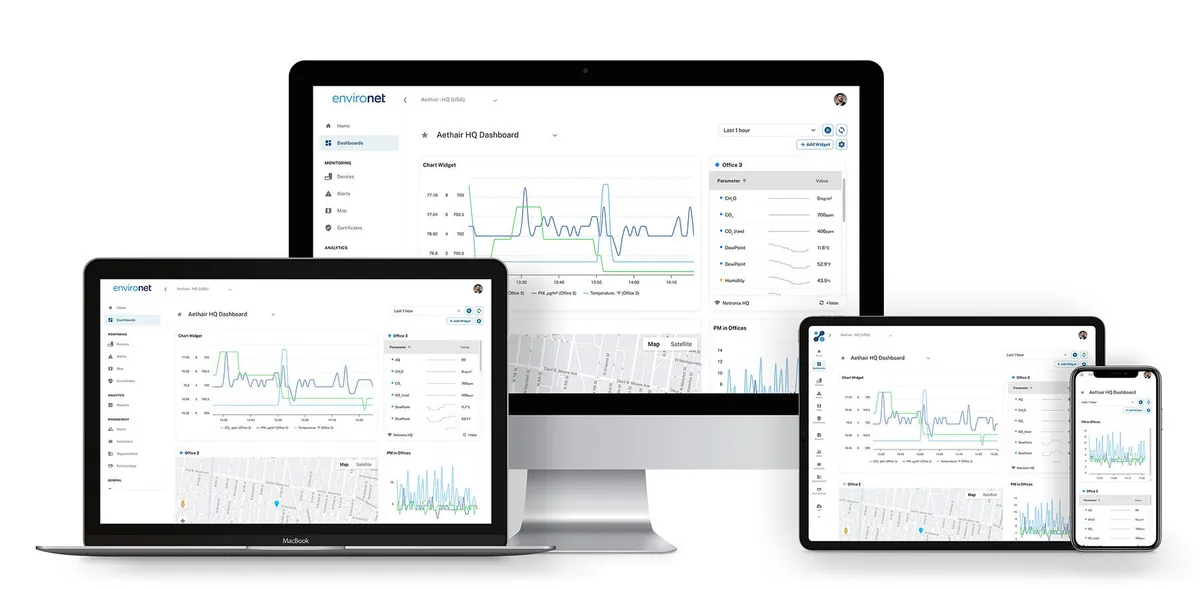
Aethair was built from the ground up to close the gap between raw environmental data and actionable intelligence. The Aethair Platform connects hardware and software in a continuous loop. It captures conditions in the field, applies analysis through Noesis, and enables teams to act before issues become incidents.
Noesis, Aethair’s AI tool, analyzes environmental data to identify trends, flag anomalies, and support report generation through defined workflows. Paired with Environet, Noesis gives EHS and ESG teams real-time visibility across facilities, devices, and data streams from a single interface, accessible anywhere.
Many monitoring systems stop at dashboards. Aethair goes further, connecting raw signals to clear thresholds, producing accurate and detailed reports, and enabling next-best actions rather than just awareness.
The Business Case for Environmental Intelligence
Organizations that invest in Environmental Intelligence move beyond compliance. They demonstrate ESG performance with auditable data, reduce remediation costs by identifying issues earlier, and free teams to focus on higher-value work.
For businesses with strict regulatory requirements or public ESG commitments, environmental intelligence is not optional. It is foundational. Aethair is trusted by thousands of professionals in countries around the world to deliver exactly that.
Turn Your Environmental Data Into Intelligence
Aethair connects field-grade hardware, data collection and management, AI analysis, and compliance reporting into a single platform. See how it works.
Environmental Intelligence FAQs
What is environmental intelligence?
Environmental intelligence is the practice of converting real-world environmental data into actionable, defensible decisions. It combines continuous monitoring, data management, and AI analysis so raw sensor readings become insight a team can act on and document. Aethair delivers environmental intelligence through field-grade hardware, the Environet platform, and Noesis, its AI analysis tool.
How is environmental intelligence different from environmental monitoring?
Environmental monitoring captures measurements. Environmental intelligence interprets them. Monitoring tells you that PM2.5 rose in a given location. Environmental intelligence adds context, identifying whether the reading crossed a threshold, how it compares with past patterns, and what response is appropriate. The difference is decision support with traceable data lineage, not data collection alone.
How does environmental intelligence work?
Environmental intelligence follows three steps. Field-grade devices capture environmental conditions continuously. The platform and AI analysis process that data to detect trends, thresholds, and anomalies. The system then supports action and reporting, generating alerts and compliance-ready documentation with full traceability from raw reading to final report.
What does environmental intelligence track?
Environmental intelligence tracks the conditions that matter to a site over time, including particulate matter (PM1, PM2.5, PM10), gases such as CO, CO₂, NO₂, ozone, and VOCs, and parameters like temperature, humidity, and pressure. Tracking these continuously, rather than sampling periodically, lets teams see how conditions change and respond before a reading becomes a liability.
Who uses environmental intelligence?
EHS, ESG, sustainability, and operations teams use environmental intelligence to support compliance, document ESG performance, and protect people and facilities. It applies wherever environmental conditions carry regulatory or operational risk, from industrial sites and construction perimeters to healthcare facilities and city-wide monitoring networks.