
Wildfire smoke has become a continental air quality event. Plumes that used to stay regional now routinely reach the eastern half of the continent during a major fire season, and the operational consequences for outdoor workforces, indoor facilities, and public health agencies have grown with them. Canada's 2023 fire season burned an estimated 15 million hectares according to Natural Resources Canada (opens in a new tab), with some estimates reaching as high as 18.4 million hectares per NASA Earth Observatory (opens in a new tab), affecting all thirteen provinces and territories at six to seven times the long-term annual average of roughly 2.5 million hectares. Smoke from those fires carried across most of North America and reached western Europe. The smoke from a fire in northern British Columbia or northern Quebec can degrade air quality in Toronto, Chicago, New York, and Philadelphia within days. Aethair's own monitors recorded the impact at a station in New York during the June 2023 Quebec fire event (see the event data in our platform (opens in a new tab) and a video of its impact across New York and Philadelphia (opens in a new tab)). AQI values across the US Northeast reached the Unhealthy, Very Unhealthy, and Hazardous categories, and Philadelphia briefly recorded its worst air quality readings in more than two decades. Wildfire smoke is now a recurring operational challenge for EHS managers responsible for outdoor workers, emergency response coordinators planning evacuation and shelter, public health officials communicating exposure risk, and operators managing indoor air. It needs the same measurement, documentation, and response infrastructure as any other major environmental hazard.
Wildfire smoke air quality monitoring is the practical foundation for that response. It answers three questions teams need answers to in real time: what is in the air, who is being exposed, and what should we do about it. This article covers what wildfire smoke contains, how Canadian and US air quality indices and workplace standards treat it, and how a monitoring program supports detection, communication, and protection across outdoor work sites, indoor facilities, and broader community networks.
Updated July 2026: In mid-July 2026, smoke from more than 800 wildfires burning across Canada brought unhealthy and at times hazardous air quality to a wide stretch of the US, from Minnesota and the Great Lakes through New England and as far south as Maryland, with major impacts in Philadelphia, New York City, and Baltimore (NPR coverage (opens in a new tab)). The EPA issued a statement on the cross-border smoke impact (opens in a new tab) and deployed supplemental monitoring in Minnesota. The guidance in this article, from index thresholds to workplace smoke rules, applies directly to events like this one.
What Is in Wildfire Smoke
Wildfire smoke is a complex mixture of solid particles, liquid droplets, and gases produced by the incomplete combustion of vegetation, structures, and the soils underneath them. The composition varies with fuel type, fire intensity, moisture, and the age of the plume as it travels downwind, but a few constituents are present at every scale and drive most of the health and visibility impacts.
Particulate matter dominates the public health concern. Wildfire smoke is rich in fine particulates, with the majority of mass concentrated in the PM2.5 fraction (particles 2.5 micrometers in aerodynamic diameter or smaller) and a meaningful share in PM1 (1 micrometer or smaller). These particles bypass the upper respiratory tract and reach the deep lung and bloodstream. PM10 (10 micrometers or smaller) is also elevated, particularly close to active fires, and contributes to visibility reduction, eye and airway irritation, and ash deposition on surfaces and water bodies.
Gases are part of the mixture from the start. Carbon monoxide (CO) is produced wherever fuel burns incompletely and is highest near the active fire front, on the fireline, and in confined areas like canyons and structure interiors. Nitrogen oxides (NOx), sulfur dioxide (SO2), and many volatile organic compounds (VOCs), including formaldehyde, acrolein, and benzene, are also present, and polycyclic aromatic hydrocarbons (PAHs) are produced when biomass burns. Carbon dioxide (CO2) is the largest gaseous output by mass and is a useful indicator of combustion activity even when other parameters are not directly measured.
Secondary pollutants form as the plume ages. Sunlight drives photochemical reactions between NOx and VOCs in the smoke that produce ground-level ozone (O3), which can rise well above background levels hundreds of kilometers downwind of the source. Secondary organic aerosols also form, adding to the PM2.5 load far from the fire. This is why air quality alerts can rise sharply in cities that are nowhere near an active burn: the plume that arrives has had days to chemically transform.
A representative parameter set for a wildfire smoke monitoring program reflects this mix:
| Parameter | Why It Matters |
|---|---|
| PM2.5 | Primary health-driving pollutant; basis for AQI and AQHI alerts |
| PM1, PM10 | Submicron penetration; coarse fraction for visibility and dust |
| Carbon monoxide (CO) | Combustion proximity; firefighter and structure-fire risk |
| Carbon dioxide (CO2) | Combustion intensity; HVAC and indoor ventilation indicator |
| Total VOCs | Toxic gas burden; secondary ozone precursor |
| Nitrogen dioxide (NO2) | Combustion emissions; AQHI component |
| Ozone (O3) | Secondary pollutant in aged plumes |
| Wind speed and direction | Plume tracking, exposure attribution |
| Temperature, humidity, pressure | Sensor correction, fire behavior context |
How Air Quality Indices Treat Wildfire Smoke
Both Canada and the United States summarize air quality conditions for the public through a single composite index, and both indices respond to wildfire smoke primarily through their particulate matter inputs. The two systems are structured differently, and teams operating across the border benefit from understanding both.
Air Quality Health Index (AQHI), Canada
Environment and Climate Change Canada and Health Canada publish the Air Quality Health Index (AQHI) (opens in a new tab), a scale calculated from 3-hour average concentrations of ground-level ozone, PM2.5, and nitrogen dioxide. It is reported on a 1 to 10+ scale grouped into four risk categories: Low (1 to 3), Moderate (4 to 6), High (7 to 10), and Very High (above 10). During wildfire smoke events, the PM2.5 contribution typically drives the index, and provincial agencies issue Special Air Quality Statements when the AQHI is forecast to reach the High range. Health Canada's wildfire smoke guidance (opens in a new tab) follows the standard AQHI health messages: at AQHI 7 to 10 (High), the general population is advised to consider reducing or rescheduling strenuous outdoor activity, and at-risk groups (children, older adults, pregnant individuals, and people with cardiovascular or respiratory conditions) are advised to reduce or reschedule strenuous activity outright; at AQHI above 10 (Very High), the general population is advised to reduce or reschedule, and at-risk groups to avoid strenuous outdoor activity entirely. Researchers in British Columbia have evaluated AQHI-Plus variants that respond more sensitively to short-term PM2.5 spikes typical of wildfire smoke, recognizing that the standard AQHI's averaging structure can lag behind a fast-developing smoke event.
Air Quality Index (AQI), United States
The US Environmental Protection Agency publishes the Air Quality Index (AQI) (opens in a new tab), a 0 to 500 scale with six categories: Good (0 to 50), Moderate (51 to 100), Unhealthy for Sensitive Groups (101 to 150), Unhealthy (151 to 200), Very Unhealthy (201 to 300), and Hazardous (301 to 500). The AQI is reported for each pollutant separately and the highest sub-index becomes the headline number. EPA revised the PM2.5 NAAQS in 2024 (opens in a new tab), lowering the annual standard from 12.0 to 9.0 micrograms per cubic meter and adjusting several AQI breakpoints: AQI 50 now corresponds to 9.0 micrograms per cubic meter, and the upper-category breakpoints at AQI 200, 300, and 500 were lowered to 125.4, 225.4, and 325.4 micrograms per cubic meter respectively. The breakpoints at AQI 100 and 150 (35.4 and 55.4 micrograms per cubic meter) and the 24-hour PM2.5 NAAQS of 35 micrograms per cubic meter were retained. During wildfire smoke events, AirNow and state agencies typically report the NowCast AQI, which weights more recent hourly PM2.5 data to reflect rapidly changing conditions.
Reference Values to Keep in Mind
The World Health Organization's 2021 air quality guideline sets an annual PM2.5 target of 5 micrograms per cubic meter and a 24-hour target of 15 micrograms per cubic meter, well below both Canadian and US regulatory standards. Reference values are useful context for indoor air quality programs and for organizations setting internal action thresholds below the regulatory minimum. Many monitoring teams use a rough shorthand during a smoke event, adjusted for the 2024 AQI breakpoint revisions. PM2.5 above roughly 35 micrograms per cubic meter indicates a meaningful smoke impact. Above 55, conditions reach AQI Unhealthy and typically push AQHI into the High range. Above 125 (the post-2024 AQI 200 breakpoint), outdoor activity should be curtailed for nearly everyone.
Regulatory and Workplace Frameworks
Wildfire smoke sits across several regulatory layers. There is no single North American rule, and many of the most consequential frameworks are issued by occupational health authorities rather than environmental ones.
Canada
The Canadian Centre for Occupational Health and Safety (CCOHS) (opens in a new tab) directs employers to evaluate wildfire smoke risk in their hazard assessments, monitor the AQHI, maintain HVAC and filtration systems to limit indoor infiltration, and have written procedures for smoke events including evacuation criteria. Provincial occupational health authorities translate this into enforceable expectations. WorkSafeBC (opens in a new tab) instructs employers to use the AQHI when scheduling outdoor work, reschedule or relocate work during peak smoke, provide NIOSH-approved respiratory protection such as N95 respirators with appropriate fit-testing where exposure cannot be otherwise controlled, and inspect HVAC systems and consider portable air cleaners with high-efficiency filters indoors. Alberta, Ontario, Manitoba, and Saskatchewan publish similar guidance through their respective occupational health and safety authorities. None of these frameworks specify a single numeric trigger across Canada, which makes a continuous, locally measured air quality record especially important for documenting employer due diligence.
United States
California's Cal/OSHA section 5141.1, Protection from Wildfire Smoke (opens in a new tab), is the most prescriptive workplace wildfire smoke rule in North America and is widely referenced as a template by other jurisdictions. It applies when the current PM2.5 AQI is 151 or greater and employees may reasonably be exposed to wildfire smoke. At that trigger, employers must communicate the hazard, train employees, implement engineering and administrative controls where feasible to reduce exposure below an AQI of 151, and provide NIOSH-approved respirators (typically N95) for voluntary use. When the PM2.5 AQI exceeds 500, respirator use becomes mandatory. Washington (Chapter 296-820 WAC (opens in a new tab), effective January 2024) and Oregon (OAR 437-002-1081 (opens in a new tab) for general industry and OAR 437-004-9790 for agriculture) have adopted analogous wildfire-smoke worker-protection rules, both with PM2.5 triggers lower than California's: Washington requires training and response planning at PM2.5 of 20.5 micrograms per cubic meter, and Oregon makes respirator use mandatory at PM2.5 of 200.9 micrograms per cubic meter rather than California's AQI-500 trigger. Federal OSHA (opens in a new tab) does not have a wildfire-specific standard, but its General Duty Clause obligates employers to protect workers from recognized hazards, and OSHA references the AQI as a practical exposure indicator. NIOSH (opens in a new tab) publishes additional guidance for wildland firefighters and outdoor workers, including respiratory protection selection and post-fire cleanup considerations.
Detection, Communication, Protection: A Practical Wildfire and Smoke Monitoring Approach
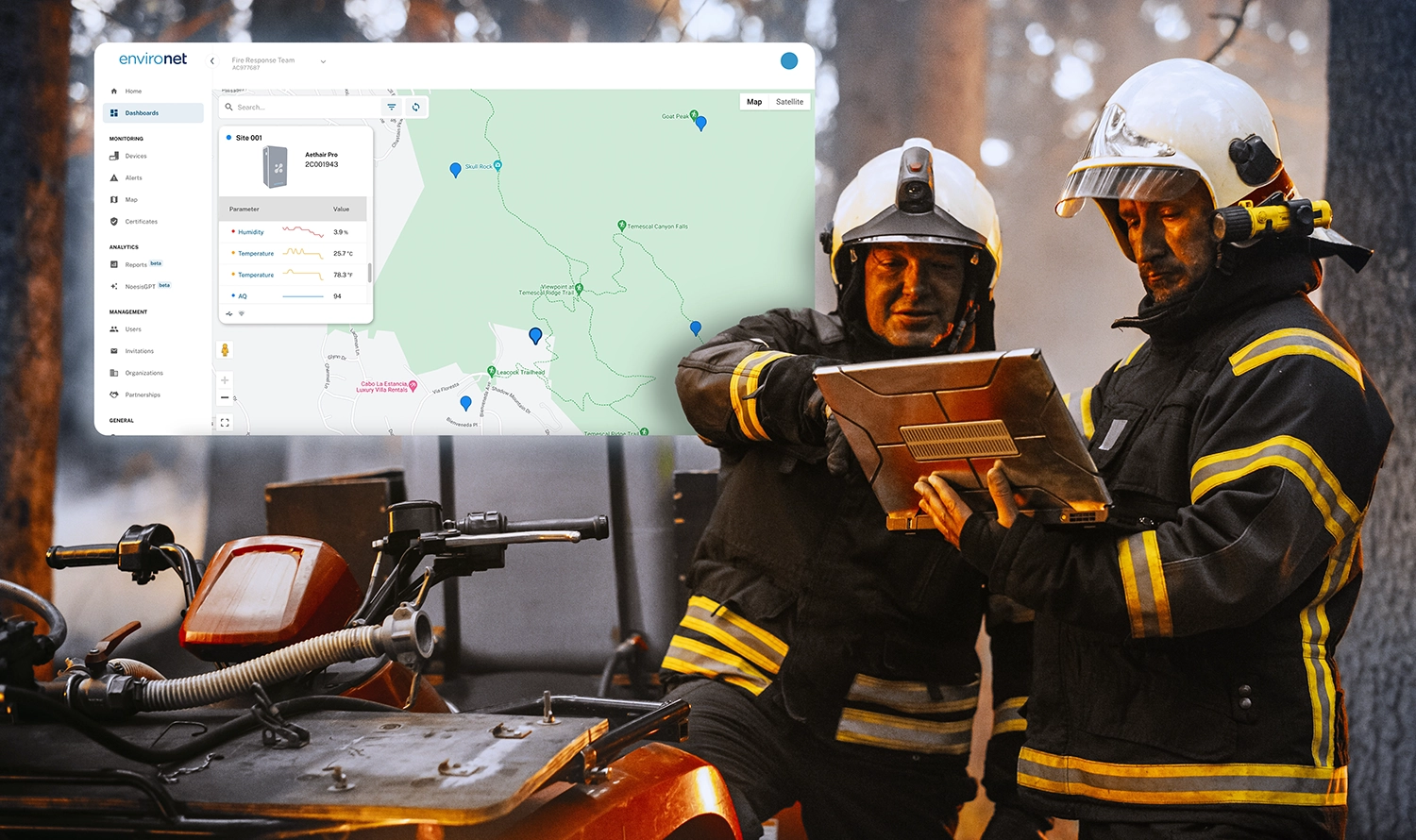
A wildfire smoke monitoring program serves three operational purposes, and a well-designed program treats them as a connected sequence rather than three independent functions.
Detection
Detection is the measurement layer. The objective is to know, in real time and with calibrated confidence, what the air looks like at every location that matters. For an outdoor work site, that means a monitor at the work zone. For an industrial facility or warehouse, monitors at the perimeter and at relevant indoor locations. For a municipal program, a distributed network of sensors across neighborhoods, with coverage weighted toward vulnerable populations, outdoor public spaces, and major transportation corridors. PM2.5 is the anchor parameter; CO, VOCs, and meteorology round out the picture in contexts where proximity to active fire or secondary chemistry matters.
Three properties of the data determine whether it will support real decisions during a fast-moving event. First, continuity. Wildfire smoke conditions can change by an order of magnitude within an hour, and gaps in the record will be filled by assumption; continuous measurement at intervals of five to fifteen minutes is the practical minimum. Second, calibration traceability. Optical PM sensors drift, and a documented calibration history with periodic span and zero checks is what allows a reading to be defended as accurate. Third, contextual integrity. A PM2.5 number without supporting context is harder to act on. Wind direction, temperature, and humidity help a responder tell whether a local reading reflects nearby activity or a regional smoke layer that has arrived overhead. A dense enough network can also map plume movement directly, by tracking how concentration peaks move from one location to the next, even when meteorological data is limited.
Communication
Detection without communication is wasted measurement. The communication layer translates sensor data into the messages, alerts, and dashboards that workers, the public, and decision-makers actually use.
For outdoor workforces, this means automated threshold alerts routed to supervisors and EHS leads by SMS, email, or webhook when AQHI or AQI thresholds are crossed, paired with documented response procedures. For emergency response coordinators, it means a live operational picture, often a map of monitor locations with current readings and trend arrows, that supports incident command decisions about resource staging, evacuation timing, and responder rotation. For public health and municipal officials, it means publicly accessible dashboards that show neighborhood-level conditions in language and units the public understands, and the ability to push notifications to vulnerable populations when conditions warrant.
At the regional scale, agencies also rely on satellite remote sensing to track smoke transport across the continent. NOAA's GOES East and GOES West geostationary satellites and the Joint Polar Satellite System feed AerosolWatch (opens in a new tab) products and AirNow.gov (opens in a new tab) forecasts that show where plumes are moving over hours to days. NOAA's analysis of the June 2023 Quebec fire event (opens in a new tab) documented that more than 86 million people experienced fine particulate pollution above the federal health standard during that single episode, and similar satellite coverage continued through the 2025 season (opens in a new tab) as fires in Manitoba, Saskatchewan, and Alberta sent smoke south into the United States. Satellite data sets the regional context. Ground-based outdoor and ambient air quality monitoring networks fill in what satellites cannot resolve at street level: what people in a specific building, neighborhood, or work site are actually breathing.
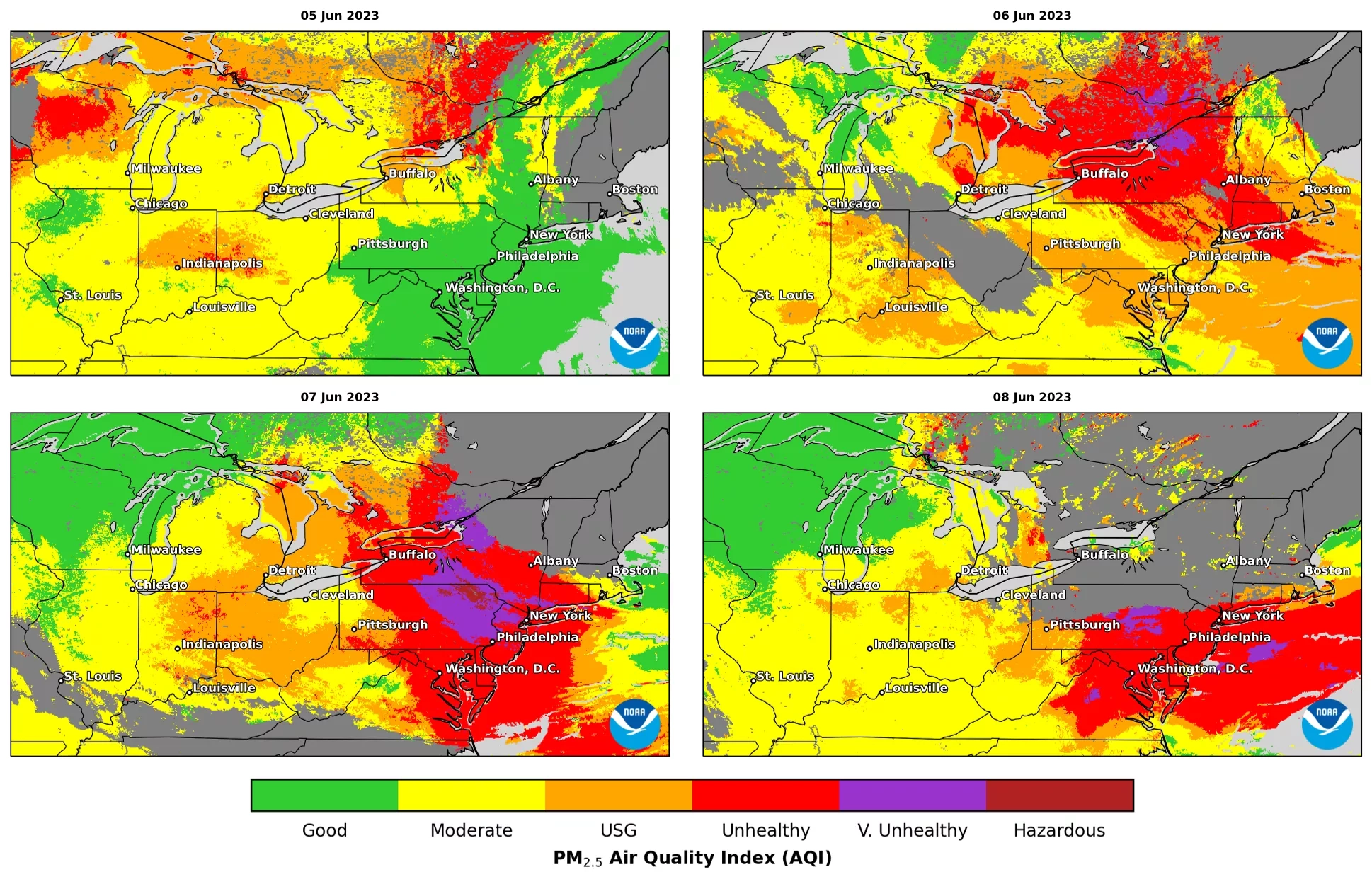
Daily mean PM2.5 across the eastern US, June 5 to 8, 2023, estimated from aerosol optical depth observed by NOAA's GOES-East ABI. "USG" is Unhealthy for Sensitive Groups. Image courtesy of NOAA NESDIS (opens in a new tab).
The credibility of the communication layer rests on the underlying record. Public-facing data that disagrees with regulatory monitors, or that updates inconsistently, erodes trust quickly. The same data infrastructure that supports operational alerts should be the source of public communication so that internal and external messages stay aligned. Aethair CEO Vasileios Nasis discussed how this plays out at the building level in his article on why air quality monitoring matters more than filtering alone (opens in a new tab), drawing on data from the 2023 event.
Protection
Protection is the action layer, and it splits cleanly into outdoor and indoor scenarios. Outdoors, the playbook follows the regulatory frameworks above: reschedule or relocate work, reduce exertion, provide and require properly fit-tested respirators when conditions warrant, and rotate exposed personnel. Indoors, the protection question is whether the building envelope and HVAC system are keeping the smoke out, and continuous indoor monitoring is what answers that.
A typical pattern during a smoke event: outdoor PM2.5 rises sharply, and indoor PM2.5 lags but rises in proportion to the building's air exchange rate and filtration efficiency. A facility with high-efficiency filtration and recirculation mode engaged should show a much smaller indoor rise than outdoors. A facility with a leaky envelope or compromised filtration will show indoor levels approaching outdoor levels. The indoor-to-outdoor ratio measured during a smoke event is one of the most useful diagnostics a facilities team can have, and it directly informs filter upgrade decisions, portable air cleaner deployment, and HVAC operating procedures for future events.
For projects with existing perimeter monitoring already in place, the wildfire monitoring layer often shares infrastructure with the operational perimeter program, with action levels and reporting reconfigured for the smoke event.
How Aethair PRO, Thiamis, and Environet Support Wildfire Response
Aethair PRO is built for the deployment patterns wildfire smoke monitoring demands: outdoor, often remote, often on short notice. Each unit continuously measures PM1, PM2.5, and PM10, along with temperature, humidity, and barometric pressure. It takes two hot-swappable gas sensor cartridges, plus a MultiSense cartridge, stock or built to order with three more gases, chosen from options including carbon monoxide, carbon dioxide, nitrogen dioxide, sulfur dioxide, ozone, hydrogen sulfide, and total VOCs. Units are pre-calibrated, housed in a rugged aluminum alloy enclosure for indoor or outdoor deployment, and transmit data over 4G LTE to Environet, so a fresh deployment can be online and reporting within minutes of installation. The optional Solar Panel Bracket supports locations without grid power, which matters for community network deployments and for staging during an active event.
Aethair IAQ complements the outdoor network on the indoor side. For hospitals, long-term care and skilled nursing facilities, schools, and other buildings serving sensitive populations, Aethair IAQ provides continuous indoor PM1, PM2.5, PM10, CO2, VOC, temperature, and humidity readings that let operators see how outdoor smoke is translating into indoor exposure in real time, and verify that HVAC adjustments, filter changes, and portable air cleaners are actually working.
Thiamis extends the network by integrating third-party instruments and existing site equipment into the same record. For organizations with weather stations, particulate samplers, or reference instruments already deployed, Thiamis brings every reading into one system of record. Adding a wind sensor through Thiamis alongside an Aethair PRO network gives responders the meteorological context to interpret what they are seeing: a PM2.5 spike with the wind shifting north tells a different operational story than a slow regional rise with calm conditions.
Environet is the operational layer. It shows data from every Aethair PRO, Aethair IAQ, and Thiamis device on a unified live map, displays PM, gas, and meteorological readings at each location with historical trend views, applies user-configured action levels against any monitored parameter, and routes alerts by email, SMS, or webhook. For a distributed deployment across a region, the live map shows how PM2.5 and other readings rise and fall at each station as a smoke event develops. Emergency response and public health teams share one real-time picture of which locations are most affected. The same data feeds public dashboards where transparency is part of the response.
Aethair Reports turns the continuous record into the documentation that follows a smoke event. Exposure summaries, exceedance logs against configured action levels, indoor-versus-outdoor diagnostics, and meteorologically contextualized data tables can be generated automatically and delivered as PDFs, web links, or scheduled emails. The same chain-of-custody record that supported real-time decisions becomes the post-event documentation for insurers, regulators, public health authorities, and internal review.
Noesis, Aethair's AI analysis engine, layers natural-language analysis on top of the same record. Teams can ask Noesis to surface the locations and time windows where PM2.5 exceeded an action level during a multi-day event, identify which stations in a regional network saw the highest sustained concentrations as the plume moved through, or generate narrative event summaries without writing them by hand. For agencies and operations leaders making decisions across many sites at once, that turns hours of manual review into a few minutes of confirmation.
Across most of North America, wildfire smoke is now part of the standard environmental risk picture rather than an exceptional event. The teams that handle it best build their detection, communication, and protection program ahead of the season, using the same continuous, documented data infrastructure they apply to any other major environmental risk.
The recommended configuration for this
Recommended
best match-

Industrial monitor for indoor and outdoor sites. Built-in sensors cover the essentials, and hot-swappable gas sensor cartridges and a differential-pressure option add more.
Built-inRelative HumidityPM1PM10PM2.5Barometric PressureAir TemperatureGas 1

Aethair MultiGas+
Carbon Monoxide (CO)VOC (Total)Metal-oxide semiconductor (MOS) sensing tracks carbon monoxide, methane, and total VOC from a compact…
Gas 2

Aethair O₃+NO₂
Nitrogen Dioxide (NO₂)Ozone (O₃)Four-electrode electrochemical sensing measures oxidizing gases (ozone plus nitrogen dioxide) and reports one…
MultiSense

Custom MultiSense built to order
Carbon Dioxide (CO₂)Built to order for the MultiSense socket with the Aethair CO₂ (dual NDIR) cartridge's sensor (0-5000 ppm, 1 ppm resolution).
Expansion
Free: differential pressure
Also measures 8 more
Dew PointHeat IndexIlluminance / LightParticle Count (by size)Total PM / Mass Conc.Equivalent Continuous Level (Leq)Sound Pressure Level (SPL)Methane (CH₄)
Not in this configuration 2
Wind SpeedWind Direction
Recommended
best match-
Industrial monitor for indoor and outdoor sites. Built-in sensors cover the essentials, and hot-swappable gas sensor cartridges and a differential-pressure option add more.
Built-inRelative HumidityPM1PM10PM2.5Barometric PressureAir TemperatureGas 1
Aethair MultiGas+
Carbon Monoxide (CO)VOC (Total)Metal-oxide semiconductor (MOS) sensing tracks carbon monoxide, methane, and total VOC from a compact…
Gas 2
Aethair O₃+NO₂
Nitrogen Dioxide (NO₂)Ozone (O₃)Four-electrode electrochemical sensing measures oxidizing gases (ozone plus nitrogen dioxide) and reports one…
MultiSense
Custom MultiSense built to order
Carbon Dioxide (CO₂)Built to order for the MultiSense socket with the Aethair CO₂ (dual NDIR) cartridge's sensor (0-5000 ppm, 1 ppm resolution).
Expansion
Free: differential pressure
Also measures 8 more
Dew PointHeat IndexIlluminance / LightParticle Count (by size)Total PM / Mass Conc.Equivalent Continuous Level (Leq)Sound Pressure Level (SPL)Methane (CH₄) -

Thiamis connects 1 instrument
A gateway that connects the third-party instruments you choose to the Aethair Platform.
-
 Wind DirectionWind Speed
R.M. Young ResponseONE weather instruments, with solid-state ultrasonic wind sensing and no moving parts.
Swap for
-
Wildfire Smoke Monitoring That Scales from Site to Region
See how Aethair PRO and Thiamis deliver continuous PM2.5, gas, and meteorological data, and how Environet and Noesis turn that data into real-time alerts, exposure analysis, and shareable updates.
Schedule a call (opens in a new tab)See Wildfire Solutions →See Aethair PRO →
Wildfire Smoke Air Quality Monitoring: FAQs
What PM2.5 or AQI level triggers wildfire smoke protections for workers?
It depends on the jurisdiction, and the triggers are not aligned. California's Cal/OSHA section 5141.1 applies when the current PM2.5 AQI is 151 or greater and workers may reasonably be exposed, requiring hazard communication, training, feasible engineering and administrative controls, and NIOSH-approved respirators such as N95s for voluntary use. Respirator use becomes mandatory above an AQI of 500. Washington (Chapter 296-820 WAC) sets a lower bar, requiring training and response planning at PM2.5 of 20.5 micrograms per cubic meter. Oregon (OAR 437-002-1081) makes respirator use mandatory at PM2.5 of 200.9 micrograms per cubic meter rather than using California's AQI-500 trigger.
Is there a federal OSHA standard for wildfire smoke?
No. Federal OSHA has no wildfire-specific standard. Its General Duty Clause still obligates employers to protect workers from recognized hazards, and OSHA references the Air Quality Index as a practical exposure indicator. In practice the enforceable requirements come from state plans, currently California, Washington, and Oregon, and from provincial occupational health authorities in Canada. NIOSH publishes additional guidance for wildland firefighters and outdoor workers covering respirator selection and post-fire cleanup.
What PM2.5 readings indicate a meaningful smoke impact?
Applied loosely and adjusted for the 2024 AQI breakpoint revisions, monitoring teams generally treat PM2.5 above roughly 35 micrograms per cubic meter as a meaningful smoke impact, above 55 as corresponding to AQI Unhealthy and typically pushing Canada's AQHI into the High range during smoke-dominated conditions, and above 125, the post-2024 AQI 200 breakpoint, as the level where outdoor activity should be curtailed for nearly everyone. For context, the World Health Organization's 2021 guideline sets a 24-hour PM2.5 target of 15 micrograms per cubic meter and an annual target of 5.
What should a wildfire smoke monitoring program measure besides PM2.5?
PM2.5 drives the health impact and underpins both AQI and AQHI alerts, but it is not sufficient on its own. A representative parameter set adds PM1 and PM10 for submicron penetration and coarse dust, carbon monoxide for combustion proximity and structure-fire risk, carbon dioxide as a combustion intensity and indoor ventilation indicator, total VOCs for toxic gas burden, nitrogen dioxide as an AQHI component, and ozone, which forms in aged plumes far downwind. Wind speed and direction support plume tracking and exposure attribution, and temperature, humidity, and pressure are needed for sensor correction.
Why do air quality alerts rise in cities far from any active fire?
Because the plume chemically transforms as it travels. Sunlight drives photochemical reactions between nitrogen oxides and volatile organic compounds in the smoke, producing ground-level ozone that can rise well above background hundreds of kilometers downwind. Secondary organic aerosols form at the same time and add to the PM2.5 load. A plume arriving in a distant city has had days to age, which is why local measurement matters more than proximity to the fire.
What does Canada require employers to do during a smoke event?
The Canadian Centre for Occupational Health and Safety directs employers to evaluate wildfire smoke risk in their hazard assessments, monitor the AQHI, maintain HVAC and filtration systems to limit indoor infiltration, and keep written procedures for smoke events including evacuation criteria. WorkSafeBC adds that employers should use the AQHI when scheduling outdoor work, reschedule or relocate work during peak smoke, provide fit-tested NIOSH-approved respiratory protection where exposure cannot otherwise be controlled, and consider portable air cleaners indoors. No Canadian framework specifies a single numeric trigger, which makes a continuous, locally measured record important for documenting due diligence.