
Aethair solutions
Aquaculture & Fish Farming
Dissolved oxygen, temperature, and ammonia control
Why it matters
Why Fish Farms Monitor Water Quality
In aquaculture, water quality is the difference between a healthy crop and a catastrophic loss. Fish and shellfish live entirely within their water, so any adverse change acts on them directly and often fast. The most acute risk is dissolved oxygen, which can crash overnight or during a warm, still spell and suffocate an entire stock within hours. Beyond outright kills, sub-optimal conditions suppress growth, stress animals, and invite disease, all of which erode the economics of a farm. Continuous water monitoring gives the operator the early warning to run aerators, adjust feeding, or intervene before a problem becomes a mortality event.
Whether the system is an open cage, an earthen pond, or a recirculating aquaculture system (RAS), the same principle holds: keep the water within the range the species tolerates, and know immediately when it drifts.
What to measure
What to Measure and the Limits That Apply
The core panel covers the main program. Other parameters are added for a specific site or requirement. Every limit below is the published value from the standard that sets it.
Dissolved oxygen is the primary parameter and the main kill risk: it must stay above the level the stock needs, and it varies with temperature, stocking density, feeding, and daylight. Water temperature governs oxygen solubility, metabolism, and appetite, and drives much of the daily oxygen cycle. pH affects fish health and shifts the balance between harmless and toxic forms of ammonia. Salinity (via conductivity) matters for marine and brackish operations and for species with specific tolerances. In intensive and recirculating systems, ammonium and nitrate track the nitrogen load and confirm that the biofilter is converting toxic ammonia through the nitrogen cycle as it should.
In aquaculture, dissolved oxygen is the number that keeps stock alive: an oxygen crash in a pond, tank, or cage can wipe out a crop within hours, especially on warm, still nights. Continuous DO monitoring with alarms is the core of any fish-farm or recirculating-system management program, driving aeration and feeding decisions and providing the pre-dawn warning that prevents catastrophic losses.
- EPA aquatic life 5 mg/L: 3 mg/L for other life stages; the coldwater criteria are higher (EPA 1986 DO criteria)
In aquaculture, water temperature sets the metabolic rate, feeding, growth, and disease susceptibility of the stock, and it directly limits how much dissolved oxygen the water can hold. Continuous temperature monitoring is fundamental to fish-farm and hatchery management, driving feeding and aeration decisions and warning of the warm conditions that precede oxygen stress.
Water Temperature: sensors, units, and every standardpH governs the chemistry that keeps aquaculture stock healthy, controlling how toxic ammonia becomes and reflecting the balance of photosynthesis, respiration, and feed inputs in intensive systems. Continuous pH monitoring alongside dissolved oxygen catches the daily swings and gradual drifts that stress fish and signal a system heading out of balance, before they become a loss.
pH: sensors, units, and every standardSalinity is a critical husbandry parameter in marine, brackish, and estuarine aquaculture, where species tolerate only a defined range and rainfall or evaporation can shift it quickly. Continuous salinity monitoring, derived from conductivity on a multiparameter sonde, keeps culture conditions within the tolerable band and warns of the swings that stress or kill stock.
Salinity: sensors, units, and every standardAmmonium (NH4) concentration in water.
Ammonium (NH₄): sensors, units, and every standardNitrate (NO₃) concentration in water, an indicator of nutrient pollution.
Nitrate (NO₃): sensors, units, and every standardElectrical conductivity of water (ion content).
Conductivity: sensors, units, and every standardWater turbidity (light scattering by suspended particles).
Turbidity: sensors, units, and every standardChlorophyll-a fluorescence, an indicator of algal biomass.
Chlorophyll: sensors, units, and every standardBlue-green algae (cyanobacteria) pigment fluorescence (phycocyanin/phycoerythrin).
Blue-Green Algae: sensors, units, and every standardOxidation-reduction (redox) potential of water.
ORP: sensors, units, and every standard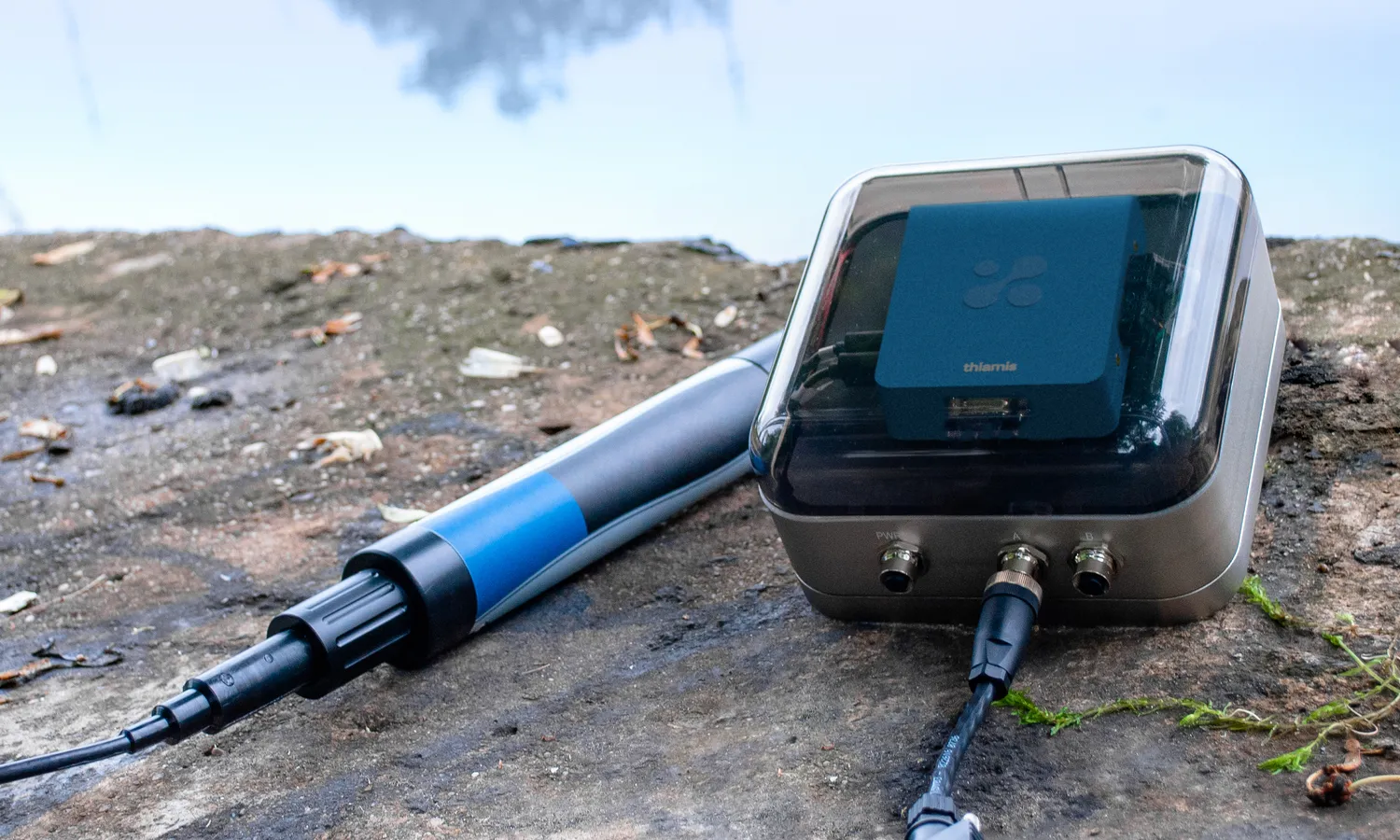
The setup
How a Monitoring Setup Works
Aquaculture monitoring is water monitoring, so it uses a Thiamis gateway connected to a multiparameter water sonde carrying dissolved oxygen, temperature, pH, and conductivity together on one probe, deployed in the pond, tank, or cage and logging continuously with alerting on the oxygen minimum. In a recirculating system the sonde is placed to represent the culture water, often with ammonium and nitrate sensors added to watch the biofilter; in ponds and cages it sits at a representative depth where the stock actually lives. Because dissolved oxygen is the acute risk, its alert is the one that matters most: it reaches the people who start the aerators by SMS or email, day or night, or goes by webhook to the farm's own control system, before a crash. Sensors need periodic cleaning and calibration to counter biofouling in productive water. The recommended configuration below pairs a logger with a sonde covering the core panel. Use the configurator to add nutrient sensors for RAS or biofilter monitoring.
Recommended
best match-

Thiamis connects 1 instrument
A gateway that connects the third-party instruments you choose to the Aethair Platform.
-
 Dissolved OxygenpHSalinityWater Temperature
YSI multiparameter water-quality sondes (Xylem): the current EXO platform and the legacy 6-series ('Sonde 6').
Swap for
Also measures 15 more
Dissolved Ammonia (NH₃)Ammonium (NH₄)Blue-Green AlgaeChlorideChlorophyllConductivityfDOM / CDOMNitrate (NO₃)ORPSpecific ConductanceTDSTSSTurbidityWater Level / DepthWater Pressure -
Which monitor
The Instruments in This Configuration
A Thiamis gateway logs these instruments continuously and sends their readings to Environet over 4G LTE (cellular data included) or the site's Wi-Fi. There they get the same alerts, reports, dashboards, and API as any Aethair monitor, in one account with every other device on the site, instead of a separate vendor app for each instrument. Thiamis runs on mains power, a solar panel, or an external battery.
YSI Water Quality Sondes
YSI multiparameter water-quality sondes (Xylem): the current EXO platform and the legacy 6-series ('Sonde 6').
What you get
Readings, Alerts, and the Report That Proves It
Every reading goes to the Aethair platform. Here is what a monitoring program gets from it.
Live data and alerts
Every reading in Environet as it happens, with alerts by email, SMS, or webhook at the thresholds you set.
Compliance reports
Scheduled or on-demand reports against the standards above or your own limits, as PDF or a secure link.
Dashboards and AI analysis
Live displays for a site or the public, and Noesis answering questions about the data in plain language.
Your data, through the API
Live and historical readings as JSON or CSV through the Environet API (OpenAPI 3.2), for a building management system, an ERP, or your own applications. The data is yours.
Related solutions
Related Solutions
Water Quality Monitoring
Rivers, lakes, drinking water, and stormwater
Hydrology, Level & Flow
Flood warning, stream gauging, and groundwater
Questions
Aquaculture & Fish Farming FAQ
Why is dissolved oxygen the most important parameter in aquaculture?
Because a shortage of dissolved oxygen is the fastest way to lose a stock: levels can fall overnight or in warm, still conditions and suffocate fish within hours. Monitoring it continuously with a low-level alert is what gives an operator time to switch on aeration before a crash becomes a mortality event.
What does monitoring ammonium and nitrate tell me?
In intensive and recirculating systems these nutrients track the nitrogen load from feed and waste and show whether the biofilter is working. A rise in ammonium signals that toxic ammonia is not being converted quickly enough, while nitrate confirms the nitrogen cycle is completing. Both are essential to managing a RAS safely.
Does monitoring differ between ponds, cages, and RAS?
The core parameters are the same, but placement and additions differ: ponds and cages need a representative depth and focus on the oxygen and temperature cycle, while recirculating systems add ammonium and nitrate to watch the biofilter. All benefit from continuous dissolved-oxygen alerting.
What is the best monitoring setup for a fish farm?
A Thiamis gateway with a multiparameter sonde measuring dissolved oxygen, temperature, pH, and salinity, with a priority alert on the oxygen minimum, plus ammonium and nitrate sensors for recirculating systems and biofilters. Use the configurator to pair the logger with the right sonde for your operation.
Put Your Monitoring on the Record
Schedule a callBuild a Configuration All solutions
A 30-minute call: you tell us about your application, then we demo the solution for it.