
Aethair solutions
Water Quality Monitoring
Rivers, lakes, drinking water, and stormwater
Why it matters
Why Continuous Water Quality Monitoring Matters
Rivers, lakes, reservoirs, groundwater, and coastal waters change constantly with rainfall, discharges, temperature, algal growth, and human activity, and damaging events often happen quickly, between a sampling technician's visits. A pollution spill, an oxygen crash that kills fish, a turbidity surge after a storm, or the onset of a harmful algal bloom can come and go in hours. Continuous, in-situ monitoring with multiparameter sondes captures these dynamics, providing early warning, regulatory evidence, and the long-term records that underpin water management, drinking-water protection, and environmental compliance.
The result is a shift from occasional snapshots to a live picture of water condition, with alerts when a parameter crosses a threshold.
What to measure
What to Measure and the Limits That Apply
The core panel covers the main program. Other parameters are added for a specific site or requirement. Every limit below is the published value from the standard that sets it.
The core panel is pH, dissolved oxygen, conductivity (or specific conductance), turbidity, and water temperature, the five parameters that together describe the basic health and chemistry of a water body and appear in most monitoring programs. From there the panel extends to the concern at hand: nutrients (nitrate, ammonium) for eutrophication and agricultural runoff, chloride and total dissolved solids for salinity and drinking-water quality, algal pigments (chlorophyll, blue-green algae) for bloom detection, ORP and total suspended solids for treatment and sediment, and water level so that concentrations can be tied to flow and events.
pH is one of the most fundamental water-quality parameters, governing the chemistry, biological health, and treatment of any water body, and shifting quickly with discharges, algal activity, and rainfall. Continuous pH monitoring with a multiparameter sonde catches those changes in real time (an acid spill, a photosynthetic swing, a treatment upset) where periodic sampling would miss them.
pH: sensors, units, and every standardDissolved oxygen is the parameter that most directly governs aquatic life, and an oxygen crash (from an algal bloom collapse, an organic pollution load, or a hot, still night) can kill fish within hours. Continuous DO monitoring is the early-warning backbone of river, lake, and aquaculture management, catching the fast, event-driven declines that spot sampling cannot.
- EPA aquatic life 5 mg/L: 3 mg/L for other life stages; the coldwater criteria are higher (EPA 1986 DO criteria)
Conductivity is a fast, reliable proxy for the total dissolved-ion content of water and one of the most useful early-warning parameters in a monitoring program: a sudden change flags a pollution event, a saline intrusion, or a discharge. Continuous conductivity monitoring with a multiparameter sonde tracks this baseline chemistry and underpins the derived salinity and total-dissolved-solids figures.
Conductivity: sensors, units, and every standardTurbidity, the cloudiness caused by suspended particles, is the water-quality parameter that responds fastest and most visibly to storms, spills, dredging, and treatment upsets. Continuous turbidity monitoring provides real-time event detection and is a regulated indicator in drinking-water treatment, closely tracking suspended solids and the transport of attached contaminants.
- EPA drinking water 1 NTU: ≤0.3 NTU in 95% of samples
Water temperature governs almost everything else in a water body: how much oxygen it can hold, how fast biological and chemical processes run, and which species can survive. Continuous temperature monitoring is a foundational channel of any multiparameter sonde deployment, giving essential context to dissolved oxygen, conductivity, and the whole water-quality picture.
Water Temperature: sensors, units, and every standardOxidation-reduction (redox) potential of water.
ORP: sensors, units, and every standardTotal dissolved solids.
TDS: sensors, units, and every standardSalinity derived from conductivity/temperature.
Salinity: sensors, units, and every standardNitrate (NO₃) concentration in water, an indicator of nutrient pollution.
Nitrate (NO₃): sensors, units, and every standardAmmonium (NH4) concentration in water.
Ammonium (NH₄): sensors, units, and every standardChloride ion concentration in water.
Chloride: sensors, units, and every standardChlorophyll-a fluorescence, an indicator of algal biomass.
Chlorophyll: sensors, units, and every standardBlue-green algae (cyanobacteria) pigment fluorescence (phycocyanin/phycoerythrin).
Blue-Green Algae: sensors, units, and every standardTotal suspended solids.
TSS: sensors, units, and every standardWater level / depth (pressure- or acoustic-derived).
Water Level / Depth: sensors, units, and every standard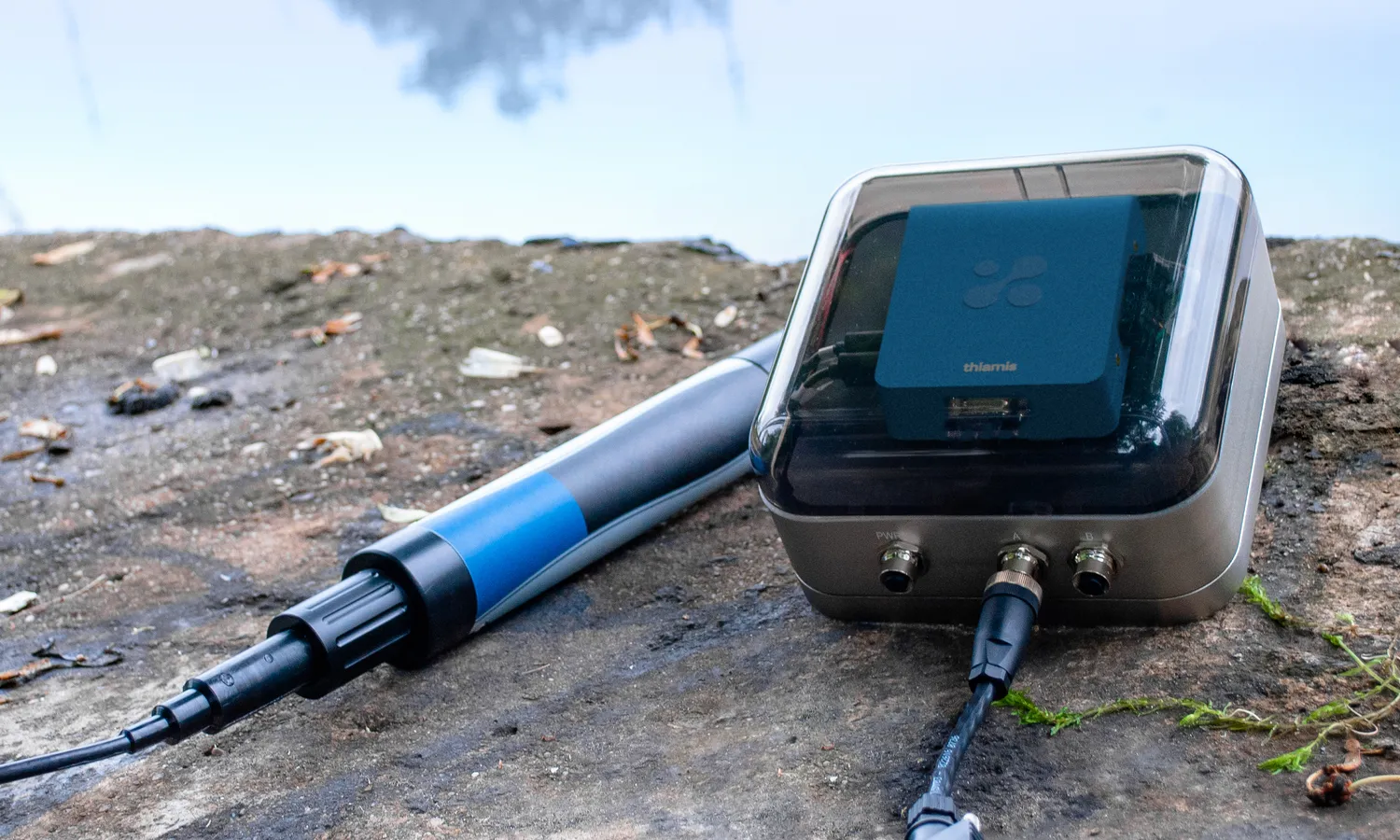
The setup
How a Monitoring Setup Works
Water quality monitoring uses a multiparameter sonde (a single probe carrying several sensors) deployed in the water body and logging continuously, with data telemetered back for dashboards and alerting. Because one sonde carries the whole core panel, a typical deployment is a single instrument rather than a collection of separate sensors. Placement depends on the goal: mid-channel and mid-depth for representative river monitoring, near an intake for drinking-water protection, or at the outfall for discharge compliance. Sensors need periodic cleaning and calibration to counter biofouling and drift. The recommended configuration below pairs a logger with a multiparameter sonde covering the core panel. Use the configurator to add nutrient, algae, or level sensors for your application.
Recommended
best match-

Thiamis connects 1 instrument
A gateway that connects the third-party instruments you choose to the Aethair Platform.
-
 ConductivityDissolved OxygenpHTurbidityWater Temperature
YSI multiparameter water-quality sondes (Xylem): the current EXO platform and the legacy 6-series ('Sonde 6').
Swap for
Also measures 14 more
Dissolved Ammonia (NH₃)Ammonium (NH₄)Blue-Green AlgaeChlorideChlorophyllfDOM / CDOMNitrate (NO₃)ORPSalinitySpecific ConductanceTDSTSSWater Level / DepthWater Pressure -
Which monitor
The Instruments in This Configuration
A Thiamis gateway logs these instruments continuously and sends their readings to Environet over 4G LTE (cellular data included) or the site's Wi-Fi. There they get the same alerts, reports, dashboards, and API as any Aethair monitor, in one account with every other device on the site, instead of a separate vendor app for each instrument. Thiamis runs on mains power, a solar panel, or an external battery.
YSI Water Quality Sondes
YSI multiparameter water-quality sondes (Xylem): the current EXO platform and the legacy 6-series ('Sonde 6').
What you get
Readings, Alerts, and the Report That Proves It
Every reading goes to the Aethair platform. Here is what a monitoring program gets from it.
Live data and alerts
Every reading in Environet as it happens, with alerts by email, SMS, or webhook at the thresholds you set.
Compliance reports
Scheduled or on-demand reports against the standards above or your own limits, as PDF or a secure link.
Dashboards and AI analysis
Live displays for a site or the public, and Noesis answering questions about the data in plain language.
Your data, through the API
Live and historical readings as JSON or CSV through the Environet API (OpenAPI 3.2), for a building management system, an ERP, or your own applications. The data is yours.
Related solutions
Related Solutions
Aquaculture & Fish Farming
Dissolved oxygen, temperature, and ammonia control
Hydrology, Level & Flow
Flood warning, stream gauging, and groundwater
Questions
Water Quality Monitoring FAQ
What are the core water quality parameters?
pH, dissolved oxygen, conductivity, turbidity, and water temperature form the standard core panel. Together they capture the basic chemistry, oxygen status, and clarity of a water body. Nutrients, chloride, algal pigments, and level are added according to whether the concern is eutrophication, salinity, blooms, or flow.
Why monitor continuously instead of taking samples?
Water quality changes rapidly with weather, discharges, and biological activity, and the critical events (spills, oxygen crashes, turbidity surges, algal blooms) often occur between manual sampling visits. Continuous in-situ monitoring catches them, provides early warning, and builds the long-term record that spot sampling cannot.
What is a multiparameter sonde?
A sonde is a single submersible instrument carrying several water-quality sensors together, typically pH, dissolved oxygen, conductivity, turbidity, and temperature, with optional nutrient and algae sensors. Because it measures the whole core panel in one device, a water-quality deployment is usually one sonde rather than many separate sensors.
How do I set up water quality monitoring?
Deploy a multiparameter sonde at a representative location, logging continuously with telemetry and periodic calibration to counter biofouling. Use the configurator to pair a logger with a sonde and add the nutrient, algae, or level sensors your application needs.
Put Your Monitoring on the Record
Schedule a callBuild a Configuration All solutions
A 30-minute call: you tell us about your application, then we demo the solution for it.