
Aethair solutions
Cabin Air Quality Monitoring for Mining and Heavy Equipment
Real-Time Cabin Air Monitoring for Mining, Construction, and Transportation Fleets
Why it matters
Why Cabin Air Quality Monitoring Matters
Operators of mining vehicles, heavy construction equipment, agricultural and forestry machinery, and transportation fleets spend their shifts surrounded by dust, diesel exhaust, and other contaminants. The cab's filtration and pressurization are what keep them out, and when those fail, the result is fatigue, lost productivity, and long-term health risk. Continuous monitoring in the cab shows whether they are working:
- ISO 23875 verification: the CO₂, particulate, and pressurization the standard sets for an operator enclosure, measured in the cab while the machine works.
- Operator health and safety: particulate and gas building up in the cab, flagged in real time.
- Filtration and pressurization faults: a loaded filter or a failed seal, seen across the whole fleet.
- Maintenance and ESG reporting: data and reports that target filter changes and document conditions for the fleet.
What to measure
The Cab Panel, and the Mine Around It
Inside the cab, ISO 23875 sets the numbers. Outside it, the mine's own hazards and limits apply.
In the cab (ISO 23875):
| Requirement | ISO 23875:2021, clause 4.1 |
|---|---|
| CO₂ | Sustained level no more than 400 ppm above ambient CO₂ |
| Respirable particulate | ≤ 25 µg/m³ at the start and end of the standard's decay test, with a decay time of 120 s at most |
| Pressurization | Sustained ≥ 20 Pa with the machine's electrical system on, and no more than 200 Pa |
CO₂ is the ventilation check: with the pressurizer bringing in enough outside air, it stays close to ambient. The respirable particulate figure is a test result (the standard's decay test), so in daily operation Aethair PRO's PM2.5 and PM10 are the filtration signal, and a rise shows a cab losing its protection. Cab pressure is what keeps unfiltered air out, and the differential-pressure cartridge tracks it. Gases outside the cab are outside ISO 23875's scope, but diesel exhaust is not outside the operator's lungs, which is why CO is the usual addition. ISO 23875 was written for mining, but its design and test requirements are meant to apply to fixed and mobile operator enclosures alike. Besides these performance numbers, it sets requirements for the enclosure's monitoring devices, including a CO₂ operator notification system. Source: ISO 23875:2021, introduction, clauses 1 and 4.1.
Around the cab (the mine panel): the mine's own hazards, outside ISO 23875's scope, with the limits that apply to them.
For worker health, respirable dust (PM4) and crystalline silica are central (silicosis remains a defining occupational disease of mining), alongside noise. For atmosphere and gas safety, carbon monoxide, nitrogen dioxide, methane, oxygen, and combustible gas (LEL) cover the mine-gas and confined-working hazards, with WBGT heat stress in hot deep workings. At the boundary, PM10 with wind speed and direction manages the community dust impact and attributes exceedances to on-site activity. The exact set depends on whether the operation is surface or underground and on the mineral being worked.
At the surface boundary of a mine or quarry, PM10 is the parameter that governs the operation's dust impact on neighboring communities. Real-time PM10 monitoring with wind speed and direction detects dust drifting off-site, attributes it to on-site activity rather than an external source, and triggers suppression before a boundary limit is exceeded. This is a routine condition of most operating permits.
PM10: sensors, units, and every standardRespirable dust (PM4) is the worker-health frontline in mining and quarrying, because it is the size fraction that reaches deep into the lungs and, where it carries crystalline silica, causes silicosis. Real-time PM4 monitoring at the face and in processing areas shows which tasks generate the most respirable dust and whether controls are working, complementing the gravimetric sampling used for exposure compliance.
- ISO 23875 25 µg/m³: respirable particulate; decay time 120 s at most
So much of what mining and quarrying drills, blasts, and crushes contains crystalline silica that respirable silica exposure is a defining occupational hazard of the sector. Because a general dust reading cannot quantify the crystalline fraction, silica monitoring combines gravimetric personal sampling for compliance with real-time respirable-dust monitoring to control exposure as work proceeds.
- MSHA silica 50 µg/m³: full shift
- MSHA silica 25 µg/m³: full shift
Mining and quarrying are persistently noisy (drilling, blasting, crushing, and heavy haulage). That creates both an occupational hearing-conservation duty and an environmental noise impact on nearby communities. Continuous Leq monitoring covers both: personal and area measurement for worker exposure, and boundary measurement against the environmental limit.
Equivalent Continuous Level (Leq): sensors, units, and every standardCarbon monoxide: a toxic, odorless combustion gas that binds to hemoglobin.
Carbon Monoxide (CO): sensors, units, and every standardNitrogen dioxide: a criteria pollutant, respiratory irritant, and marker of traffic combustion.
Nitrogen Dioxide (NO₂): sensors, units, and every standardOxygen concentration; critical for confined-space safety (deficiency below 19.5 %, enrichment above 23.5 %).
Oxygen (O₂): sensors, units, and every standardMethane: a combustible gas (explosion hazard, measured in %LEL) and a potent greenhouse gas.
Methane (CH₄): sensors, units, and every standardCombustible-gas concentration as a percentage of the Lower Explosive Limit, a key flammability and explosion-safety metric.
Combustible (LEL): sensors, units, and every standardWet-Bulb Globe Temperature (WBGT): the standard composite index for occupational heat-stress assessment.
WBGT (Heat Stress): sensors, units, and every standardHorizontal wind speed.
Wind Speed: sensors, units, and every standardHorizontal wind direction (0–360°).
Wind Direction: sensors, units, and every standardTime-weighted average / noise dose over the work shift.
- MSHA noise 90 dBA: 5 dB exchange rate; integrates 90 to at least 140 dBA
- MSHA noise 85 dBA: hearing conservation program; integrates 80 to at least 130 dBA
The setup
How a Cabin Monitoring Setup Works
One monitor per cab, so the count follows the fleet.
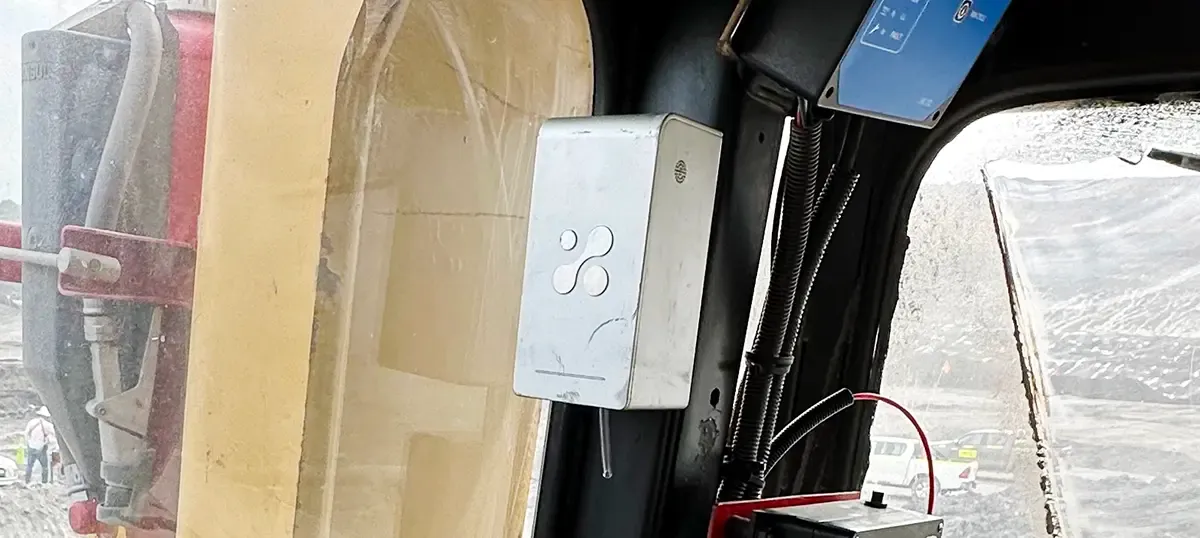
An Aethair PRO goes in each operator cab. Its built-in particle sensor covers PM, a CO₂ cartridge in one gas socket covers ventilation, and the differential-pressure cartridge in the expansion socket covers pressurization, which leaves the second gas socket for CO or another gas the operation needs. Cartridges come pre-calibrated and swap without recalibration, and the monitor reports over its own 4G LTE, so there is no site network to join.
Recommended
best match-

Industrial monitor for indoor and outdoor sites. Built-in sensors cover the essentials, and hot-swappable gas sensor cartridges and a differential-pressure option add more.
Built-inPM10PM2.5Gas 1

Aethair CO₂ (dual NDIR)
Carbon Dioxide (CO₂)Dual-thermopile NDIR (non-dispersive infrared) sensing measures CO₂ with no chemical consumables, for…
Also fits: Aethair CO₂ (self-calibrating NDIR)
Gas 2
Free: one more gas sensor cartridge
MultiSense
Free: a MultiSense, stock or built to order
Expansion

Aethair Diff. Pressure
Differential PressureA gauge sensor reads 0–10 kPa, with the higher-pressure side connected to its port.
Also measures 11 more
Dew PointHeat IndexRelative HumidityIlluminance / LightParticle Count (by size)PM1Total PM / Mass Conc.Barometric PressureEquivalent Continuous Level (Leq)Sound Pressure Level (SPL)Air Temperature
Recommended
best match-
Industrial monitor for indoor and outdoor sites. Built-in sensors cover the essentials, and hot-swappable gas sensor cartridges and a differential-pressure option add more.
Built-inPM10PM2.5Gas 1

Aethair CO (electrochemical)
Carbon Monoxide (CO)An amperometric electrochemical CO cell with a solid, non-aqueous electrolyte (the long-life, low-power…
Also fits: Aethair MultiGas+, Aethair CO (ppb, four-electrode)
Gas 2
Aethair CO₂ (dual NDIR)
Carbon Dioxide (CO₂)Dual-thermopile NDIR (non-dispersive infrared) sensing measures CO₂ with no chemical consumables, for…
Also fits: Aethair CO₂ (self-calibrating NDIR)
MultiSense
Free: a MultiSense, stock or built to order
Expansion
Aethair Diff. Pressure
Differential PressureA gauge sensor reads 0–10 kPa, with the higher-pressure side connected to its port.
Also measures 11 more
Dew PointHeat IndexRelative HumidityIlluminance / LightParticle Count (by size)PM1Total PM / Mass Conc.Barometric PressureEquivalent Continuous Level (Leq)Sound Pressure Level (SPL)Air Temperature
Configure ISO 23875 Monitoring Configure it with diesel CO
Beyond the cab:
Mining monitoring spans personal, area, and boundary measurement. Underground and at the face, multi-gas monitors watch the atmosphere continuously and personal dust and noise sampling captures worker exposure. At the surface boundary, real-time PM10 with meteorology manages the community impact, and gravimetric silica sampling documents exposure compliance. Instruments must withstand a harsh, dusty, humid environment and hold calibration under it. The recommended configuration below assembles a respirable-dust and noise panel. Use the configurator to add the mine-gas set, heat stress, or boundary meteorology for the specific operation.
Recommended
best match-
Industrial monitor for indoor and outdoor sites. Built-in sensors cover the essentials, and hot-swappable gas sensor cartridges and a differential-pressure option add more.
Built-inPM10Equivalent Continuous Level (Leq)Gas 1
Free: one more gas sensor cartridge
Gas 2
Free: one more gas sensor cartridge
MultiSense
Free: a MultiSense, stock or built to order
Expansion
Free: differential pressure
Also measures 11 more
Dew PointHeat IndexRelative HumidityIlluminance / LightParticle Count (by size)PM1PM2.5Total PM / Mass Conc.Barometric PressureSound Pressure Level (SPL)Air Temperature -

Thiamis connects 1 instrument
A gateway that connects the third-party instruments you choose to the Aethair Platform.
-

Trolex Particulate & Dust Monitors
PM4 (Respirable)Respirable Crystalline SilicaTrolex real-time dust and silica monitors for harsh mining and industrial environments: the Air XD fixed optical dust…
Also measures 3 more
PM1PM2.5Total PM / Mass Conc. -
Which monitor
Aethair PRO, Built In
Aethair PRO is an industrial monitor built for continuous, low-maintenance operation in demanding environments. Every unit carries these built-in sensors, calibrated before it ships.
| Parameter | Range | Resolution | What it measures |
|---|---|---|---|
| PM1µg/m³ | — | 1 µg/m³ | Submicron particulate ≤1 µm, the fraction that penetrates deepest into the lungs. Measured by 90° laser light-scattering, in µg/m³. |
| PM2.5µg/m³ | 0–1000 µg/m³ | 1 µg/m³ | Fine particulate ≤2.5 µm, the headline health metric behind NAAQS and WHO limits. 90° laser light-scattering, µg/m³. |
| PM10µg/m³ | 0–1000 µg/m³ | 1 µg/m³ | Coarse particulate ≤10 µm: dust, pollen, and road grit. Measured by 90° laser light-scattering, in µg/m³. |
| Total PM / Mass Conc.µg/m³ | 0–2000 µg/m³ | 1 µg/m³ | Total particulate mass the optical sensor reports across its size bins (the device's "PM" channel; the spec sheet calls it TSP), µg/m³. An optical sensor under-counts the largest particles, so this is not a gravimetric TSP measurement. |
| Particle Count (by size)particles≥0.3 µm, ≥0.5 µm, ≥1.0 µm, ≥2.5 µm, ≥5.0 µm, ≥10.0 µm | — | — | Raw particle counts in six optical size bins (≥0.3, ≥0.5, ≥1.0, ≥2.5, ≥5.0, and ≥10.0 µm) from the laser counter, used to derive the PM mass fractions. |
| Air Temperature°C / °F | -20 to 70 °C | 0.1 °C | Air temperature, reported in °C or °F. |
| Relative Humidity% | 0–90 % | 0.1 % | Relative humidity, %. |
| Barometric PressurekPa | 30–110 kPa | — | Barometric pressure, kPa. |
| Dew Point°C / °F | — | — | Dew point (the temperature at which air becomes saturated), derived from temperature and humidity. °C or °F. |
| Heat Index°C / °F | — | — | Heat index (apparent temperature), derived from temperature and humidity. °C or °F. |
| Sound Pressure Level (SPL)dB | 40–120 dB | 1 dB | Sound pressure level: instantaneous ambient noise, dB. |
| Equivalent Continuous Level (Leq)dB | 40–120 dB | 1 dB | Equivalent continuous sound level (Leq): time-averaged ambient noise, dB. |
| Illuminance / Lightlums | 0–10,000 | — | Ambient light level on the sensor's own scale. |
Hot-swappable
Gas, MultiSense, and Expansion Cartridges
Two gas sockets, a MultiSense socket, and an expansion socket take pre-calibrated cartridges, so the same monitor fits a haul truck, a dozer, or a rail cab. Need a gas that is not listed? Ask us.
An Aethair PRO takes up to 2 customer-selected gas sensor cartridges, plus 1 MultiSense socket that takes Aethair MultiSense (or a Custom MultiSense built to order) and 1 expansion socket that takes Aethair Diff. Pressure.
| Cartridge | Description | Measures & specs |
|---|---|---|
Aethair CO (electrochemical) Gas 0d01 | Carbon monoxide cartridge. An amperometric electrochemical CO cell with a solid, non-aqueous electrolyte (the long-life, low-power sensing element used in residential and commercial CO alarms), for combustion safety, garages, and workplace air monitoring. | Carbon Monoxide (CO)0-1000 ppm · res. 1 ppm |
Aethair CO₂ (dual NDIR) Gas 0d02 | Carbon dioxide cartridge. Dual-thermopile NDIR (non-dispersive infrared) sensing measures CO₂ with no chemical consumables, for demand-controlled ventilation, HVAC, and indoor air quality. | Carbon Dioxide (CO₂)0-5000 ppm · res. 1 ppm |
 Aethair VOC (ppm PID) Gas 0d03 | Total VOC cartridge (ppm range). A 10.6 eV photoionization detector (PID) ionizes volatile organic compounds for direct ppm readings across a wide range. Used for industrial hygiene, leak detection, and fenceline monitoring of solvent, fuel, and off-gassing vapors. | VOC (Total)0-4000 ppm · res. 0.1 ppm |
 Aethair CO₂ (self-calibrating NDIR) Gas 0d04 | Carbon dioxide cartridge. NDIR (non-dispersive infrared) sensing with automatic background self-calibration for maintenance-free CO₂ measurement in demand-controlled ventilation and indoor air quality. | Carbon Dioxide (CO₂)0-5000 ppm · res. 1 ppm |
 Aethair NO₂ Gas 0d05 | Nitrogen dioxide cartridge. Four-electrode electrochemical sensing resolves NO₂ down to parts-per-billion, for roadside traffic, combustion, and ambient air-quality networks. | Nitrogen Dioxide (NO₂)0-20 ppm · res. 20 ppb |
 Aethair CH₄ Gas 0d0a | Methane cartridge. Molecular Property Spectrometer (MPS) MEMS sensing, poison-immune and factory-calibrated for life, for combustible-gas monitoring in %LEL. | Methane (CH₄)0-100 %LEL · res. 1 %LEL |
 Aethair O₂ Gas 0d11 | Oxygen cartridge. A self-powered galvanic electrochemical cell with instant-on response measures O₂ from 0 to 30%, for oxygen depletion and enrichment monitoring. | Oxygen (O₂)0-30 % · res. 0.1 % |
 Aethair VOC (ppb PID) Gas 0d13 | Total VOC cartridge (ppb range). A high-sensitivity 10.6 eV photoionization detector (PID) resolves volatile organic compounds to single-digit ppb, for low-level VOC monitoring in indoor air quality and fugitive-emissions surveillance. | VOC (Total)0-40 ppm · res. 1 ppb |
 Aethair NO Gas 0d15 | Nitric oxide cartridge. Biased four-electrode electrochemical sensing resolves NO to parts-per-billion, for combustion, NOₓ, and ambient air-quality monitoring. | Nitric Oxide (NO)0-20 ppm · res. 15 ppb |
 Aethair MultiGas+ Gas 0d16 | Combination cartridge. Metal-oxide semiconductor (MOS) sensing tracks carbon monoxide, methane, and total VOC from a compact element, for combustible-gas safety and indoor air-quality monitoring. A MOS element responds to all three gases and to humidity, so its readings are indicative trends rather than selective measurements. | Methane (CH₄)0-10000 ppm · res. 10 ppm Carbon Monoxide (CO)0-1000 ppm · res. 1 ppm VOC (Total)0-100 ppm · res. 1 ppm |
 Aethair VOC (ppb PID, wide range) Gas 0d25 | Total VOC cartridge (ppb range). Photoionization detection (PID) resolves volatile organic compounds to parts-per-billion, for low-level VOC monitoring in indoor air and process environments. | VOC (Total)0-4000 ppm · res. 1 ppb |
 Aethair CO (ppb, four-electrode) Gas 0d35 | Carbon monoxide cartridge. Four-electrode electrochemical sensing resolves CO from parts-per-billion up to 1000 ppm, for ambient air-quality and traffic-pollution monitoring. | Carbon Monoxide (CO)0-1000 ppm · res. 4 ppb |
 Aethair O₃+NO₂ Gas 0d45 | Ozone cartridge. Four-electrode electrochemical sensing measures oxidizing gases (ozone plus nitrogen dioxide) and reports one combined O₃+NO₂ value (shown under both parameters), for ambient air-quality monitoring. | Nitrogen Dioxide (NO₂)0-20 ppm · res. 15 ppb Ozone (O₃)0-20 ppm · res. 15 ppb |
 Aethair SO₂ Gas 0d55 | Sulfur dioxide cartridge. Four-electrode electrochemical sensing resolves SO₂ from parts-per-billion up to 100 ppm, for combustion, industrial-emissions, and ambient air-quality monitoring. | Sulfur Dioxide (SO₂)0-100 ppm · res. 5 ppb |
 Aethair H₂S Gas 0d65 | Hydrogen sulfide cartridge. Filtered four-electrode electrochemical sensing resolves H₂S to parts per billion, for wastewater, odor, oil & gas, and safety monitoring. | Hydrogen Sulfide (H₂S)0-50 ppm · res. 5 ppb |
 Aethair HCl Gas 0d75 | Hydrogen chloride cartridge. A large-electrolyte electrochemical sensor built for high-humidity, corrosive environments detects HCl for semiconductor etch, exhaust-scrubber, and incineration monitoring. | Hydrogen Chloride (HCl)0-30 ppm · res. 0.5 ppm |
 Aethair HF Gas 0d85 | Hydrogen fluoride cartridge. Three-electrode electrochemical sensing detects HF at trace levels, for aluminum smelting, glass etching, semiconductor, and refining safety. | Hydrogen Fluoride (HF)0-10 ppm · res. 0.05 ppm |
 Aethair MultiSense MultiSense 0d09 | Multi-gas sensor cartridge. Simultaneous electrochemical detection of sulfur dioxide, nitrogen dioxide, and formaldehyde at parts-per-billion resolution, for ambient and indoor air-quality monitoring. | Nitrogen Dioxide (NO₂)0-20 ppm · res. 20 ppb Formaldehyde (CH₂O)0-10 ppm · res. 10 ppb Sulfur Dioxide (SO₂)0-20 ppm · res. 10 ppb |
Aethair Diff. Pressure Expansion 0d08 | Differential-pressure cartridge for the Aethair PRO expansion socket, for room-to-room pressure monitoring in cleanrooms and containment. A gauge sensor reads 0–10 kPa, with the higher-pressure side connected to its port. | Differential Pressure0-10000 Pa |
What you get
Cabin Air Monitoring at Fleet Scale
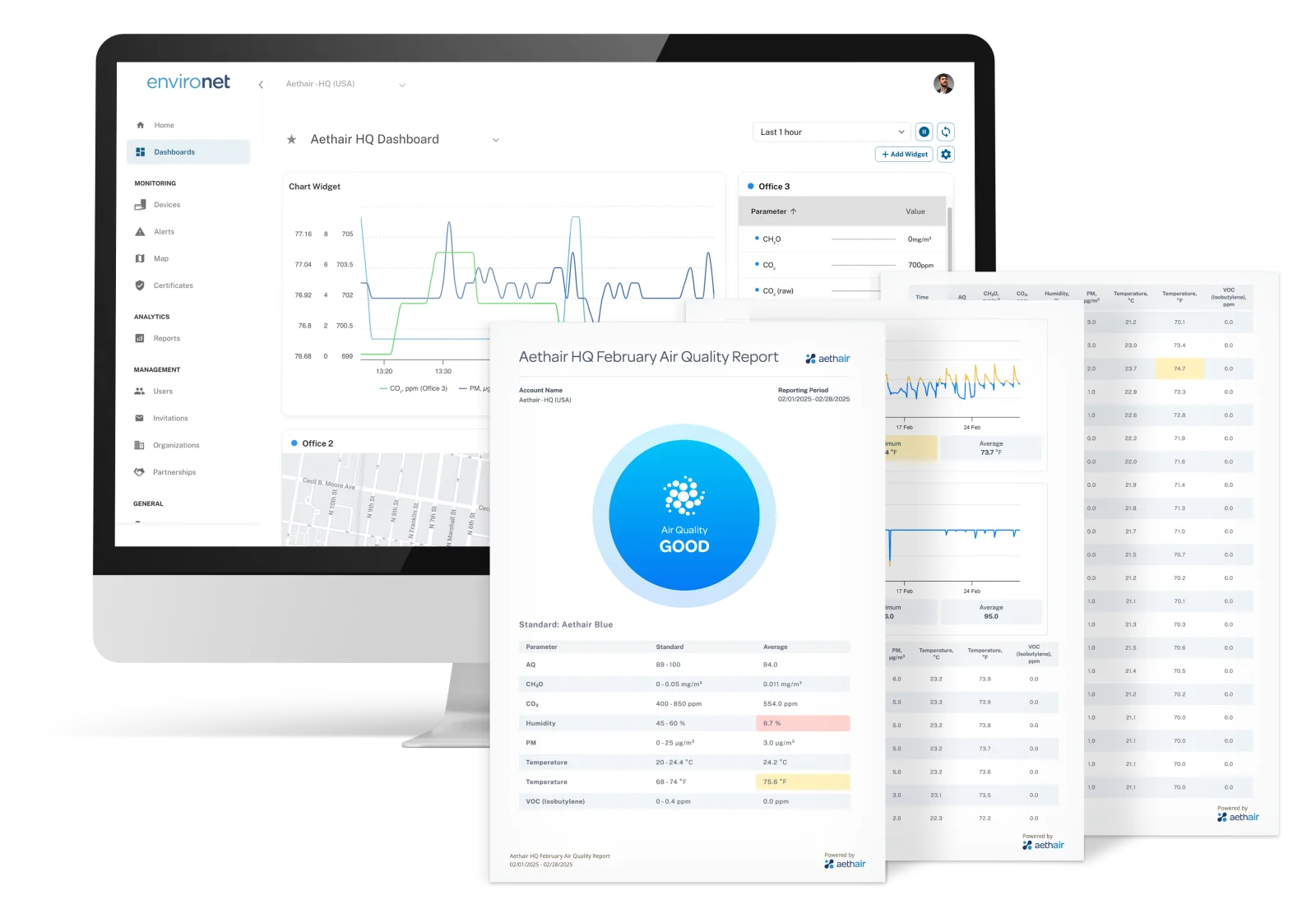
Whether it is a handful of vehicles or hundreds of machines, every cab reports into Environet, with one view of the fleet and alerts by email, SMS, or webhook when a cab's air or pressure drifts. Aethair Reports generates customizable reports in seconds, including the Aethair Cabin template, which documents a cab against ISO 23875.
- Fleet-wide deployment: one monitor per cab, all vehicles and equipment in one account.
- Real-time cab monitoring: PM, CO₂, cab pressure, gases, temperature, and humidity.
- Reports without spreadsheets: trends and exceedances organized for you, on demand or on a schedule.
- Evidence for ISO 23875: a continuous record of the cab against the standard's numbers.
Ask the data
Noesis: AI Analysis for the Fleet
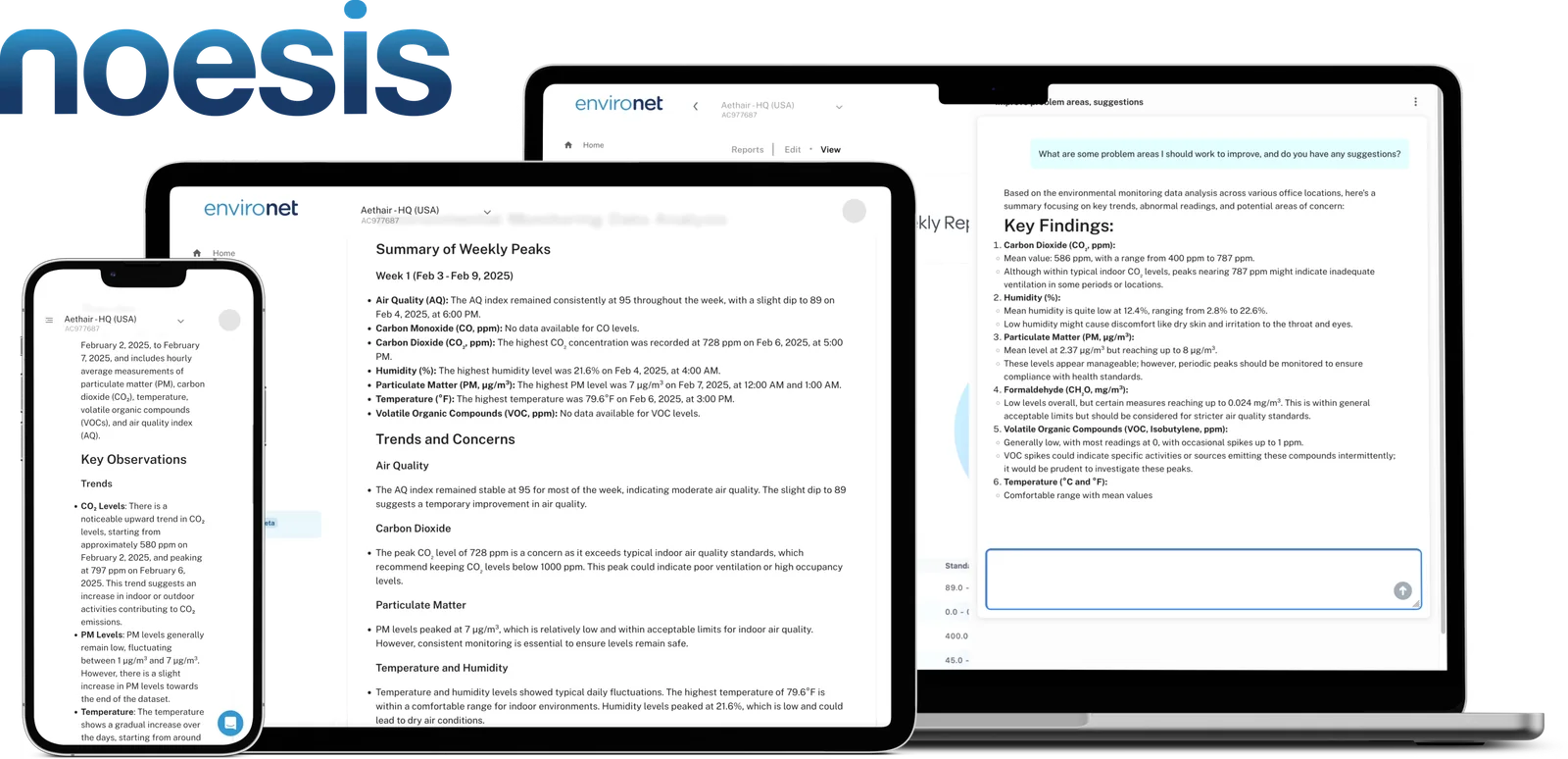
With Noesis, cab air data becomes something a safety manager can question. Analyze live or historical readings, generate a report, or review an existing one in Environet. In a few clicks, find anomalies, compare conditions across the fleet, and support the decisions that follow, with far less manual review.
Customer success story
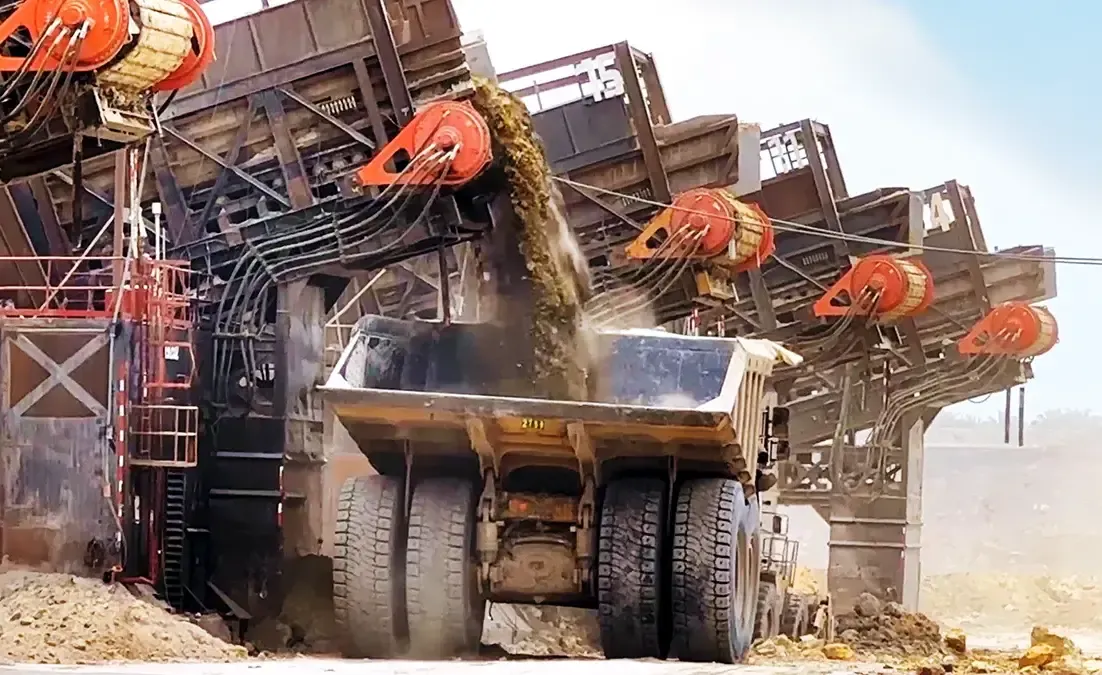
Drummond Mine, Colombia
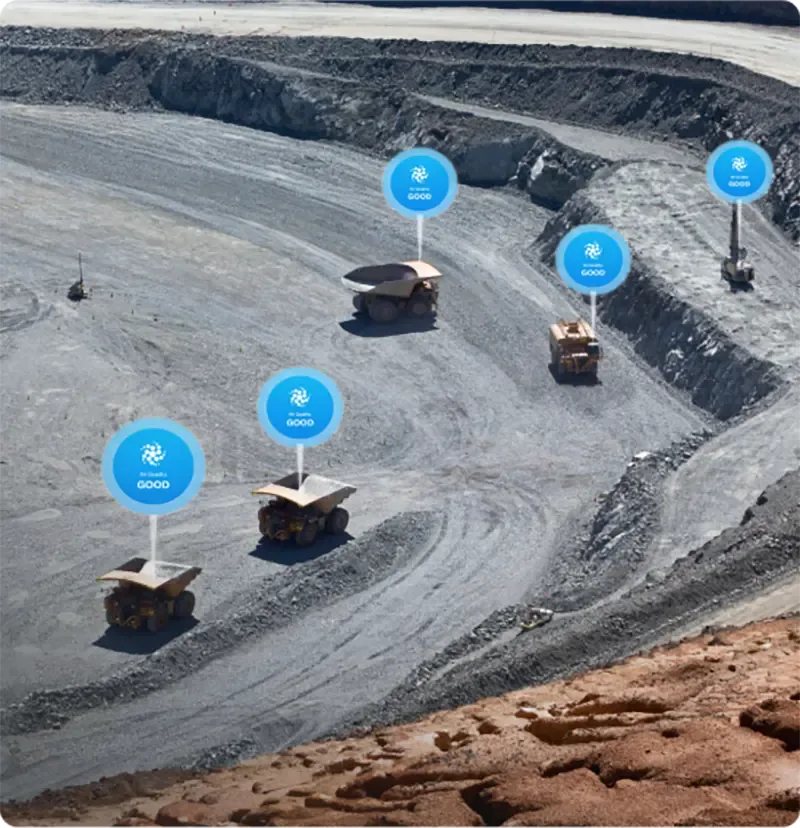
At Drummond Company's mining operation in Colombia, Aethair PRO monitors cabin air quality across the vehicle fleet. The rugged, flexible system gives real-time in-cab readings, simplifies compliance reporting, and supports operator health and safety, so oversight takes less of Drummond's attention and more goes to mining.
By sector
Mining Air Monitoring Beyond the Cab
The cab is one part of a mine's air. Each of these is the same platform with a different panel, standard, and report.
Perimeter and boundary dust
PM10 and wind at the edge of the pit or the site, for the community dust a surface operation is answerable for.
Occupational safety
CO, H₂S, oxygen, and combustible gas for confined and enclosed working, against the action levels that apply.
Heat stress
WBGT for crews working in hot deep workings or outdoors in summer heat.
Article Library
Reading for Cabin and Mining Air Programs
Guides to the standards and practices behind air monitoring in mining and heavy equipment.
How to Choose an Air Quality Monitor: PRO, IAQ, or Thiamis
Compare Aethair PRO, IAQ, and Thiamis to match the right device to your site, from commercial interiors to industrial and fenceline monitoring.
What Is Environmental Intelligence? Definition & Use Cases
Environmental intelligence turns real-world environmental data into decisions you can act on and defend. Learn how platforms combine monitoring and AI.
Industrial Perimeter Air Quality Monitoring: Action Levels
What industrial perimeter monitoring requires at fenceline and construction sites: DER-10 CAMP action levels, EPA fenceline rules, and continuous records.
Questions
Cabin Air Quality Monitoring FAQ
What is ISO 23875?
ISO 23875:2021 is the ISO standard for air quality control systems in operator enclosures, the cabs of mining machines. It was written for mining, but its design and test requirements are meant to be universal, for fixed and mobile enclosures alike. It sets performance requirements for the filtration and pressurization system: sustained CO₂ no more than 400 ppm above ambient, respirable particulate at or below 25 µg/m³ at the start and end of its decay test, and sustained pressurization of at least 20 Pa and no more than 200 Pa. It also sets requirements for the enclosure's monitoring devices, including a CO₂ operator notification system.
What is a mining cabin air monitor?
A monitor installed inside the operator cab of a mining vehicle or heavy machine that measures the cab air continuously (particulate matter, CO₂, cab pressure, and gases such as CO) to show whether filtration and pressurization are keeping outside contaminants out. Aethair PRO does this with its built-in particle sensor and gas and differential-pressure cartridges.
What does ISO 23875 require for cabin air quality?
Clause 4.1 of ISO 23875 requires sustained cab CO₂ no more than 400 ppm above ambient (a measure of ventilation), respirable particulate of 25 µg/m³ or less at the start and end of the decay test, with the decay taking 120 seconds at most, and sustained pressurization between 20 Pa and 200 Pa. Gases and vapors outside the cab are outside its scope.
How does Aethair PRO support fleet-wide cabin air monitoring?
Aethair PRO goes in each cab and streams its readings over 4G LTE to Environet, where the fleet shows on one dashboard, alerts go out when a cab's air or pressure drifts, and Aethair Reports reports each cab to ISO 23875 with its Aethair Cabin template.
Can cabin air monitoring detect filtration failures?
Yes. A loaded filter or a failed seal shows up as particulate rising inside the cab or pressurization falling, often before the operator notices anything. Continuous monitoring catches the trend, so maintenance can change the filter or fix the seal before exposure becomes a safety issue.
What industries use cabin air quality monitoring?
Mining first, then heavy construction, agriculture, forestry, and rail: anywhere operators work in an enclosed cab surrounded by dust, diesel exhaust, or chemicals.
How does cabin air affect operator productivity and safety?
Poor cab air contributes to fatigue, reduced alertness, and long-term respiratory risk. Continuous monitoring shows when a cab stops protecting its operator, and gives the fleet operator the record to show the enclosure performed.
What are the main air hazards in mining?
Respirable dust and crystalline silica (causing silicosis), mine gases including carbon monoxide, nitrogen dioxide, and methane, oxygen deficiency in confined workings, plus noise and heat. Surface operations add boundary PM10 affecting neighboring communities. Which apply depends on whether the operation is surface or underground and on the mineral.
Why is silica such a concern in mining and quarrying?
Because so much of what is drilled, blasted, and crushed contains crystalline silica, and the fine respirable fraction causes irreversible, progressive lung scarring (silicosis) and lung cancer. It has a strict occupational exposure limit and requires size-selective, crystalline-specific measurement rather than a general dust reading.
How do mines manage community dust impact?
By monitoring PM10 at the site boundary in real time, alongside wind speed and direction, so that dust drifting toward neighbors is detected and attributed to on-site activity. This lets the operation apply suppression before a boundary limit is breached and provides evidence to answer complaints.
How do I set up mining air and gas monitoring?
Combine personal and area respirable-dust and noise monitoring with a mine-gas multi-gas monitor underground, and real-time boundary PM10 with meteorology at the surface. Use the configurator to assemble a dust-and-noise panel and add the gas set, heat stress, or boundary monitoring your operation needs.
Put Every Cab on the Record
Schedule a ConsultationAethair PRO Aethair Reports Build a Configuration
A 30-minute call: you tell us about your application, then we demo the solution for it.
Used by teams at