
Aethair solutions
School Air Quality Monitoring
Real-Time Air Quality for Classrooms, Common Spaces, and Campuses
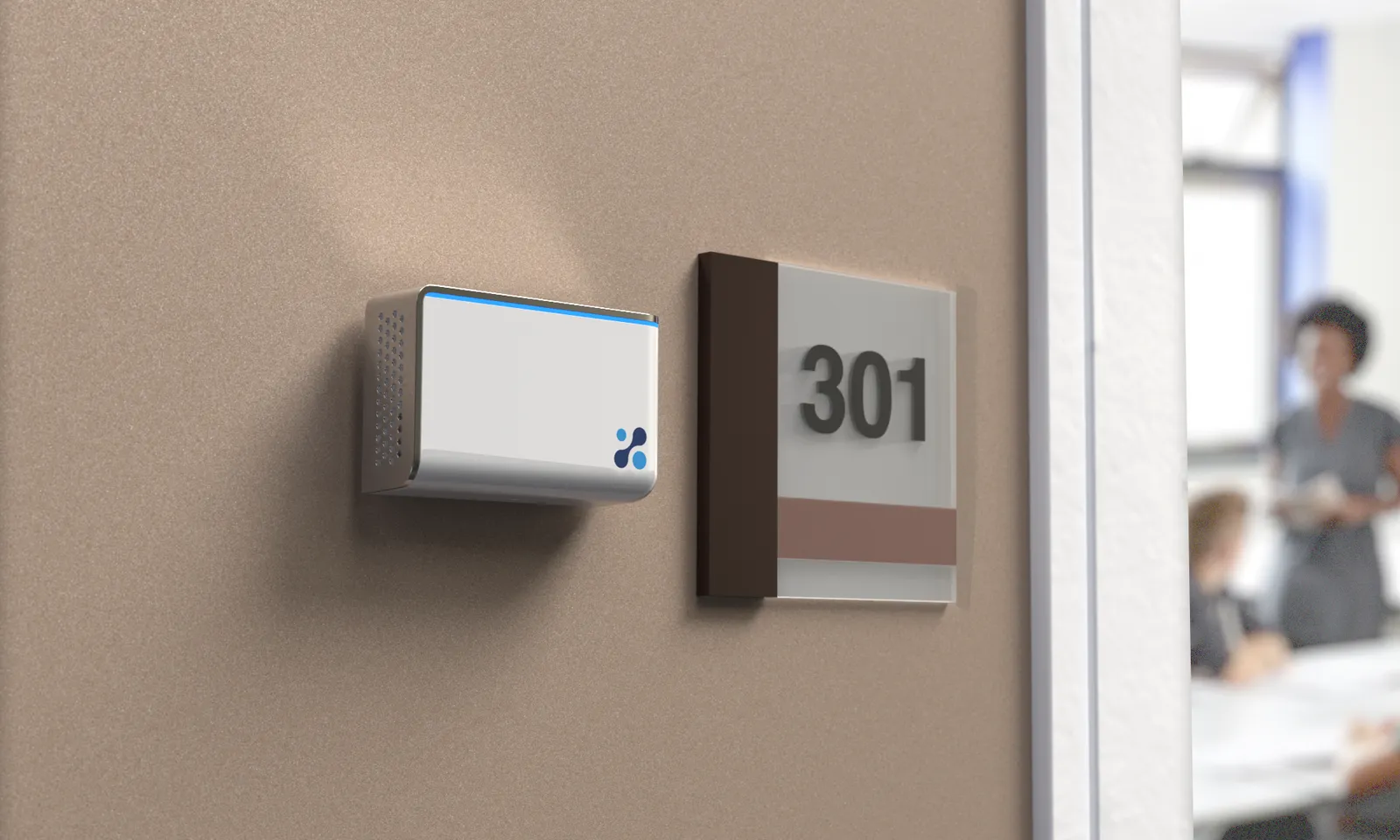
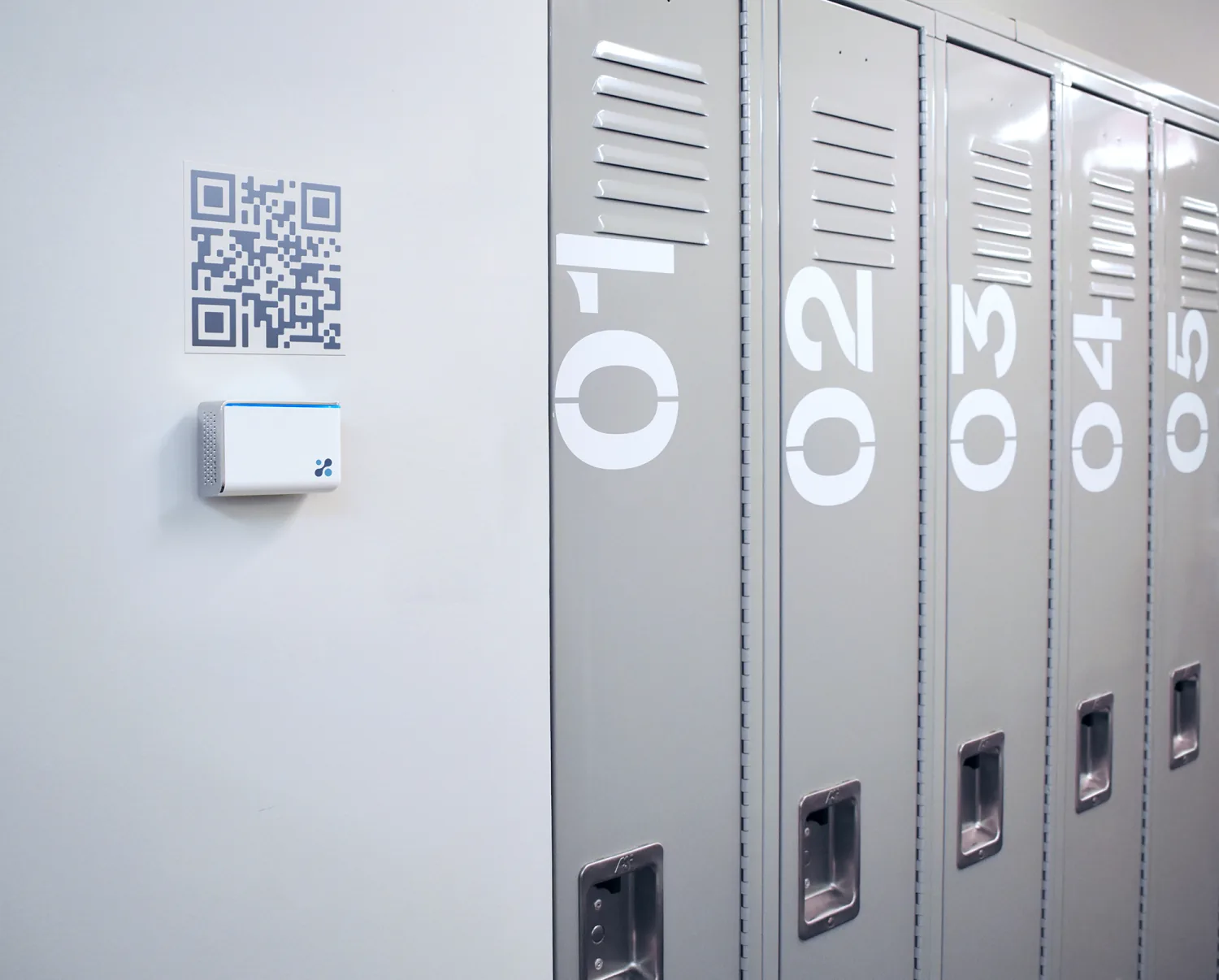
Why it matters
Why Air Quality Matters in Schools and Universities
Classrooms are densely occupied, many buildings rely on HVAC well past its design life, and younger students are more sensitive to the conditions around them. Budgets are tight, so facilities teams need to know which rooms to prioritize rather than guess. Continuous monitoring answers that with data.
- Dense occupancy: a full classroom raises CO₂ quickly, which can affect concentration.
- Aging HVAC: older ventilation drifts out of balance, and monitoring shows where.
- Sensitive occupants: children breathe more air relative to their body weight than adults.
- Where to start: the standards and the return on monitoring are in our article on indoor air quality in schools.
What to measure
The Classroom Panel and the Limits That Apply
Five parameters carry a school program; the rest are added for a specific building. Aethair IAQ measures all five on one calibrated device: particulates, gases (CO₂ as the ventilation indicator, total VOCs from cleaning products and supplies), and the temperature and humidity that affect comfort and focus. It also measures formaldehyde from furnishings. Every limit below is the published value from the standard that sets it.
The classroom core is CO₂ (the headline indicator of whether a room is being ventilated in step with how many students occupy it), PM2.5 (fine particles reaching classrooms from outdoor traffic, wildfire smoke, and indoor activity), total VOCs (the chemical load from cleaning products, art and science supplies, and furnishings), and temperature and relative humidity (comfort and concentration, and the drivers of dampness and mold in aging buildings). Many schools add formaldehyde, common in new furnishings and building materials, and PM10. Together these cover the parameters that healthy-school programs specify and that students and staff experience through the school day.
In schools, PM2.5 reaches classrooms from outdoor traffic and wildfire smoke as well as indoor activity, and children, who breathe more air relative to body weight than adults, are more exposed to its effects. Continuous PM2.5 monitoring in classrooms and shared spaces shows when outdoor pollution or smoke is penetrating the building and whether filtration and ventilation are keeping fine particles down while rooms are occupied.
PM2.5: sensors, units, and every standardCO₂ is the parameter schools lead with, because a full classroom drives it up quickly and elevated CO₂ is linked to reduced concentration and learning performance. Continuous CO₂ monitoring per classroom exposes under-ventilated rooms through the school day and provides the documented record that a growing number of jurisdictions now require for classroom ventilation.
- WELL v2 900 ppm: or no more than 500 ppm above outdoor; one of four ways to meet the precondition
- WELL v2 750 ppm: or no more than 350 ppm above outdoor
- UBA CO₂ 1000 ppm: < 1000 ppm: hygienically acceptable
- UBA CO₂ 2000 ppm: > 2000 ppm: hygienically unacceptable
Total VOCs in schools come from cleaning products, art and science supplies, furnishings, and new building materials, and they accumulate in rooms that are not ventilated in step with their use. Tracking TVOC against a classroom's own baseline flags cleaning cycles, off-gassing, and process emissions so staff can ventilate before the chemical load affects comfort or focus.
- WELL v2 500 µg/m³: continuous TVOC monitoring, an alternative to laboratory testing of benzene, formaldehyde, and toluene
Classroom temperature swings directly affect how well students concentrate, and older school HVAC often struggles to hold a comfortable, even setpoint across a densely occupied room. Continuous temperature monitoring shows which rooms drift outside the comfortable range and when, giving facilities teams the data to balance heating and ventilation rather than react to complaints.
Air Temperature: sensors, units, and every standardRelative humidity shapes both comfort and health in schools: dry winter air irritates airways, while damp rooms invite mold in aging buildings. Continuous humidity monitoring alongside temperature and CO₂ completes the classroom comfort picture and surfaces the damp, poorly ventilated spaces that need attention first.
Relative Humidity: sensors, units, and every standardInhalable ('thoracic') particulate ≤10 µm; includes coarse dust that deposits in the upper airways.
PM10: sensors, units, and every standardFine particulate matter ≤1 µm aerodynamic diameter, the finest fraction, which reaches the deep alveolar regions of the lung.
PM1: sensors, units, and every standardFormaldehyde (CH₂O/HCHO), a colorless carcinogenic VOC emitted by pressed-wood products, insulation, furnishings, and combustion; a key indoor air quality parameter.
- WELL v2 50 µg/m³: verified by laboratory testing of occupiable spaces
- WHO indoor 2010 0.1 mg/m³: formaldehyde guideline value
Barometric / atmospheric pressure.
Barometric Pressure: sensors, units, and every standardCarbon monoxide: a toxic, odorless combustion gas that binds to hemoglobin.
Carbon Monoxide (CO): sensors, units, and every standardOzone: a secondary photochemical pollutant and respiratory irritant, and an occupational hazard near generators.
Ozone (O₃): sensors, units, and every standardMethods and guidance:
The setup
How Aethair Works Across Your District
Install Aethair IAQ in classrooms, libraries, gyms, and cafeterias. Each device reports into Environet, where your team sees live status, history, and trends for every room and manages the whole deployment from one account with role-based access, whether that is a single school or a multi-building district or campus.
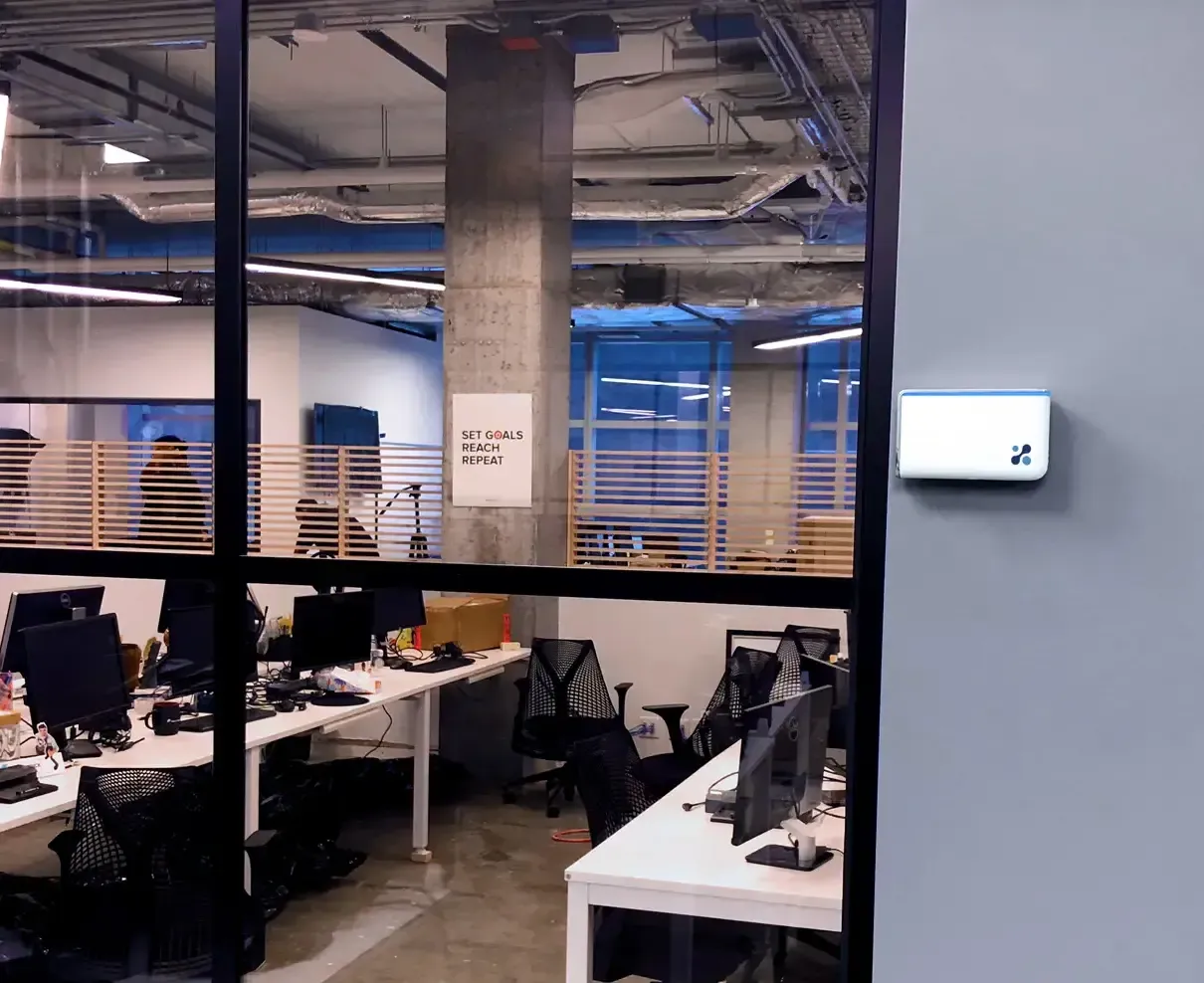
Because all of the core classroom parameters can be measured by a single compact monitor, a school does not need to assemble separate instruments per room. A fixed monitor is placed in the occupied part of each classroom or zone, away from doors and windows that would give unrepresentative readings, and logs continuously, feeding a dashboard, threshold alerts, and board-ready reports. One monitor represents one room, so the usual starting point is one unit per classroom plus the shared spaces (library, gym, and cafeteria) that have ventilation needs of their own. Large open volumes and outdoor areas such as sports fields and bus loops are better served by an outdoor-capable monitor. The whole deployment, whether a single building or a multi-site district or campus, is managed from one account. The recommended configuration below is a single Aethair IAQ covering the core panel, formaldehyde included. Use the configurator to add parameters for a specific building or requirement.
Devices ship calibrated and report over built-in 4G LTE, so they don't need the school network. Deployment is simple: mount the monitor, power it on, and readings appear in Environet. From there, the data is yours, live and historical, as JSON or CSV through the Environet API. Many districts begin with a pilot in a few rooms and expand once the data shows where the problems are.
Recommended
best match-

Aethair IAQ built-in sensors
Compact plug-in monitor with every sensor built in, nothing to add. Ideal for straightforward indoor air quality monitoring.
Built-inCarbon Dioxide (CO₂)Relative HumidityPM2.5Air TemperatureVOC (Total)Also measures 8 more
Formaldehyde (CH₂O)Dew PointHeat IndexParticle Count (by size)PM1PM10Total PM / Mass Conc.Barometric Pressure
Alternative
Aethair PRO-

Industrial monitor for indoor and outdoor sites. Built-in sensors cover the essentials, and hot-swappable gas sensor cartridges and a differential-pressure option add more.
Built-inRelative HumidityPM2.5Air TemperatureGas 1

Aethair CO₂ (dual NDIR)
Carbon Dioxide (CO₂)Dual-thermopile NDIR (non-dispersive infrared) sensing measures CO₂ with no chemical consumables, for…
Also fits: Aethair CO₂ (self-calibrating NDIR)
Gas 2

Aethair VOC (ppm PID)
VOC (Total)A 10.6 eV photoionization detector (PID) ionizes volatile organic compounds for direct ppm readings across a…
Also fits: Aethair VOC (ppb PID), Aethair MultiGas+, Aethair VOC (ppb PID, wide range)
MultiSense
Free: a MultiSense, stock or built to order
Expansion
Free: differential pressure
Also measures 10 more
Dew PointHeat IndexIlluminance / LightParticle Count (by size)PM1PM10Total PM / Mass Conc.Barometric PressureEquivalent Continuous Level (Leq)Sound Pressure Level (SPL)
Which monitor
Aethair IAQ for Classrooms, Aethair PRO for Big and Outdoor Spaces
Aethair IAQ covers occupied indoor rooms: nine parameters from internal sensors. Aethair PRO covers large indoor spaces such as gymnasiums and auditoriums, along with outdoor areas such as athletic fields and bus loops, on the same platform. Its hot-swappable gas sensor cartridges add specific gas monitoring where needed. Thiamis brings third-party sensors your buildings already run into the same account. Aethair IAQ and Aethair PRO are both calibrated in-house before shipping and supplied with a performance certificate.
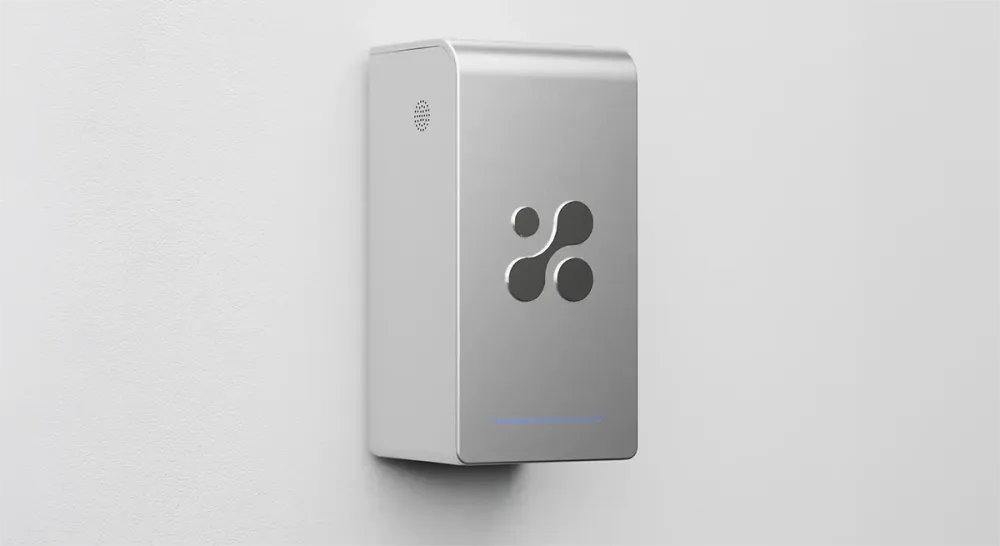
Aethair PRO
Industrial monitor for indoor and outdoor sites. Built-in sensors cover the essentials, and hot-swappable gas sensor cartridges and a differential-pressure option add more.
6 built-in parameters (PM2.5, PM10, temperature, humidity …), plus 19 swappable cartridges (H₂S, SO₂, NO₂, CO, O₃, CH₄ and more) in 2 gas sockets, 1 MultiSense socket, and 1 expansion socket
See Aethair PRO
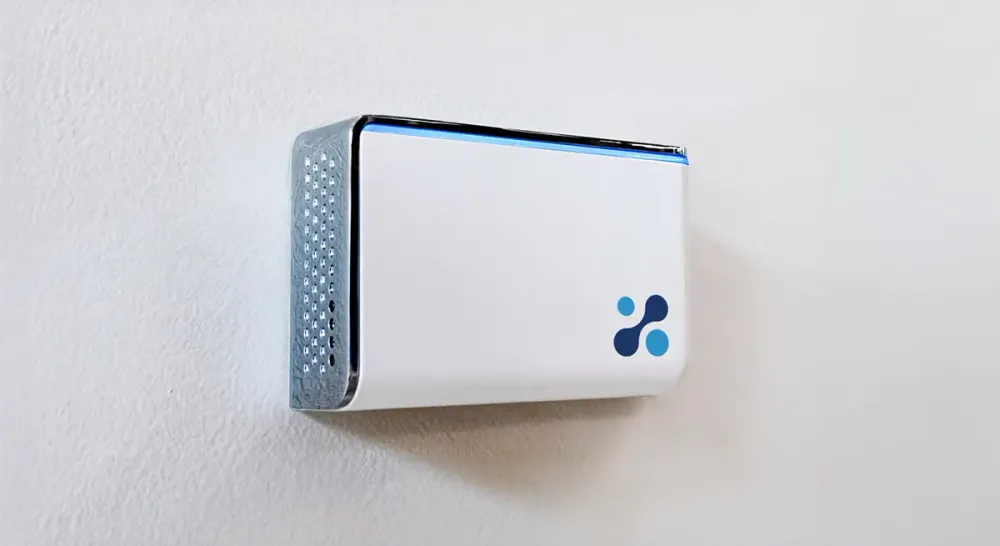
Aethair IAQ
Compact plug-in monitor with every sensor built in, nothing to add. Ideal for straightforward indoor air quality monitoring.
9 built-in parameters: CO₂, PM2.5, PM10, tVOC and more
See Aethair IAQ
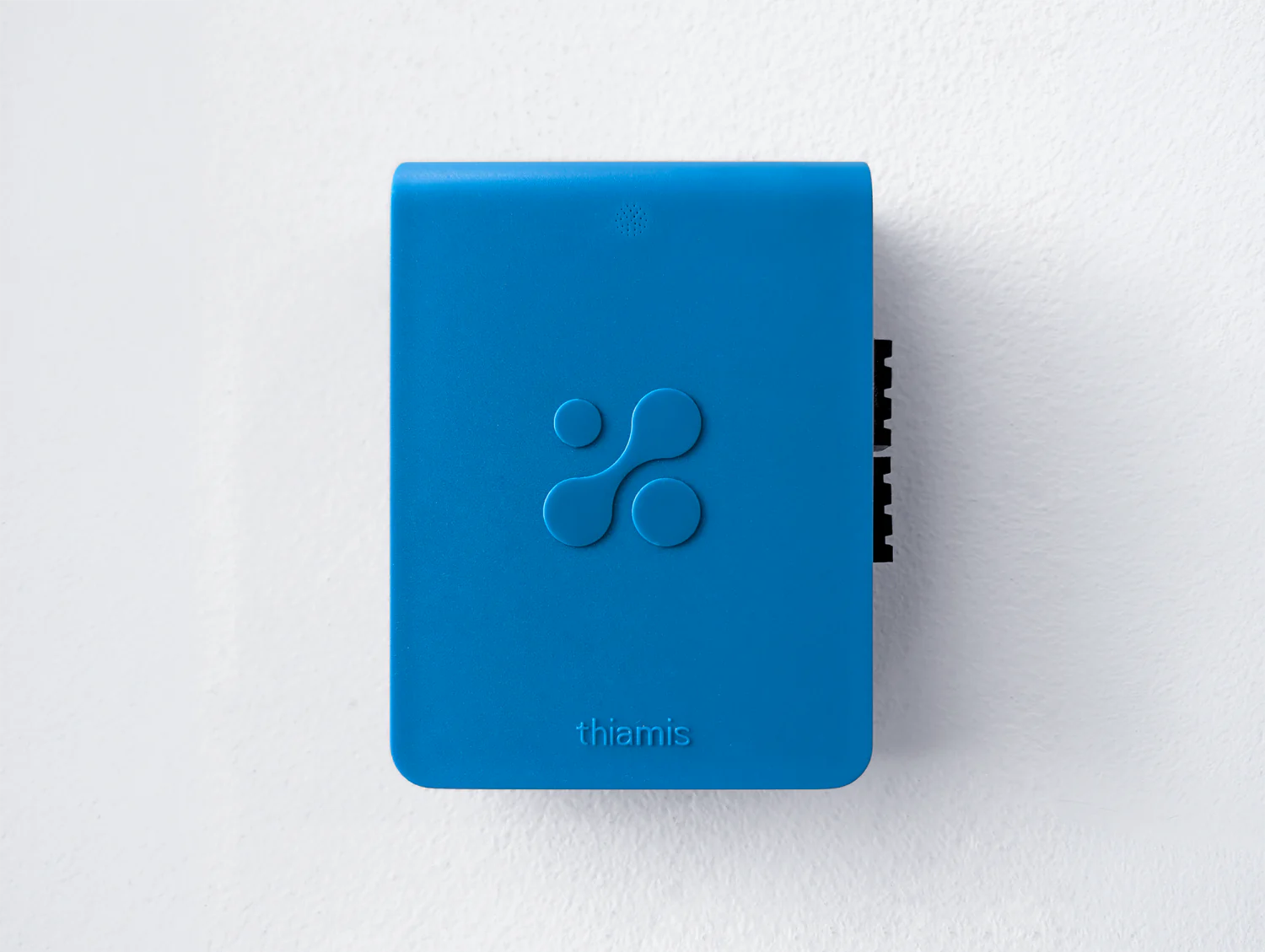
Thiamis
A gateway that connects the third-party instruments you choose to the Aethair Platform.
RS-232, RS-485, SDI-12, and USB · 224 device models from 35 integrations
See Thiamis
By setting
Monitoring by School Setting
A school is made of very different spaces, and one platform covers all of them.
Classrooms
The highest-occupancy rooms in any school, where CO₂ climbs through a lesson and temperature swings affect how well students focus. Districts usually start here, with one Aethair IAQ per room.
Libraries, gyms, and cafeterias
Large shared spaces whose occupancy rises and falls through the day, with ventilation needs of their own.
Large and outdoor spaces
Gymnasiums, auditoriums, athletic fields, and bus loops, where Aethair PRO adds indoor and outdoor coverage.
Higher-education campuses
Lecture halls, labs, and dorms across many buildings, monitored campus-wide from one account.
What you get
Alerts, Reports, and Dashboards from the Same Readings
Aethair is more than monitoring hardware: the same readings drive the alert that reaches facilities, the report that goes to the board, and the screen that parents see.
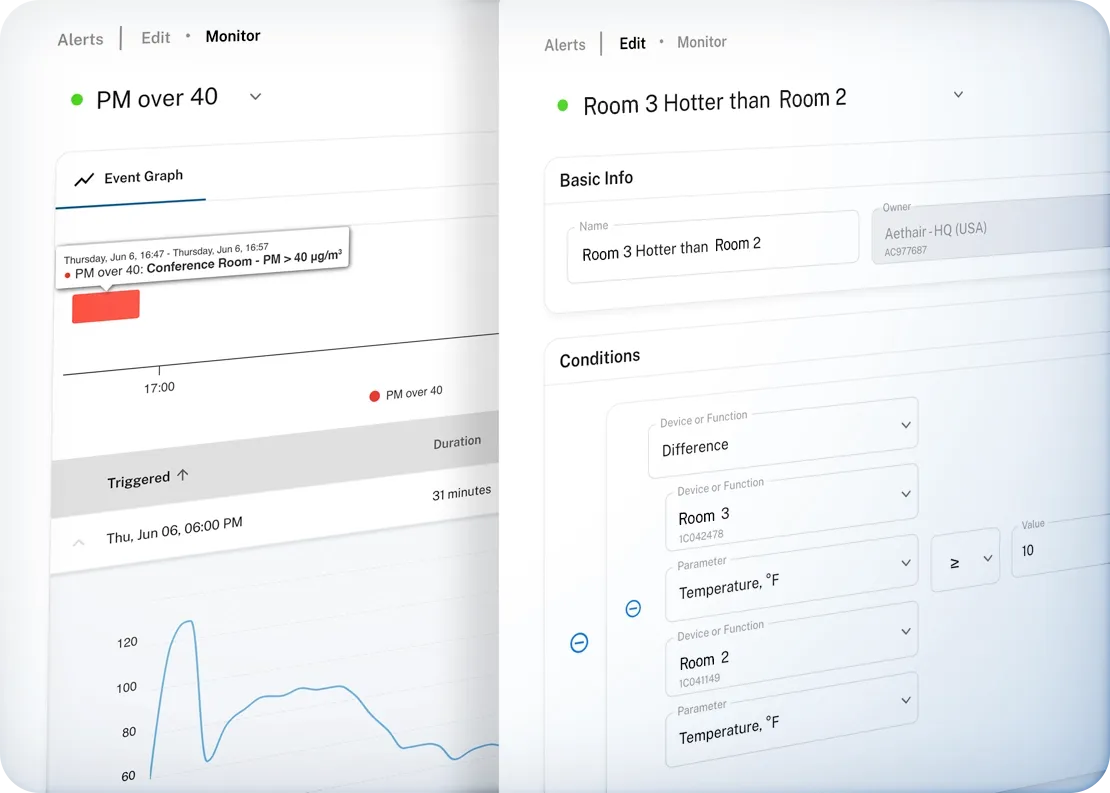
Real-time alerts
Notifications sent automatically to the right staff when CO₂, particulates, or any other reading moves outside the range you set.

Board and staff reports
Aethair Reports compiles the readings into records for school boards, district administrators, and regulatory reporting. Reports can be downloaded, printed, and shared.
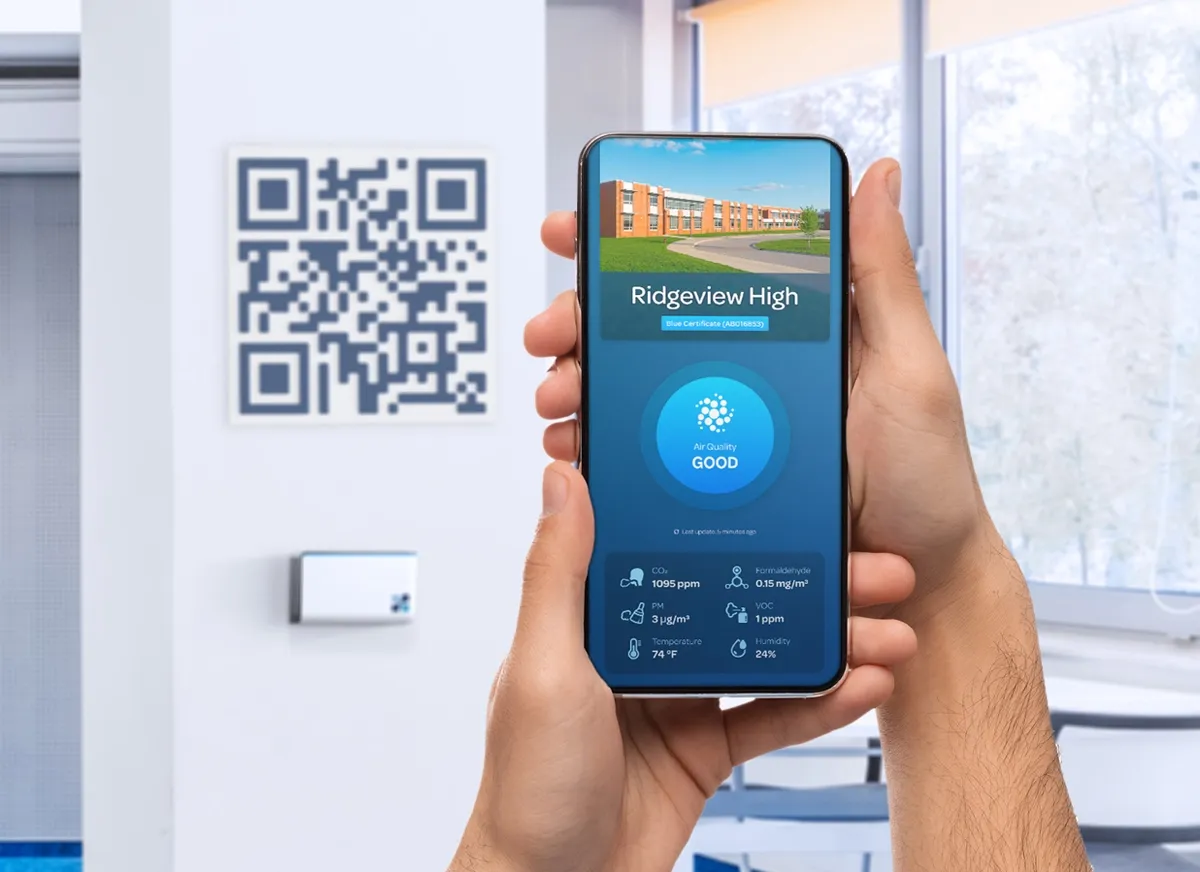
Public dashboards
Aethair Dashboards show live air quality on a screen or behind a QR code, so families, students, and visitors can see it too.
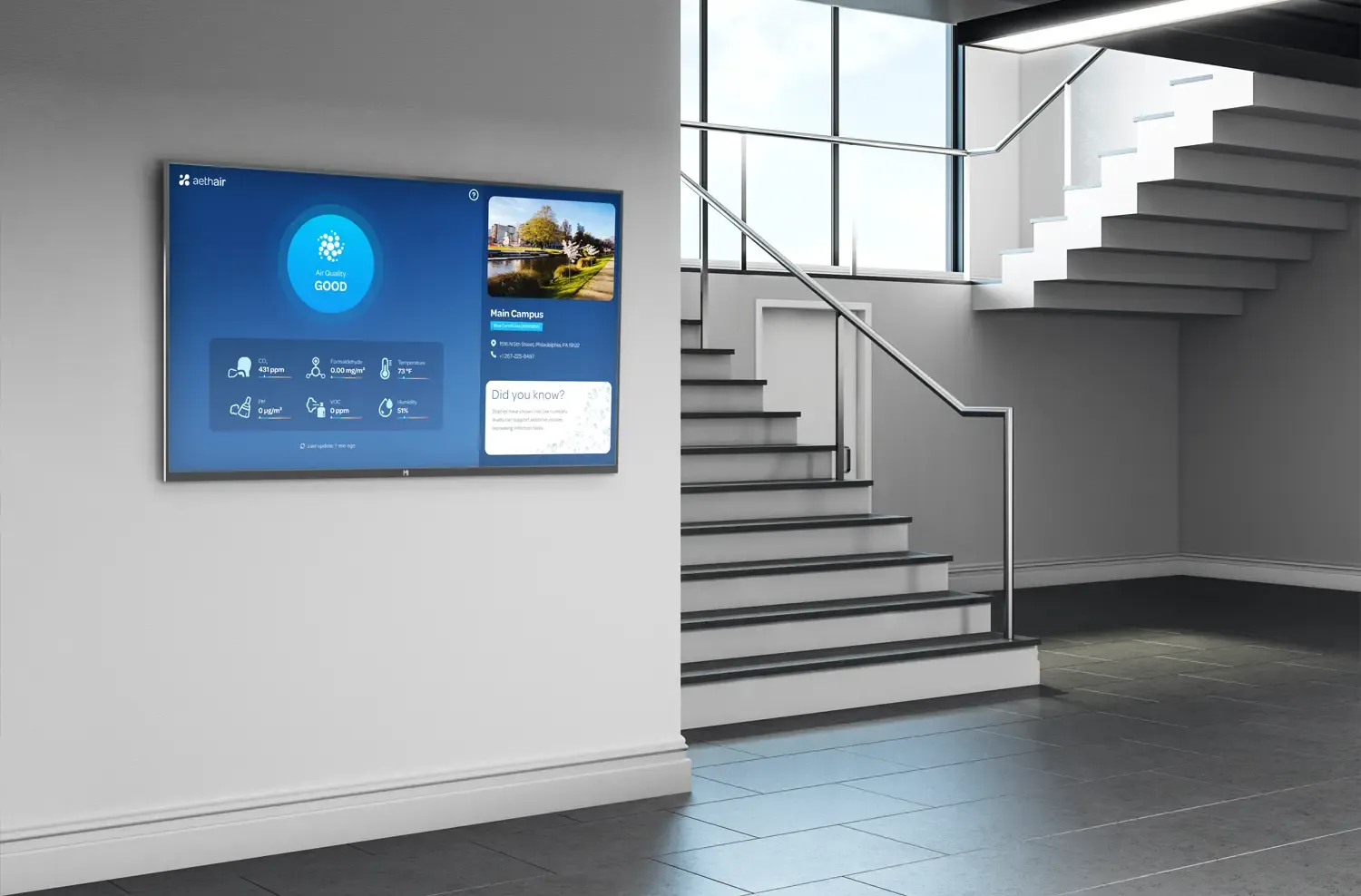
Dashboards
Dashboards and Public Displays
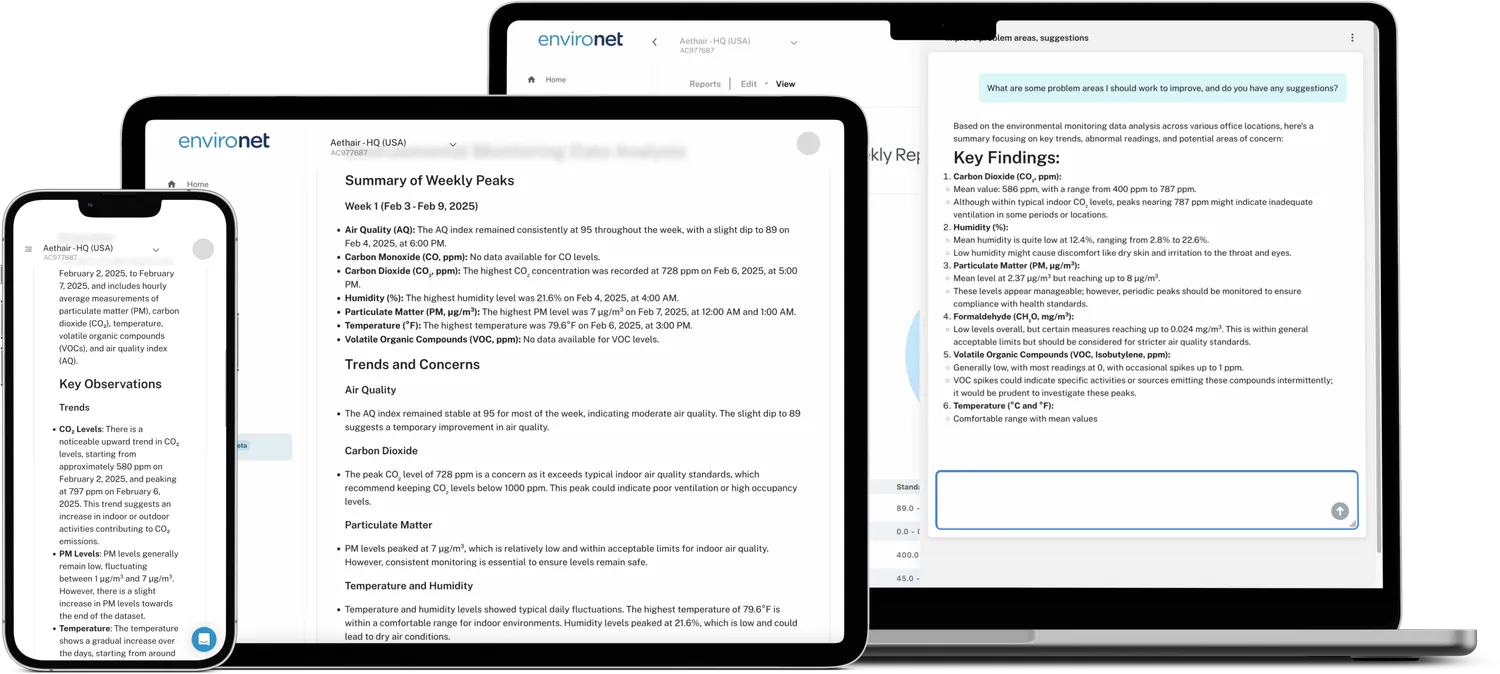
Reports and alerts keep the facilities team informed; Aethair Dashboards do the same for everyone else. A dashboard shows current air quality on a screen in a lobby, hallway, or classroom, or behind a QR code that students, staff, and families scan with their phones. It is a practical way to show the community that conditions are being watched.
Ask the data
Noesis: AI Analysis for Facilities Teams
Noesis answers plain-language questions about your school air quality data: how a wing performed last winter, which rooms have recurring CO₂ spikes, what belongs in the report for next month's board meeting. It supports decisions; it does not replace the judgment of your facilities and EHS staff.
Why it pays off
Why Monitoring Educational Spaces Pays Off
Healthy classrooms connect to outcomes school leaders already track. Monitoring gives facilities teams the data to act and the record to back it up; the full case, with sources, is in the article's ROI section.
- Attendance and funding: in many states a share of school funding is tied to average daily attendance, so absences carry a direct budget cost. Monitoring finds the rooms that drive avoidable absences.
- Student and staff performance: ventilation, CO₂, and temperature are linked to concentration and test results. Continuous data helps staff keep rooms in range, rather than finding problems after a difficult day.
- Energy and maintenance: real data right-sizes ventilation instead of running systems harder than needed, and surfaces faults early (a unit out of balance, a damper stuck closed) before a small issue becomes a larger repair.

Compliance
School Air Quality Standards and Requirements
No single federal standard governs indoor air in schools. The EPA's IAQ Tools for Schools program offers voluntary guidance, ASHRAE Standard 62.1 sets minimum ventilation rates for classrooms, and several states now require CO₂ monitoring in classrooms. California's newly built classrooms, for example, must have CO₂ monitors that alert at 1,100 ppm.
Aethair gives you the continuous, time-stamped record of where each space stands against those requirements, and supports the reporting some of them call for. If your school or state has its own rules, custom alerts and reports are set up to match. For an explanation of each standard, see indoor air quality in schools.
By sector
Related Solutions
The same platform, with a different panel and reporting template, beyond the school building.
Commercial buildings
The same indoor panel for offices and workplaces, documented against WELL v2 or your own targets.
Wildfire smoke
Outdoor and indoor PM2.5 side by side when smoke reaches a campus, so a decision to keep students inside rests on data.
HVAC and building management
Demand-controlled ventilation, filter and duct pressure, and setpoint verification for the system behind the classrooms.
Article Library
Reading for Schools and Campuses
Guides to the standards and practices behind air quality monitoring in schools.
Indoor Air Quality in Schools: Standards & Monitoring 2026
Indoor air quality in schools: which standards apply, what to monitor, and how CO2 and ventilation affect student attendance, health, and test scores.
IAQ Monitoring Parameters: PM2.5, CO2, VOCs & Formaldehyde
Indoor air quality monitoring parameters explained: PM2.5, CO2, VOCs, and formaldehyde, plus the sensors, thresholds, and OSHA, ASHRAE 62.1, and WELL limits.
WELL Building Standard Air Quality: CO2 & PM2.5 Limits 2026
WELL v2 air quality limits: PM2.5 at 15 µg/m³, formaldehyde at 50 µg/m³, CO2 at 900 ppm for ventilation monitoring, plus the monitoring WELL verifies.
Questions
School Air Quality Monitoring FAQ
How many air quality monitors does a school need?
It depends on building size and how granular you want the data. A common starting point is one Aethair IAQ per classroom or zone, plus shared spaces such as the gym, library, and cafeteria, which may use an Aethair PRO. Some schools also place an Aethair PRO outdoors to track the air directly outside their buildings. Many districts begin with a pilot in a few buildings and expand once they see the data; we can help size a deployment during a demo.
Can we monitor a whole district from one dashboard?
Yes. Every Aethair device (Aethair IAQ, Aethair PRO, and Thiamis) reports into Environet, where facilities and leadership see every building and room from one account, with role-based access. The same setup works for a multi-building higher-education campus.
Does this support state CO₂ monitoring requirements?
Several states now require CO₂ monitoring in classrooms, and the specifics vary by state. Aethair IAQ measures CO₂ continuously, and so does Aethair PRO with a CO₂ cartridge. The readings in Environet compile into Aethair Reports, giving you a documented history to reference. For the standards that apply, see our article on indoor air quality in schools.
What does Aethair monitor in a classroom?
It depends on the device. Aethair IAQ tracks CO₂, particulate matter (PM1, PM2.5, PM10), total VOCs, formaldehyde, temperature, humidity, and pressure. Aethair PRO tracks particulate matter, temperature, humidity, pressure, sound, and light, plus the gases on its two gas sensor cartridges and its MultiSense cartridge: CO₂, CO, VOCs, and more (the full cartridge list). CO₂ and PM2.5 are usually the most watched in schools, and one device covers them together, so you are not installing separate sensors for one space.
How is this different from a consumer air quality monitor?
Consumer devices are not built for scale, and they fall short when used for facility-wide management or documentation. Aethair IAQ and Aethair PRO are calibrated before shipping and come with a performance certificate, their data feeds a central platform in Environet, and the platform adds live and historical data, real-time alerts, and audit-ready reports. For buildings beyond schools, see our commercial indoor air quality monitoring solution.
How quickly can a school get started?
Start with a pilot: install devices in a few rooms and scale when you decide to. After a demo, we help you choose where to place devices and ship calibrated Aethair IAQ and Aethair PRO units that report into Environet as soon as they are powered on. Expanding to more rooms or buildings is a matter of turning on a new device associated with your account.
What are the most important parameters to monitor in a classroom?
CO₂ and PM2.5 are the two most watched: CO₂ because a full classroom drives it up quickly and elevated levels are linked to reduced concentration, and PM2.5 because children are more exposed to fine particles from outdoor smoke and traffic. Temperature, humidity, and total VOCs complete the comfort-and-health picture, with formaldehyde added where new furnishings or building materials make it relevant.
Implement Air Quality Monitoring in Your School or Campus
Schedule a MeetingSee a live dashboard Aethair IAQ Aethair PRO Build a Configuration
A 30-minute call: you tell us about your application, then we demo the solution for it.
Used by teams at