
Aethair solutions
Weather Stations & Meteorology
Professional multi-parameter weather monitoring
Why it matters
Why Weather Stations and Meteorology Matter
Weather underlies almost every outdoor activity, and measuring it locally turns a general forecast into the specific conditions at a site. Airports, ports, farms, construction projects, sports grounds, research institutions, and safety agencies all need accurate, continuous meteorological data for operations, for warning of hazardous conditions, and for the scientific record. A forecast covers a region; a station measures the actual temperature, wind, and rain at the exact place a decision is being made, which is what operations and safety depend on. Long, consistent records matter as much: they form the climatological baseline that research and planning rest upon.
From wind shear on a runway to heat stress on a worksite, the value of on-site meteorology is that it captures conditions no distant forecast can resolve.
What to measure
What to Measure
The core panel covers the main program. Other parameters are added for a specific site or requirement.
The standard meteorological panel is temperature, humidity, barometric pressure, wind speed and direction, precipitation, and solar radiation, the parameters that define the state of the atmosphere at a site. Temperature and humidity describe comfort, frost, and heat risk; pressure underpins forecasting and altitude correction; wind matters for aviation, dispersion, structures, and safety; precipitation feeds hydrology and operations; and solar radiation drives evapotranspiration and energy applications. From these, useful quantities are derived rather than measured directly: dew point and heat index from temperature and humidity, and wind chill from temperature and wind. The same core sensors answer specific operational questions. Wet-bulb globe temperature (WBGT) for heat-stress assessment is the exception: it is measured with its own natural wet-bulb and black-globe sensors.
Air temperature is the headline measurement of any weather station, essential to forecasting, climate records, agriculture, and public safety. Continuous, well-sited temperature monitoring (in a radiation shield at standard height) provides the baseline meteorological record and the input to derived values such as dew point, wind chill, and heat index.
Air Temperature: sensors, units, and every standardRelative humidity is a core weather-station parameter, governing dew, fog, comfort, and the moisture available for precipitation. Continuous humidity monitoring alongside temperature yields dew point and the derived comfort and frost indices, and is fundamental to agricultural, operational, and research meteorology.
Relative Humidity: sensors, units, and every standardBarometric pressure is one of the oldest and most useful weather measurements, since falling pressure signals approaching storms and pressure patterns drive the wind. Continuous pressure monitoring is a standard weather-station channel, feeding forecasting, aviation, and the altitude and sea-level corrections that meteorology depends on.
Barometric Pressure: sensors, units, and every standardWind speed is essential to weather stations for forecasting, safety, and the dispersion calculations that underpin air-quality and hazard work. Continuous wind-speed monitoring, with a cup or ultrasonic anemometer at standard exposure, supports operations from aviation and marine to construction and renewable energy, and pairs with wind direction for a full wind picture.
Wind Speed: sensors, units, and every standardWind direction tells forecasters and operators where weather and airborne material are coming from, and it is indispensable for source attribution in air-quality and hazard monitoring. Continuous wind-direction monitoring alongside wind speed completes the wind vector that drives dispersion, sailing, aviation, and pollution-source work.
Wind Direction: sensors, units, and every standardPrecipitation is a defining weather measurement for forecasting, hydrology, agriculture, and climate records. Continuous rainfall monitoring by tipping-bucket or optical gauge captures both totals and intensity, feeding flood warning, irrigation, and the long-term records that reveal climate trends.
Precipitation: sensors, units, and every standardGlobal (solar) radiation / irradiance.
Solar / Global Radiation: sensors, units, and every standardDew-point temperature; the temperature at which air becomes saturated.
Dew Point: sensors, units, and every standardWet-Bulb Globe Temperature (WBGT): the standard composite index for occupational heat-stress assessment.
WBGT (Heat Stress): sensors, units, and every standardWet-bulb temperature: an input for evaporative cooling and heat-stress calculations.
Wet Bulb Temperature: sensors, units, and every standardHeat index / apparent temperature combining heat and humidity.
Heat Index: sensors, units, and every standardDetected lightning strike events.
Lightning: sensors, units, and every standardMethods and guidance:
The setup
How a Monitoring Setup Works
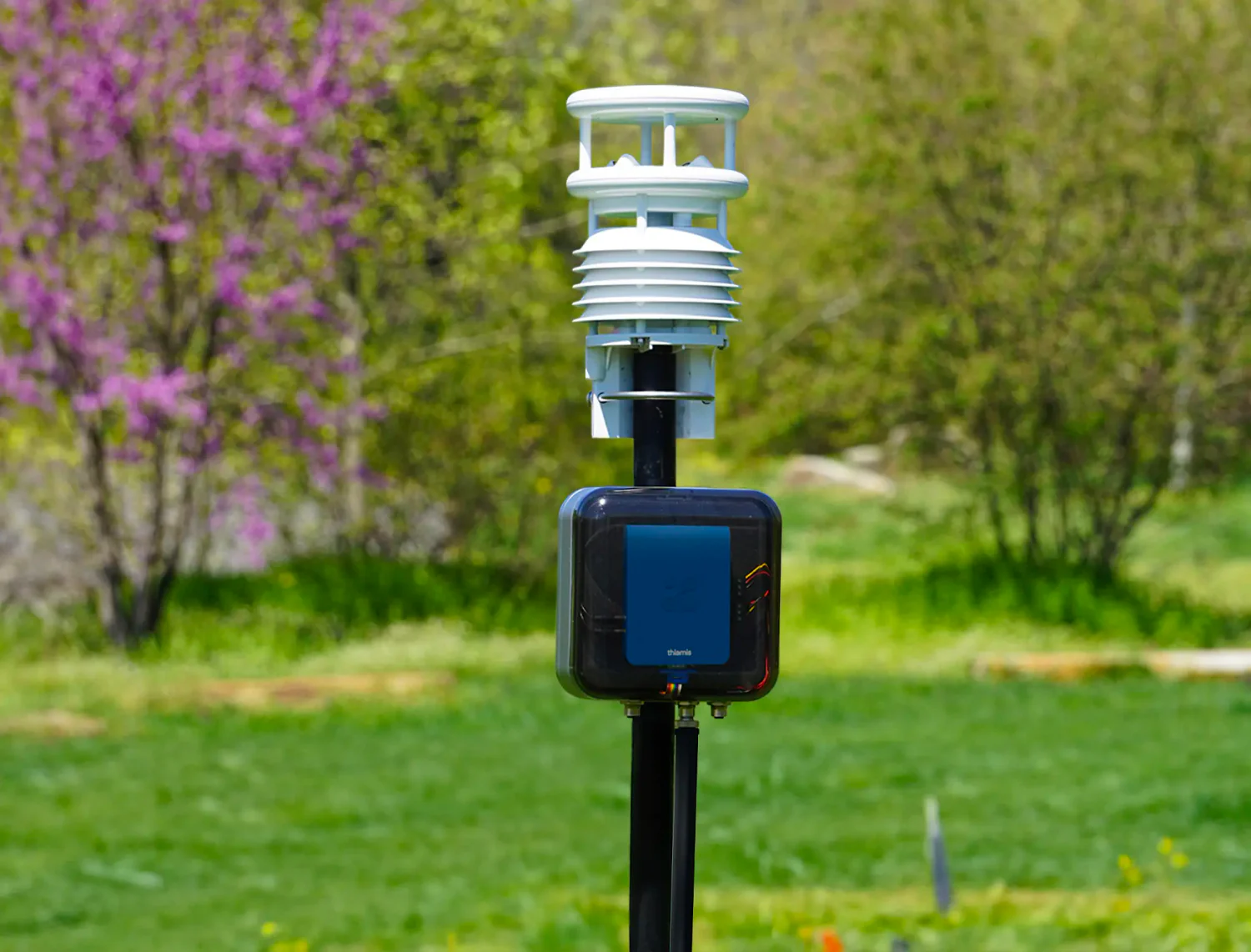
Meteorological monitoring uses a Thiamis gateway connected to a professional weather station: an integrated instrument carrying temperature, humidity, pressure, wind, precipitation, and solar-radiation sensors, or a set of discrete sensors for a research-grade installation. The logger records continuously and sends the data over 4G LTE or site Wi-Fi to dashboards and alerts, along with derived values the station calculates itself, such as dew point, wind chill, and heat index. WBGT for heat-stress decisions is not estimated from weather data: it needs a natural wet-bulb and black-globe sensor set (see heat stress). Siting follows meteorological standards (sensors at standard heights, clear of obstructions, over representative ground) so that readings are comparable and defensible. One station represents its local area, with denser networks where terrain or application demands. The recommended configuration below pairs a logger with a weather station covering the standard panel. Use the configurator to add sensors or derived outputs for your application.
Recommended
best match-

Thiamis connects 1 instrument
A gateway that connects the third-party instruments you choose to the Aethair Platform.
-
 Relative HumidityPrecipitationBarometric PressureAir TemperatureWind DirectionWind Speed
Airmar WeatherStation instruments (compact, maintenance-free ultrasonic multisensors with no moving parts) measure…
Swap for
Also measures 5 more
Absolute HumidityDew PointHeat IndexPrecipitation IntensityWind Chill -
Which monitor
The Instruments in This Configuration
A Thiamis gateway logs these instruments continuously and sends their readings to Environet over 4G LTE (cellular data included) or the site's Wi-Fi. There they get the same alerts, reports, dashboards, and API as any Aethair monitor, in one account with every other device on the site, instead of a separate vendor app for each instrument. Thiamis runs on mains power, a solar panel, or an external battery.
Airmar Weather Stations
Airmar WeatherStation instruments (compact, maintenance-free ultrasonic multisensors with no moving parts) measure apparent wind, barometric pressure, air temperature, and wind chill in one housing.
What you get
Readings, Alerts, and the Report That Proves It
Every reading goes to the Aethair platform. Here is what a monitoring program gets from it.
Live data and alerts
Every reading in Environet as it happens, with alerts by email, SMS, or webhook at the thresholds you set.
Compliance reports
Scheduled or on-demand reports against the standards above or your own limits, as PDF or a secure link.
Dashboards and AI analysis
Live displays for a site or the public, and Noesis answering questions about the data in plain language.
Your data, through the API
Live and historical readings as JSON or CSV through the Environet API (OpenAPI 3.2), for a building management system, an ERP, or your own applications. The data is yours.
Related solutions
Related Solutions
Agriculture & Irrigation
Soil moisture, microclimate, and frost warning
Heat Stress & Outdoor Work
WBGT for worksites, athletics, and events
Cabin Air Quality
Respirable dust, gases, and blast monitoring
Questions
Weather Stations & Meteorology FAQ
What parameters make up a standard weather station?
Temperature, humidity, barometric pressure, wind speed and direction, precipitation, and solar radiation form the standard meteorological panel. Together they describe the state of the atmosphere at a site and provide the inputs from which derived quantities such as dew point and heat indices are calculated.
What is the difference between measured and derived weather parameters?
Measured parameters come straight from a sensor (temperature, wind, rainfall, and so on), while derived parameters are calculated from combinations of them. Dew point comes from temperature and humidity, and wind chill from temperature and wind, so the same core sensors answer many questions without extra hardware. WBGT is the exception: for heat-stress decisions it is measured with a natural wet-bulb and black-globe sensor set, not derived from weather data.
Why measure weather on site instead of using a forecast?
A forecast describes a region, but operations and safety decisions depend on the actual conditions at a specific place, which can differ markedly because of terrain, water, or the built environment. An on-site station captures local wind, temperature, and rain in real time, and builds the consistent long-term record a forecast cannot.
What is the best setup for a weather station?
A Thiamis gateway paired with a professional weather station covering temperature, humidity, pressure, wind, precipitation, and solar radiation, with dew point, wind chill, and heat index derived as needed; add a WBGT sensor set where heat stress is the question. Use the configurator to match the sensors and derived outputs to your operational, research, or safety application.
Put Your Monitoring on the Record
Schedule a callBuild a Configuration All solutions
A 30-minute call: you tell us about your application, then we demo the solution for it.