
EHS and environmental teams tend to sit at one of two extremes. Some still measure periodically, a survey here, a lab sample there, and work from too little data to know what is happening between visits. Others run continuous sensor networks that produce so many readings every day that no one can review them all by hand. Both problems share a root cause: raw data is not the same as a decision. This is where AI air quality monitoring has started to matter, and it is changing how EHS teams and monitoring providers approach that gap, part of a broader move to bring AI into air quality monitoring worldwide (opens in a new tab).
The word AI now appears on nearly every monitoring product, which makes it harder, not easier, to tell what genuinely helps. Some of it is real and already saving teams hours of manual work. Some of it is a new label on features that have been around for years. And none of it, however capable, changes the two things environmental data has always rested on: a calibrated measurement and a person who understands what it means. Rules-based dashboards and experienced analysts still do real work, and the useful question is not whether to trust AI, but where it earns its place alongside them.
Quick answer
AI-powered air quality monitoring turns continuous sensor data into faster, clearer decisions. In practice that means detecting anomalies and patterns a person might miss, forecasting conditions before a threshold is crossed, and letting teams ask questions of their own data in plain language instead of assembling reports by hand. AI does not make an uncalibrated sensor accurate, and it does not replace professional judgment. Aethair's AI, Noesis, works inside the Environet platform on an organization's own monitoring data, and Aethair Reports turns the results into audit-ready documentation.
What AI Actually Does in Environmental Monitoring
Strip away the marketing and AI in environmental monitoring comes down to a few concrete capabilities. It can find anomalies and patterns across many sensors and long time ranges, the kind of slow drift or correlated spike that is easy to miss in a spreadsheet. It can forecast, flagging that a value is trending toward a limit before it crosses. Applied to the sensors themselves, machine learning can help calibrate and correct readings, though as the EPA's air sensor guidance (opens in a new tab) notes, this refines the data a sensor produces rather than replacing calibrated hardware. And it can increasingly handle language, answering plain questions about a dataset and drafting the narrative of a report.
What AI does not do is worth stating plainly. It does not turn an uncalibrated sensor into a reference instrument, and it does not remove the need for someone who understands the site and the regulation to check the output. Its usefulness depends entirely on the quality of the data underneath it.
How EHS Teams Turn Monitoring Data into Decisions Today
Most teams use one of three approaches, and many use more than one at once. Each does a real job.
Manual analysis
The most common approach is still manual. An analyst pulls readings into a spreadsheet, cleans and organizes them, reviews them, and writes up findings by hand. Done well, this gives full control and the judgment of someone who knows the context. It is also slow: collecting, formatting, and checking the data can take hours or days each reporting cycle. It is hard to scale across sites, it is exposed to human error in transcription and interpretation, and it leaves gaps between reviews when nobody is watching the data closely.
Rules-based threshold dashboards
Many platforms add threshold alerts: when a reading crosses a set limit, someone is notified. This is simple and effective for known limits such as a permit boundary or an action level. Alert logic ranges from a single threshold to more configurable rules, but it stays bound to the rules it is given. A slow drift, a pattern spread across several sensors, or a problem that never trips a set threshold can pass unnoticed, and poorly tuned alerts create enough noise that teams start to ignore them.
AI-assisted and predictive analysis
The newer approach applies AI to the same data, detecting anomalies, forecasting, and letting people query results in plain language. This is the basis of predictive air quality monitoring: using current and historical readings to flag where conditions are heading, not only where they are. It scales across large networks and catches the patterns the first two approaches miss. Most of the AI in the category today lives in research models, public forecasting tools, and sensor-calibration methods rather than in the platform an EHS team uses day to day, which is where the practical gap has been. It also comes with a caveat: as AI becomes a selling point, capability varies widely between tools, so what matters is whether the AI works on trustworthy, calibrated data and keeps a person in the loop.
Where AI Genuinely Helps, and Where to Be Skeptical
The honest read is that AI is useful in specific places and oversold in others. It is good at triaging alert noise, spotting patterns across multiple sites, speeding up reporting, and giving non-specialists a way to interrogate data without learning a query language.
Be skeptical when AI is used to imply that a measurement is more trustworthy than the sensor behind it. Be wary of any claim that software removes the need for calibration or for a qualified person to sign off. This is where Aethair's approach is deliberate: Noesis works on data from calibrated Aethair devices, with transparent data lineage from each raw reading through to the final report, so the analysis rests on measurements a team can defend. The tools support decisions; they do not make them.
Understanding the Different AI Monitoring Approaches
| Dimension | Manual analysis | Rules-based dashboard | AI-assisted analysis | Aethair (AI and more) |
|---|---|---|---|---|
| Speed to insight | Slow, by hand | Fast for known limits | Fast, finds the non-obvious | Fast, plain-language answers on your data, along with reports, charts, and graphs |
| Pattern and anomaly detection | Analyst-dependent | Usually threshold-based | Across many signals | Across your network, via Noesis |
| Prediction | Rare | No | Yes, with validation | Predictive insights and anomaly detection from Noesis |
| Access for non-specialists | Low | Medium | Varies | Specialists and non-specialists alike, via plain language |
| Reporting | Built by hand | Alert log | Varies by tool | Automated data reports, including air quality and perimeter monitoring |
| Runs on calibrated hardware | Depends | Depends | Often low-cost or research data | Aethair PRO and Aethair IAQ, calibrated |
| Other instruments included | Manual | Rarely | Rarely | Third-party devices via Thiamis |
How Noesis, Aethair Reports, and Environet Turn Data into Decisions
Aethair's AI, Noesis, runs inside Environet, Aethair's environmental data management platform, where an organization's monitoring data already lives. Because it works on that data directly, a user can ask a question in plain language, for example how PM2.5 behaved across a site during a specific week, and get an answer with the trend behind it. Noesis processes large datasets, spots trends, and surfaces predictive insights and anomalies for risk management. It also generates data reports, including air quality and perimeter monitoring reports, in seconds, work that once took hours by hand. Environet's Intelligent Alerts add another layer, ranging from simple threshold notifications to complex multi-parameter logic, and Noesis can help configure them. Clients have reported that these tools save thousands of hours a year of manual work.
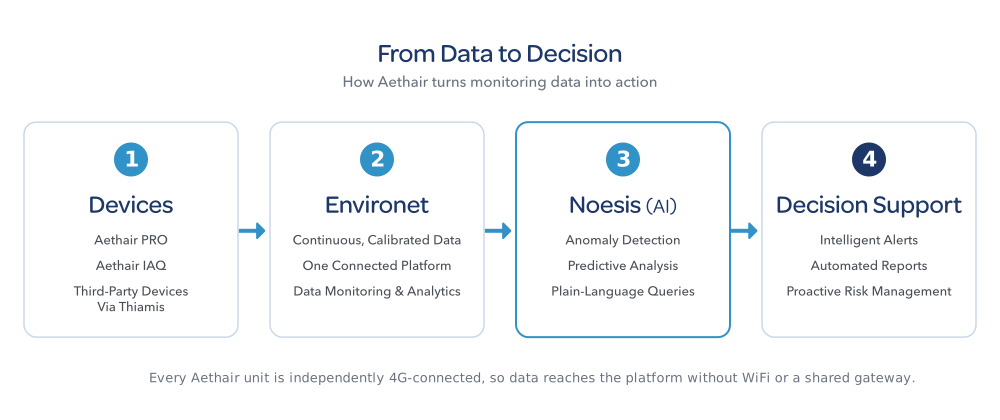
Reporting works alongside the AI rather than apart from it. Aethair Reports turns continuous data into audit-ready air quality, environmental, and perimeter monitoring reports, shareable as PDFs and secure links. A report can include a Noesis summary, and Noesis can be used from within Aethair Reports to ask questions about a specific report. The last piece is reach. With Thiamis, third-party instruments stream into the same platform alongside Aethair PRO and Aethair IAQ, so the same AI analysis and automated reporting apply to their data too, not only to Aethair's own devices. Every Aethair unit has its own 4G connection, so readings reach the platform without depending on site Wi-Fi or a shared gateway. This is what Aethair means by environmental intelligence: monitoring, analysis, and reporting working together so data becomes decisions.
Turn Monitoring Data into Decisions
Learn how to use Noesis, Aethair's AI for environmental data, to question your own monitoring data in plain language and turn it into analysis and decision support.
Schedule a call (opens in a new tab)Explore Noesis →See the Environet Platform →
AI Air Quality Monitoring: FAQs
What is AI air quality monitoring?
AI air quality monitoring is the use of machine learning and related methods to turn continuous sensor data into decisions. In practice it means detecting anomalies and patterns across many sensors, forecasting conditions before a threshold is crossed, improving how low-cost readings are calibrated, and letting people ask questions of their own data in plain language. It works on top of monitoring hardware and does not replace calibrated measurement.
Can AI make a low-cost sensor as accurate as a reference monitor?
No. AI can improve how sensor data is calibrated and interpreted, but improving interpretation is not the same as improving the physical measurement. As the EPA notes in its air sensor guidance, lower-cost sensors do not match regulatory-grade monitors, and a sensor corrected by machine learning should not be presented as a reference instrument.
What is predictive environmental monitoring?
Predictive environmental monitoring uses historical and real-time data to forecast conditions, for example flagging that a pollutant is trending toward an action level before it is reached. It is useful for early warning, though forecasts carry uncertainty and are best treated as decision support rather than certainty.
Does AI replace EHS analysts or industrial hygienists?
No. AI reduces manual work such as pulling data together and drafting reports, and it flags patterns that are easy to miss, but it does not replace professional judgment or certified sampling. The role of an analyst or industrial hygienist is to interpret results in the context of the site and the regulation, which AI supports rather than performs.
How does Noesis use AI?
Noesis is Aethair's AI for environmental data, built into the Environet platform. It lets users query their own monitoring data in plain language, processes large datasets to spot trends and detect anomalies, surfaces predictive insights for risk management, and generates data reports in seconds. See the Noesis page for details.
How is AI used in environmental compliance reporting?
AI can assemble continuous monitoring data into reports, highlight exceedances and trends, and draft the narrative that explains them, work that was traditionally done by hand. For a full walkthrough, see our article on how to generate air quality and environmental compliance reports.