
Aethair solutions
Cleanrooms, Labs & Manufacturing
Particle counting and controlled environments
Why it matters
Why Cleanrooms, Labs, and Manufacturing Monitor Particles
A cleanroom exists to hold airborne contamination below a defined limit, because in pharmaceutical, electronics, medical-device, and precision manufacturing a single particle in the wrong place can spoil a product or a batch. The whole discipline rests on measurement: a room is classified by how many particles of a given size are present per unit volume, and it must be shown to stay within that class in operation. Airborne particle counting, room-to-room pressure control, and stable temperature and humidity are the parameters that define whether a controlled environment is actually in control. Monitoring provides both the routine assurance that conditions are being held and the documented evidence that quality systems and regulators require.
Contamination control is also a containment question: the pressure relationships between rooms decide which way air (and any particles it carries) flows across a doorway.
What to measure
What to Measure and the Limits That Apply
The core panel covers the main program. Other parameters are added for a specific site or requirement. Every limit below is the published value from the standard that sets it.
Airborne particle counts by size are the defining measurement, reported at the particle diameters used to classify a room under the ISO 14644 scheme, using counters that meet the ISO 21501-4 calibration standard so results are comparable and valid. Room differential pressure maintains the cascade that keeps cleaner rooms positively pressurized relative to dirtier ones (or the reverse for containment), so that air always flows in the intended direction. Temperature and humidity must be held stable, both for process and product requirements and because humidity influences electrostatic behavior and microbial growth. Together these define the controlled environment; specific processes may add recovery-rate and airflow checks.
Airborne particle counting by size is the defining measurement of cleanroom classification, the basis on which spaces are certified to ISO 14644 classes for pharma, electronics, and other critical manufacturing. Continuous or scheduled particle counting with ISO 21501-4 instruments verifies that a controlled environment is holding its class and catches the excursions that could compromise product.
Particle Count (by size): sensors, units, and every standardRoom-to-room differential pressure is what keeps a cleanroom clean, maintaining the cascade that stops contaminated air flowing into critical spaces. Continuous differential-pressure monitoring across the pressure hierarchy is a core element of cleanroom qualification and ongoing control, alarming the moment a door, fan, or filter fault threatens the containment.
Differential Pressure: sensors, units, and every standardTemperature stability is a controlled parameter in cleanrooms and laboratories, both for product and process integrity and for the comfort of gowned operators. Continuous temperature monitoring documents that the environment stays within its tight qualified band, part of the environmental-monitoring record that regulated manufacturing depends on.
Air Temperature: sensors, units, and every standardRelative humidity is tightly controlled in cleanrooms and laboratories to protect products, prevent static and condensation, and keep processes reproducible. Continuous humidity monitoring verifies the environment holds its qualified range and provides the documented evidence that GMP and quality systems require.
Relative Humidity: sensors, units, and every standardFine particulate matter ≤2.5 µm that penetrates deep into the lungs and can enter the bloodstream.
PM2.5: sensors, units, and every standardTotal volatile organic compounds: a broadband, PID-based indicator of solvent and fuel vapors.
VOC (Total): sensors, units, and every standardCarbon dioxide: an indicator of ventilation and indoor air quality, and an asphyxiant at high concentration.
Carbon Dioxide (CO₂): sensors, units, and every standardMethods and guidance:
The setup
How a Monitoring Setup Works
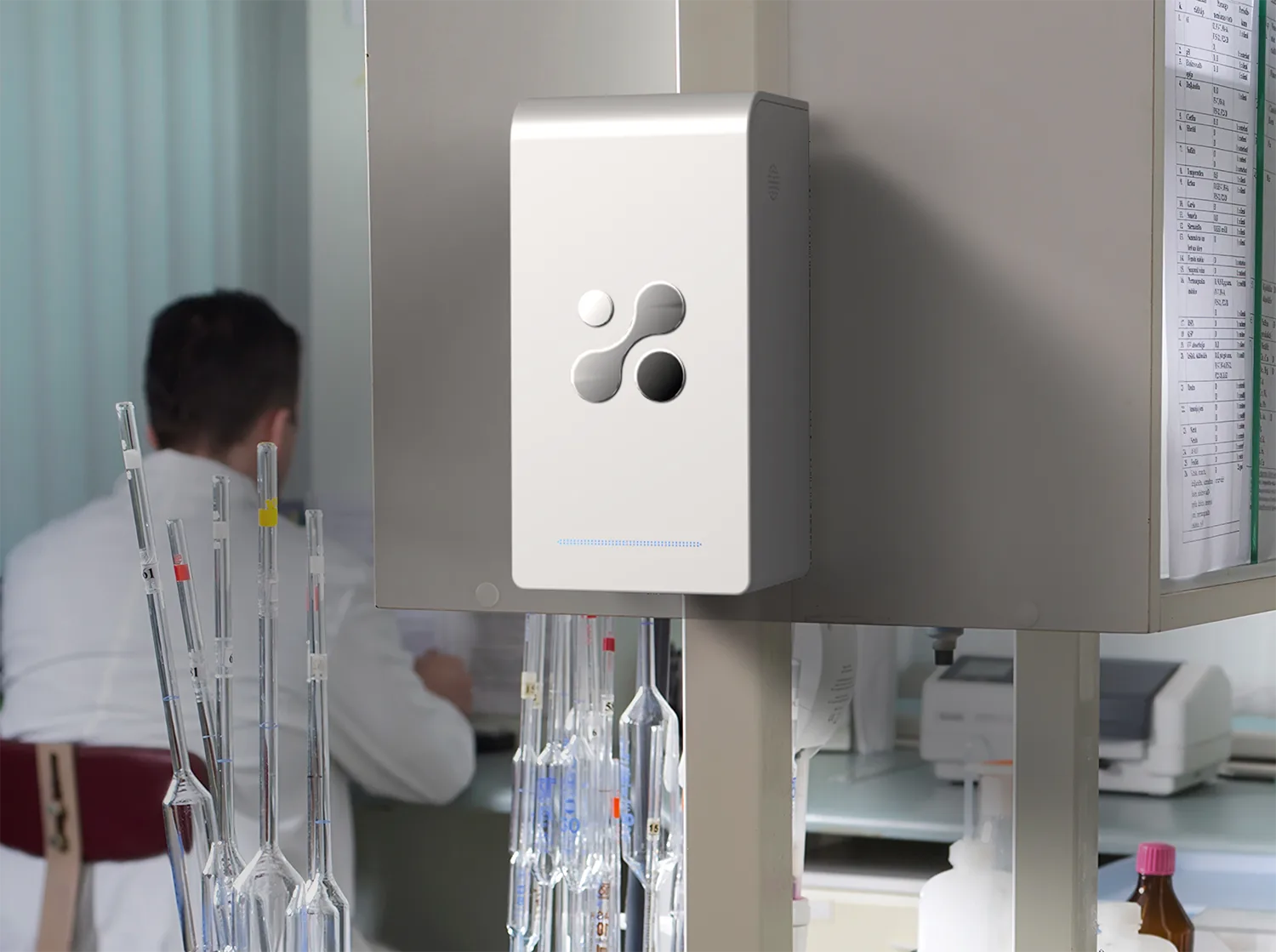
The recommended configuration below is one Aethair PRO: its optical sensor trends particle counts by size, its differential-pressure cartridge monitors the pressure cascade, and it logs temperature and humidity, so a drift in any of them raises an alert between qualification runs. Its particle counts are a monitoring trend, not classification data: demonstrating an ISO 14644 class, and the counts an ISO 14644-2 monitoring plan relies on, need a counter calibrated to ISO 21501-4. That counter (for example, a Particles Plus unit from the sensor catalog) connects through a Thiamis gateway, which records it continuously into the same dashboards and alarms. Sampling points sit at defined locations for classification and at critical process positions for ongoing monitoring, following the room's qualification. Use the configurator to match sensors to your classification and process.
Recommended
best match-

Industrial monitor for indoor and outdoor sites. Built-in sensors cover the essentials, and hot-swappable gas sensor cartridges and a differential-pressure option add more.
Built-inRelative HumidityParticle Count (by size)Air TemperatureGas 1
Free: one more gas sensor cartridge
Gas 2
Free: one more gas sensor cartridge
MultiSense
Free: a MultiSense, stock or built to order
Expansion

Aethair Diff. Pressure
Differential PressureA gauge sensor reads 0–10 kPa, with the higher-pressure side connected to its port.
Also measures 10 more
Dew PointHeat IndexIlluminance / LightPM1PM10PM2.5Total PM / Mass Conc.Barometric PressureEquivalent Continuous Level (Leq)Sound Pressure Level (SPL)
Which monitor
The Monitors in This Configuration
The configuration above is built from these monitors. Every reading lands in the same Environet account, with the same alerts and reports.
What you get
Readings, Alerts, and the Report That Proves It
Every reading goes to the Aethair platform. Here is what a monitoring program gets from it.
Live data and alerts
Every reading in Environet as it happens, with alerts by email, SMS, or webhook at the thresholds you set.
Compliance reports
Scheduled or on-demand reports against the standards above or your own limits, as PDF or a secure link.
Dashboards and AI analysis
Live displays for a site or the public, and Noesis answering questions about the data in plain language.
Your data, through the API
Live and historical readings as JSON or CSV through the Environet API (OpenAPI 3.2), for a building management system, an ERP, or your own applications. The data is yours.
Article Library
Reading for Cleanrooms, Labs & Manufacturing
ASHRAE 170 Requirements and Which Edition Applies to You
ASHRAE 170 requirements explained: what the standard sets, which edition your facility is held to, what changed in 2025, and how each value gets verified.
Hospital Air Quality Monitoring: Standards by Space
Hospital air quality standards from ASHRAE 170 and The Joint Commission explained, plus what to measure in operating rooms, isolation rooms, and labs.
How Building Certifications Use Air Quality Monitoring
How WELL and LEED v5 incorporate air quality monitoring, why both frameworks are moving toward continuous performance, and what that means for building teams.
Related solutions
Related Solutions
Healthcare Air Monitoring
Clinical air quality, pressurization, and patient safety
HVAC & Building Management
Monitor ventilation and filtration, with data for your BMS
Indoor Air Quality
Offices, schools, homes, and public buildings
Questions
Cleanrooms, Labs & Manufacturing FAQ
How are cleanrooms classified?
Cleanrooms are classified under the ISO 14644 framework by the concentration of airborne particles at specified sizes: the cleaner the class, the fewer particles permitted per unit volume. Demonstrating a class requires counting particles at those sizes with an instrument that meets the ISO 21501-4 calibration standard, so the results are valid and comparable. At ≥0.5 µm, ISO 14644-1 allows at most 3,520 particles per m³ for ISO Class 5, 35,200 for Class 6, 352,000 for Class 7, and 3,520,000 for Class 8.
Why is room differential pressure important?
The pressure differences between adjoining rooms determine which way air flows through any opening, and therefore whether particles are kept out of a clean space or contained within a dirty one. Maintaining the designed pressure cascade is central to contamination control, so a loss of differential pressure is treated as an immediate alarm.
What does ISO 21501-4 mean for particle counters?
ISO 21501-4 is the calibration standard for optical particle counters, defining how they are characterized for size and counting accuracy. Using a counter that meets it ensures the particle data underpinning a cleanroom classification is reliable and accepted, which is why it is specified for classification work.
What is the best monitoring setup for a cleanroom?
An Aethair PRO with the differential-pressure cartridge for the room cascade, temperature and humidity, and a continuous particle trend; plus, where classification counts are needed, a particle counter meeting ISO 21501-4 connected through Thiamis. Use the configurator to match the counter, pressure, and condition sensors to your classification and process.
Put Your Monitoring on the Record
Schedule a callBuild a Configuration All solutions
A 30-minute call: you tell us about your application, then we demo the solution for it.