
Workplace air quality monitoring has moved from a facilities detail to something employees notice and ask about. The trigger is usually specific: a run of complaints about stuffiness in the afternoon, a return-to-office push that puts more people in the same square footage, a wellness or certification initiative, or a lease negotiation where a tenant wants to know what the building actually delivers. Underneath all of those sits the same question: how do I know whether the air in my office is healthy, and how do I show it?
Air quality and environmental conditions in the workplace matter to employers, to the people at desks, and to anyone else who walks through the door. Existing approaches, an effective HVAC system among them, already do real work. What shifts when measurement runs continuously is timing. With live data you can act on a condition while it is happening instead of learning about it from a complaint a week later. This article covers what to measure, how offices monitor today, and what a connected program adds, whether you manage the facility, run the office, lead HR, or sign off on the budget.
Quick answer
Workplace air quality monitoring means continuously measuring the conditions that affect employee health and focus and making the results visible. The main parameters are CO2 (as a proxy for ventilation), PM2.5, VOCs, temperature, and humidity. Offices approach this in different ways today: relying on the building's HVAC system, scheduling a periodic consultant assessment, or placing standalone office monitors. Continuous calibrated monitoring turns individual readings into an ongoing record a workplace can act on, share with occupants, and use toward certification and reporting requirements.
Why Workplace Air Quality Became an Employer's Concern
The clearest evidence is about cognition. A one-year study led by the Harvard T.H. Chan School of Public Health, published in Environmental Research Letters in 2021, followed more than 300 office workers across China, India, Mexico, Thailand, the United Kingdom, and the United States. Each workstation carried a sensor measuring PM2.5, CO2, temperature, and humidity, and participants took short cognitive tests on their phones. The researchers found (opens in a new tab) that higher PM2.5 concentrations and lower ventilation rates were associated with slower response times and reduced accuracy. Those effects appeared at concentrations common in ordinary offices, not only at extreme levels. That is what makes the finding relevant to a typical workplace, and it echoes an earlier controlled study from the same group in which cognitive scores rose 61% under enhanced ventilation.
The second driver is what employees expect. A 2026 survey of 750 US employees who work in person at least once a week, reported by Facilities Dive (opens in a new tab), found that more than 60% would choose fresher, more comfortable air over high-end amenities. Another 67% said they would be more willing to work in person if their employer communicated the steps it takes to maintain a healthy environment, and 83% said visible efforts to improve comfort and safety would make them feel more respected. A separate survey cited in the same reporting put the share of workers who want employers to be transparent about indoor air quality at 77%.
Employees are asking for two things at once: better air, and evidence that someone is managing it. The second half is a monitoring and communication problem, which is why air quality now surfaces in return-to-office planning and lease conversations instead of staying inside the maintenance schedule.
What to Monitor in a Workplace, and Why It Matters
Five parameters cover most office needs, with a sixth worth adding in specific conditions.
Carbon dioxide (CO2) is the ventilation proxy, and for most workplaces it is the single most useful number on the dashboard. People exhale it continuously, so a rising level means fresh air is not keeping pace with the number of people in the room. It is the parameter behind the classic afternoon-slump complaint, and the classic place to find it is a conference room with the door closed and eight people in it.
PM2.5 is fine particulate small enough to reach deep into the lungs, and in an office it mostly comes from outside, drawn in through intake air and open doors. That is why a city building on a still day, or any building during a smoke event such as a wildfire, can have an indoor problem that originated a long way away.
Volatile organic compounds (VOCs) come from furnishings, adhesives, paints, printers, and cleaning products. Levels spike after a renovation or a furniture delivery, which makes them useful for connecting a complaint to a cause.
Temperature and humidity generate more comfort complaints than everything else combined, and both do more than affect comfort. Temperature drives mental fatigue and slows information processing at the ends of the range, and it is the parameter most likely to be the real cause when someone describes a room as stuffy. Humidity carries a health dimension of its own: very dry air irritates airways, while persistently damp air supports mold growth and building decay.
Formaldehyde matters in recently renovated or newly furnished space, where pressed-wood products and new textiles off-gas.
The EPA's introduction to indoor air quality (opens in a new tab) is a useful primer on where these pollutants originate and why inadequate ventilation concentrates them.
How Workplaces Monitor Air Quality Today
Aethair offers a continuous, connected monitoring platform that makes measuring conditions and acting on the data considerably easier, and a more modern and user-friendly approach than the alternatives. Plenty of workplaces manage air quality in other ways, and three approaches come up most often.
Relying on the HVAC or Building Management System (BMS)
The building system is already installed, and it controls the ventilation that actually determines air quality. A properly functioning, well-balanced system operating at ASHRAE Standard 62.1 (opens in a new tab) ventilation rates does most of the work that matters.
What it measures, though, is narrower than what a workplace usually wants to know. Temperature is standard, and CO2 is common where demand-controlled ventilation is in use, since the system needs it to modulate outdoor air. Particulate and VOCs are rarely instrumented at all, which leaves out the parameters most likely to explain a complaint after a renovation or during a smoke event.
Placement is the second constraint. Sensors typically sit at the air handler or in the return duct. They describe the air moving through the system as a whole rather than conditions in the breathing zone, where people actually spend time, such as a corner room on the building's south side. Most systems do log data, but it tends to live inside an engineering interface, on whatever retention window the system was configured for, which is a different thing from a record you can hand to a tenant, an auditor, or a curious employee.
Periodic Consultant Assessments
An industrial hygienist or indoor air quality (IAQ) consultant brings calibrated instruments, professional judgment, and a written report. For diagnosing a specific complaint, investigating a suspected source, or establishing a defensible baseline, this is the most thorough option available, and it is usually the arrangement workplaces reach for first.
The constraint is not the quality of the work. It is the sampling interval.
Indoor air quality moves on a timescale a scheduled visit cannot follow. CO2 in a closed conference room climbs through a meeting and falls back before anyone opens the door. VOCs spike after a furniture delivery and decay over days. An assessment describes the building on that day, under that day's weather and occupancy. If the complaint everyone is trying to solve happens on full-occupancy Mondays in August, a Tuesday visit in March will not find it.
The two approaches work well together for that reason. A consultant diagnoses and validates; continuous measurement covers the intervals in between and points to which day is worth investigating.
Standalone Office Monitors
Small monitors placed on a desk or wall are inexpensive, easy to deploy, and effective at raising awareness. Seeing a live CO2 number changes behavior in a conference room faster than any policy memo.
Constraints appear when a single device has to support a managed program. Calibration documentation varies between products, and sensors drift over time, so a reading two years in may not mean what it did out of the box. Data is often tied to a per-room app with no portfolio view, and covering several floors or multiple sites means managing each device on its own instead of running one system.
What Continuous, Connected Monitoring Changes
Continuous monitoring addresses the position, retention, and coverage limits described above.
Measurement happens where people sit. Monitors in the occupied zone measure the air in the room, which is the air that affects the person at the desk. That complements what a building system reports at the air handler.
Coverage extends across zones and sites. Every Aethair IAQ unit has 4G LTE built in, so it reports without joining office WiFi or waiting on building IT. That matters most in leased space, where the tenant may not control the network, and across multi-site portfolios. It also means there is no shared gateway whose failure would take a whole floor offline.
The data becomes a record. Continuous history in Environet means a complaint can be checked against what conditions actually were last Tuesday afternoon, and a change to the ventilation strategy can be evaluated against readings from before and after.
The result becomes visible to occupants, if you want it to be. Aethair Dashboards provides real-time, occupant-facing displays of air quality status, which addresses the transparency expectation those employee surveys describe. It is entirely optional. Some workplaces prefer to put a display in the lobby or the main corridor, others like to keep the data with the facilities team and share a monthly summary, and both are legitimate ways to run a program.
Aethair IAQ is a commercial monitor that ships with a calibration certificate and correlates with reference instruments at over 90%. It doesn't have to replace what other approaches do well. Where a regulatory reference measurement or an industrial hygienist's evaluation is required, a reference-grade instrument or an accredited consultant assessment remains the right tool.
What Each Approach Delivers
| HVAC / building system | Periodic assessment | Standalone office monitor | Connected platform (Aethair) | |
|---|---|---|---|---|
| Typical use | Ventilation control | Point-in-time diagnosis | Single-room awareness | Continuous managed program |
| Parameters | Temperature, CO2 where fitted | Chosen per visit | Varies by product | Nine, including PM, VOC, formaldehyde |
| Where it measures | Air handler or return duct | Sampling points during the visit | At the device | Occupant level, across zones |
| Time coverage | Live, history inside the system | The day of the visit | Per device | Continuous, with full history |
| Connectivity | Building network | Not applicable | Varies, typically WiFi | 4G LTE in every device |
| Occupant visibility | Rare | Report to facilities | On-device display or app | Optional dashboards and public displays |
| Documentation | Varies by system | Formal report per visit | Varies by product | Calibration certificates and automated reports |
Most workplaces combine these. A building system controls ventilation, a consultant investigates a specific problem, and continuous monitoring covers the time in between and produces the record. The right mix depends on the size of the space, how many sites are involved, and whether the data needs to be shown to anyone outside the facilities team.
Putting Aethair to Work in Your Office
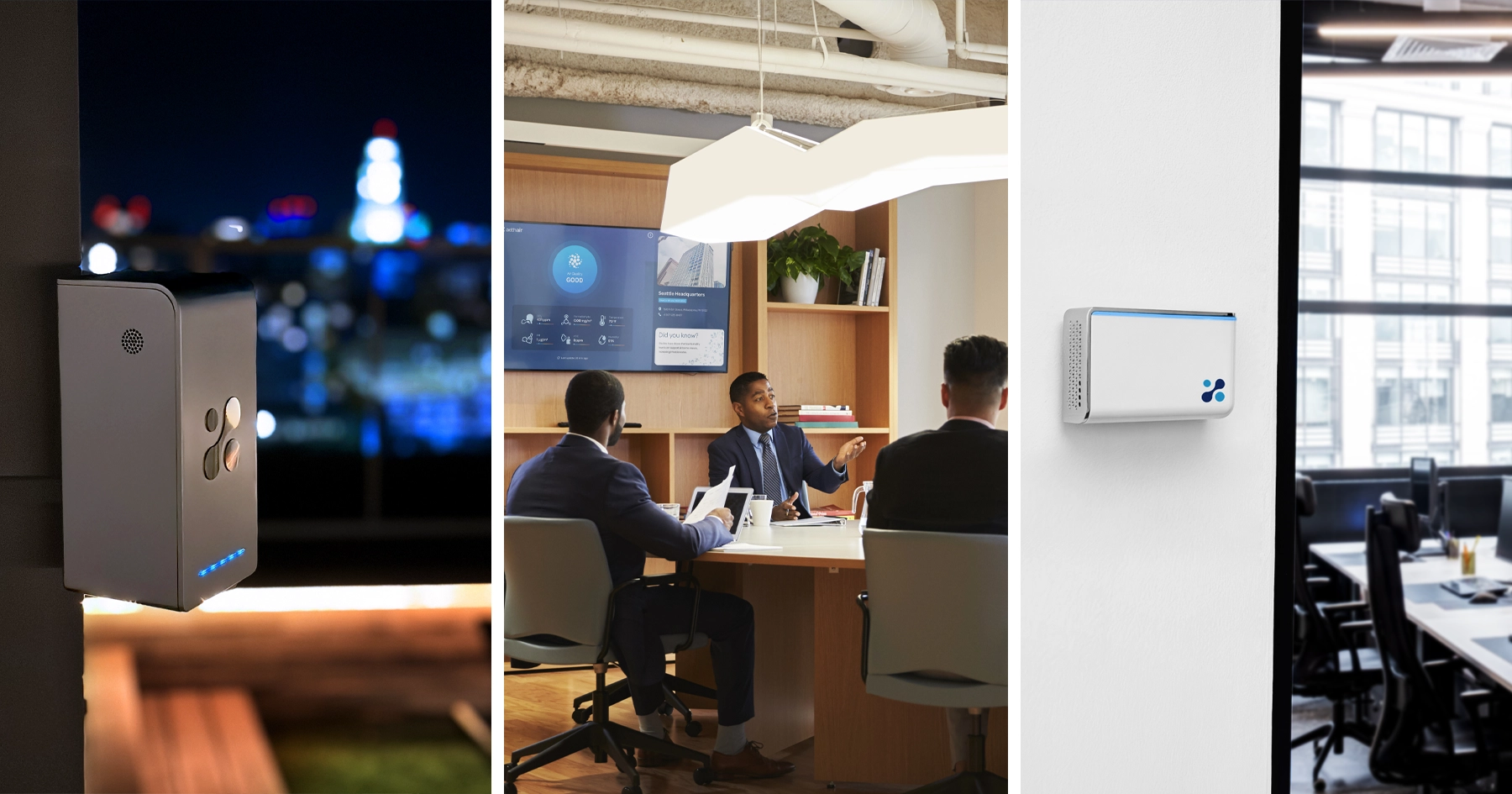
Aethair IAQ is the device built for occupied indoor spaces, and in most workplaces it is the whole hardware answer. It tracks nine parameters: PM1, PM2.5, PM10, tVOC, formaldehyde, CO2, temperature, humidity, and pressure. Units arrive fully calibrated and can be deployed immediately, and built-in 4G LTE means each one reports on its own without touching office IT.
Some workplaces have a zone that sits outside standard indoor air, and Aethair PRO covers those. It measures PM1, PM2.5, PM10, temperature, pressure, humidity, sound, and light, and takes swappable gas sensor cartridges supporting gases including CO, NO, NO2, O3, and SO2. Two cases come up often in offices: an attached parking garage or loading dock, where CO and NO2 matter and sit outside the Aethair IAQ parameter set, and a tenant improvement build-out in occupied space, where an Aethair PRO at the construction boundary documents that the rest of the floor stayed clean.
The third case is worth spelling out. An Aethair PRO on the roof or near the outdoor air intake gives every indoor reading its context, and during a smoke or pollution event that pairing tells you whether the building is holding the line. ASHRAE Guideline 44-2024 (opens in a new tab), on protecting building occupants during wildfire and prescribed burn events, recommends exactly that: PM2.5 sensors outside and inside, specifically to monitor how well the response is working, alongside MERV 13 filtration and reduced outdoor air during an event.
We have watched that play out. During the June 2023 Quebec wildfire smoke event, three buildings of roughly 500,000 square feet each, all running Aethair indoor monitoring and all sharing outdoor conditions, produced an unplanned side-by-side test of three filtration strategies. All three had shown good air quality before the smoke arrived. The building on conventional HVAC filters held above 50 µg/m³ of PM2.5 indoors for several days. The one that had added high-power multistage portable filters stayed mostly above 25 µg/m³, and the units were noisy. The building running MERV 13 filters centrally fell to single digits during operating hours, and once operators left the fans running continuously it held below 10 µg/m³ for the rest of the week. Our CEO wrote up the comparison in why air quality monitoring is more important than filtering (opens in a new tab).
The filtration lesson is useful. The monitoring lesson generalizes: every filtration method looks adequate while outdoor conditions are clean, and the only way to know which one works is to be measuring when they are not. Without paired indoor and outdoor readings, a well-filtered building and a lucky one look identical. Both devices run on one platform, so mixing them does not mean managing two systems.
The platform is where the data becomes useful. Environet holds live and historical readings from every device, with configurable dashboards and a map view, and its alerting can flag a sustained condition instead of a momentary spike. Aethair Dashboards handles the optional occupant-facing side, showing real-time status to the people in the space. Aethair Reports turns the record into documentation on demand or on a schedule, which is what certification and environmental, social, and governance (ESG) reporting typically require. Noesis answers plain-language questions about the data, such as how CO2 trended in a particular conference room last month.
For a full view of deployment options across offices and building portfolios, see our indoor air quality monitoring solutions.
The recommended configuration for this
Aethair IAQ only
one monitor, nothing to add-

Aethair IAQ built-in sensors
Compact plug-in monitor with every sensor built in, nothing to add. Ideal for straightforward indoor air quality monitoring.
Built-inCarbon Dioxide (CO₂)Relative HumidityPM2.5Air TemperatureVOC (Total)Also measures 8 more
Formaldehyde (CH₂O)Dew PointHeat IndexParticle Count (by size)PM1PM10Total PM / Mass Conc.Barometric Pressure
Recommended
best match-

Industrial monitor for indoor and outdoor sites. Built-in sensors cover the essentials, and hot-swappable gas sensor cartridges and a differential-pressure option add more.
Built-inRelative HumidityPM2.5Air TemperatureGas 1

Aethair CO₂ (dual NDIR)
Carbon Dioxide (CO₂)Dual-thermopile NDIR (non-dispersive infrared) sensing measures CO₂ with no chemical consumables, for…
Also fits: Aethair CO₂ (self-calibrating NDIR)
Gas 2

Aethair VOC (ppm PID)
VOC (Total)A 10.6 eV photoionization detector (PID) ionizes volatile organic compounds for direct ppm readings across a…
Also fits: Aethair VOC (ppb PID), Aethair MultiGas+, Aethair VOC (ppb PID, wide range)
MultiSense
Free: a MultiSense, stock or built to order
Expansion
Free: differential pressure
Also measures 10 more
Dew PointHeat IndexIlluminance / LightParticle Count (by size)PM1PM10Total PM / Mass Conc.Barometric PressureEquivalent Continuous Level (Leq)Sound Pressure Level (SPL)
Healthy Air Your Team Can See
Aethair IAQ pairs calibrated indoor sensors with Environet and Aethair Dashboards, so a workplace can measure its air, show the result to the people breathing it, and document how conditions change.
Schedule a call (opens in a new tab)See Indoor Air Quality Monitoring →Explore Aethair IAQ →
Workplace Air Quality Monitoring: FAQs
What should an office measure to monitor air quality?
CO2, PM2.5, VOCs, temperature, and humidity cover most workplace needs, with formaldehyde worth adding in recently renovated or newly furnished space. Our article on indoor air quality monitoring parameters covers each one with its reference thresholds.
Where should air quality monitors be placed in an office, and how many are needed?
Place monitors in the breathing zone, roughly 3 to 6 feet from the floor, in the spaces people actually occupy. Avoid mounting directly beside a supply vent, an operable window, or a doorway, because those spots measure the air passing by rather than the air people breathe. For an office tenant, the practical unit of coverage is the zone, not the square foot: an open-plan floor, an enclosed conference room, and a corner office on the sunny side behave differently enough that one device cannot speak for all three. Conference rooms are worth their own coverage, since CO2 climbs fastest where several people sit in a small closed room with the door shut. If you are planning placement across a whole building instead of one tenancy, including lobbies, amenity floors, and outdoor air intakes, our article on indoor air quality monitoring for commercial buildings covers that wider layout.
Employees say the air feels stuffy. What should we do first?
Stuffiness is usually a ventilation complaint, and CO2 is the fastest way to confirm it. Measure in the room where people are complaining, at the time of day they complain, because a space that reads fine at 9am can be very different by 3pm with a full meeting in progress. If CO2 climbs steadily through occupied hours, the outdoor air supply is not keeping pace with the number of people, which is a conversation to have with whoever operates the HVAC system. If CO2 stays flat while complaints continue, the cause is more likely temperature, humidity, or a VOC source such as new furniture or a change in cleaning products, and measuring those narrows it down quickly.
Does workplace air quality really affect productivity?
Two studies from the same Harvard research group are the usual starting point. In a 2016 controlled exposure study published in Environmental Health Perspectives (opens in a new tab), 24 participants spent six work days in a simulated office under different ventilation and VOC conditions, blinded to which. Cognitive function scores averaged 61% higher on the enhanced-ventilation day and 101% higher on the two days combining enhanced ventilation with low VOC levels. A larger 2021 field study, published in Environmental Research Letters (opens in a new tab), followed more than 300 office workers across six countries in real workplaces and found that higher PM2.5 and lower ventilation rates were associated with slower response times and reduced accuracy on cognitive tests, at concentrations common in ordinary indoor environments. To be precise about this evidence: both studies measured cognitive test performance under varying conditions, which speaks to the kind of thinking office work depends on. Neither is a direct measure of business output at a particular company.
Do we need monitors if our HVAC system is modern?
A well-run HVAC system does the actual work of ventilating and filtering, and monitoring does not replace it. What monitoring adds is confirmation of the result where people sit, plus the parameters most building systems do not instrument, particularly particulate and VOCs. There is a second argument that matters if you have just spent money on the system. A ventilation or filtration upgrade is invisible by definition: nobody can see cleaner air, so the investment goes unnoticed and unappreciated. Monitoring makes the return visible. Employees can see the air quality in the building and recognize what the business has invested in their health and comfort. The same data answers everyone else who asks whether the money was well spent: executives, investors reviewing capital projects, ESG and sustainability reporting teams, and regulators or certification bodies who want evidence rather than assurances.